
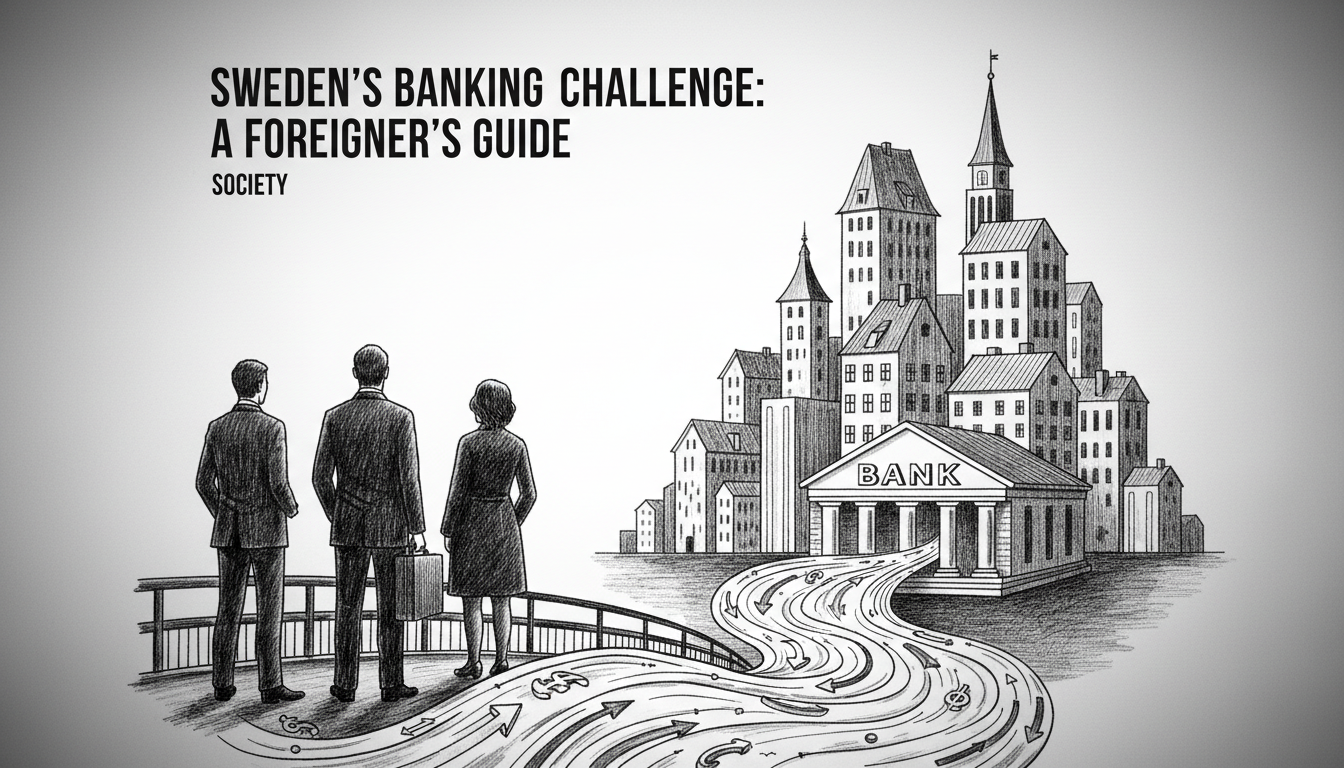
Sweden's cashless society presents a formidable first hurdle for thousands of new arrivals each year. You need a Swedish bank account to receive a salary, pay rent, and function in daily life. Yet opening that account often requires documents you cannot obtain without one, creating a frustrating circular challenge. This practical barrier tests the limits of Sweden's otherwise advanced digital infrastructure and its commitment to integration. The solution lies not in policy changes from Rosenbad, but in meticulous personal preparation and understanding a rigid identification system.
The Personnummer: Sweden's Golden Ticket
A Swedish personal identity number, or personnummer, is the foundational key to financial life. Banks use this number to verify identity against the national population register maintained by the Swedish Tax Agency (Skatteverket). Without it, options shrink dramatically and processes lengthen from days to weeks. Some traditional banks, including Handelsbanken and SEB, may open basic accounts for non-residents with compelling proof of future employment or university admission. This requires an in-person branch visit with a passport, employment contract or admission letter, and sometimes proof of a Swedish address. The resulting account typically has limited functionality until the personnummer is issued, a process entirely separate from banking.
Digital Bridges and Temporary Solutions
For those awaiting a personnummer, fintech platforms provide a critical, though temporary, workaround. Companies like Revolut and Wise, registered as electronic money institutions, offer Swedish account details through their mobile applications. Users can receive salaries, pay bills, and obtain debit cards, solving the most immediate financial access problems. Analysts note these services fill a crucial gap in the market. Costs are relatively low, with Revolut's standard plan free for basic use and Wise charging transparent fees for currency conversion. However, these are not full Swedish bank accounts. They cannot provide access to BankID, the nation's indispensable digital identification system used by over 90% of Swedes.
Securing a Full Financial Identity
The landscape transforms completely once an individual receives their personnummer. Applicants can then pursue a full-service account at major Swedish banks like Swedbank, Nordea, or ICA Banken. The process becomes largely digital, but hinges on obtaining a Swedish ID card from the Tax Agency. This physical card is non-negotiable. Banks use it to activate BankID, which financial experts describe as more essential than a physical debit card. BankID enables digital signatures, access to government services like healthcare portals, and secure online shopping. Monthly account fees are standard, with Swedbank's basic offering costing approximately 30 SEK. Many institutions waive fees for customers under 26 or those with regular salary deposits.
Navigating Regulatory Rights and Realities
EU citizens possess specific rights under European payment account regulations, which mandate access to a basic payment account. In practice, exercising this right in Sweden requires persistence and often multiple branch visits with an EU passport and proof of address. Non-EU citizens face steeper hurdles, with some banks refusing applications outright without a personnummer. The Swedish Bankers' Association acknowledges the challenge, stating that anti-money laundering and fraud prevention regulations create necessary but high barriers. This tension between security and accessibility remains unresolved in policy circles. The government has not introduced legislation to streamline the process for newcomers, leaving it as a market issue for banks to manage.
The Central Role of BankID in Swedish Society
Understanding Sweden's financial system requires recognizing that BankID is not merely a banking tool. It is the primary digital key to society. A 2022 study by the Swedish Bankers' Association confirmed over 90% of the population uses it. The system facilitates everything from filing tax returns and signing rental contracts to verifying age online. Without it, individuals face a parallel, paper-based bureaucracy that is increasingly difficult to navigate. This creates a two-tier experience where newcomers are excluded from the digital convenience natives enjoy. Financial inclusion experts argue this barrier affects integration speed and personal autonomy during a vulnerable transition period.
Comparative Costs and Choosing an Institution
Selecting a bank involves comparing fee structures and service bundles. Traditional banks typically charge monthly maintenance fees but offer extensive branch networks and integrated services like mortgages and insurance. Digital-first options like ICA Banken or Skandia often have lower fees but more limited personal service. For basic transactions, costs are relatively similar across the market. The more significant differentiator is each bank's experience and willingness to handle non-standard cases, such as customers without a personnummer. Branch staff discretion remains a factor, making it advisable to try multiple locations if initially refused service.
Long-Term Integration and Financial Planning
After establishing an account, the focus shifts to long-term financial integration. This includes understanding the Swedish credit system, which differs from those in many other countries. Building a credit history often requires having a personnummer and using Swedish financial products over time. Access to competitive mortgage rates, consumer loans, and investment platforms follows. The Swedish financial market is highly competitive and digitally sophisticated, offering numerous tools for savings and investment. However, full participation is contingent on that initial, successful navigation of the account-opening process, a gatekeeping moment that defines the early immigrant experience.
Analysis: A System Designed for Cohesion, Not Inclusion
Sweden's banking challenge for foreigners reveals a systemic design focused more on internal cohesion and security than external inclusion. The seamless digital experience for residents creates a high wall for newcomers. This is not a failure of individual banks but a feature of a society that has rapidly digitized around a trusted, centralized identification system. Policymakers have prioritized fraud prevention and system integrity over streamlining entry for non-residents. The result is a practical initiation rite that tests determination. While fintech solutions patch the immediate problem, they do not provide the full digital citizenship conferred by BankID. For Sweden to truly welcome global talent, this gap between its innovative financial infrastructure and its onboarding practicality may require renewed scrutiny from both bankers and officials in the Riksdag.