
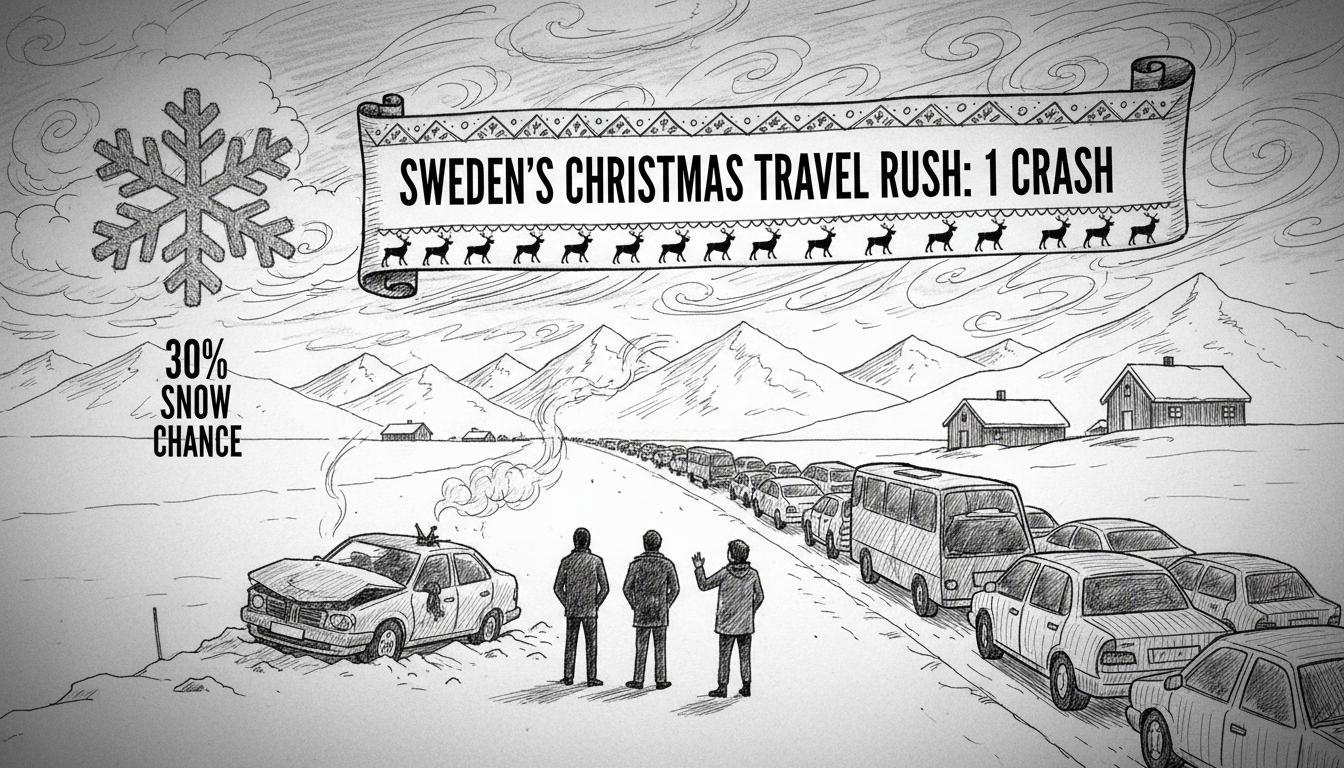
Sweden's Christmas travel rush has begun with a serious crash on a key highway northwest of Stockholm. A car rolled over at the Stäket interchange on the E18, a vital route for holiday traffic heading towards Enköping. The 25-year-old driver was taken to hospital by ambulance and is suspected of serious traffic offenses. This incident highlights the heightened risks as millions of Swedes take to the roads to reach their festive celebrations. The big question on everyone's mind remains: will it be a white Christmas this year?
The Crash That Stopped Holiday Traffic
The accident occurred during one of the busiest travel periods of the year. The Stäket interchange, connecting Kallhäll and Kungsängen, is a critical juncture on the E18. This highway is a main artery for both passenger and freight traffic moving out of the capital region. Emergency services reported the vehicle had "rolled back" during the incident. Police have launched an investigation into the driver for alleged gross negligence in traffic, causing bodily harm, and a transport of dangerous goods violation. The crash caused significant delays during the peak travel window, a frustrating start to the holidays for many.
"Every year, we see a predictable surge in accidents during this period," said a traffic safety expert I spoke with. "People are stressed, in a hurry to get to their families, and sometimes underestimate winter road conditions. The combination is dangerous." According to the Swedish Transport Administration, traffic accidents typically increase by 15-20% during the Christmas holiday period. This statistic isn't just a number—it represents real families whose holidays are disrupted by tragedy or severe inconvenience.
The Annual Swedish Pilgrimage Home
For Swedes, the journey before Christmas is a deeply ingrained ritual. It's a national movement, a pilgrimage to childhood homes and family gatherings spread across the country's vast landscape. From Stockholm's bustling neighborhoods like Södermalm and Vasastan, families pack their cars with gifts and julmust, heading for villages in Dalarna, coastal towns in Bohuslän, or forests in Småland. The roads, especially the E4, E6, and E18, become rivers of headlights. Train stations like Stockholm Central are packed with travelers hauling suitcases, their breath visible in the cold air, all sharing the same hopeful mission: to make it home for julafton.
This mass migration is about more than logistics. It's tied to the Swedish concept of 'julstämning'—the Christmas spirit—which is intrinsically linked to place and tradition. The anxiety over travel conditions is palpable. Will the snow hold off long enough for a smooth drive? Or will a sudden blizzard, a common feature of Swedish December, turn the trip into an ordeal? People check weather apps and traffic reports with a frequency usually reserved for election results. The collective sigh of relief upon safe arrival is a national sentiment.
Will Snow Blanket Sweden for Christmas?
The other half of the pre-Christmas equation is the weather. The longing for a 'vit jul' (white Christmas) is powerful here. Officially, it requires at least 1 centimeter of snow on the ground on December 24th. In Stockholm, the historical probability sits between 30-40%. This year, as families gaze out their windows or check forecasts, the odds feel like a lottery. In the north, a white Christmas is almost guaranteed—it's part of the landscape in cities like Luleå or Kiruna. But in the southern regions and in Stockholm, it's a yearly gamble.
Meteorologists are closely watching the systems moving in from the Atlantic and the Arctic. A shift of a few degrees, a change in wind direction, can mean the difference between a picturesque, snow-dusted celebration and a grey, slushy one. "The desire for snow is strong, but from a traffic safety perspective, we advise travelers to prepare for all conditions," a meteorologist explained. "Ice, in particular, is a major hazard. It's often invisible until it's too late." This duality—the beauty versus the danger of winter weather—is a classic Swedish December paradox.
Expert Advice for Safe Holiday Travel
Given the increased risks, what can drivers do? Experts are unanimous on the basics, which many Swedes know by heart but sometimes ignore in the holiday rush. Proper winter tires are non-negotiable; the law requires them from December 1st to March 31st, but they are essential for safety long before and after those dates. Reducing speed and dramatically increasing the following distance are the two most effective actions a driver can take. Black ice doesn't forgive haste.
Planning is also key. Leaving earlier to avoid the worst of the traffic peaks can reduce stress. Checking real-time road condition reports from the Transport Administration is a smart habit. For those traveling longer distances, ensuring adequate rest is crucial. Fatigue is a silent co-pilot in many winter accidents. The advice is simple, but in the festive frenzy, it's easily forgotten. The goal is for the journey to be a peaceful prelude to the holiday, not a traumatic event that overshadows it.
Beyond the Headlines: A Cultural Moment
This annual convergence of travel and weather is more than just a traffic report. It's a cultural snapshot. It reveals the Swedish commitment to family, often spread across great distances. It highlights the national relationship with nature—a respect for its beauty and a healthy fear of its power during the dark winter months. The shared experience of navigating the pre-Christmas journey, whether by car, train, or plane, creates a temporary community of travelers, all hoping for the same safe passage.
In living rooms from Malmö to Haparanda, conversations this week will inevitably turn to travel plans and weather predictions. They'll share stories of past journeys—the year the car got stuck, the time the train was delayed for hours, the magical trip where it began to snow just as they arrived. These narratives are woven into the fabric of Swedish Christmas itself. The challenges of the journey make the warmth of the arrival, the glow of the advent starlight in the window, and the first sip of glögg all the sweeter.
As the country moves towards Christmas Eve, the hope is for clear roads, safe travels, and perhaps, just perhaps, a gentle blanket of snow to make it perfect. The crash on the E18 is a sobering reminder that the season's joy is fragile. It underscores the importance of patience and preparation. For now, families wait and watch the skies, their bags packed, their hearts set on home. The great Swedish Christmas journey is underway, a testament to the powerful pull of tradition in the heart of a Nordic winter.