
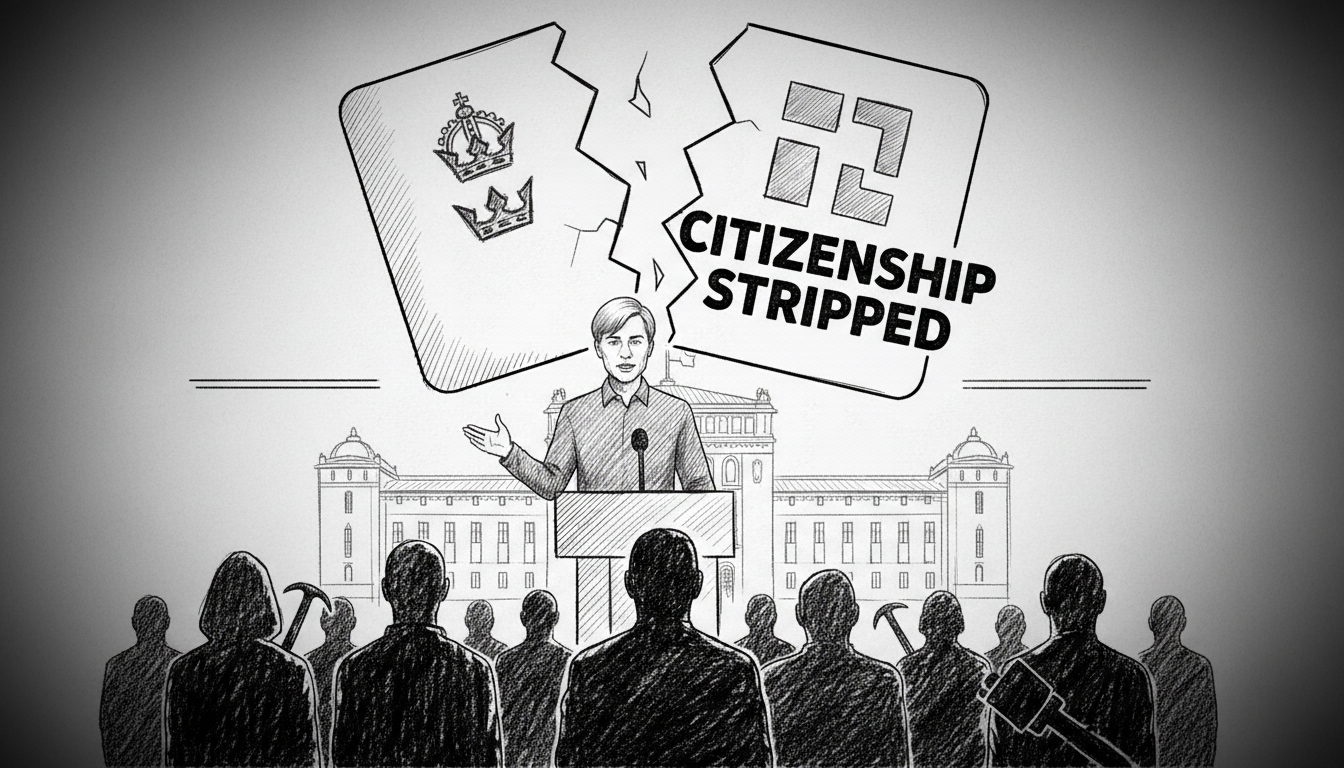
The Swedish government has proposed a major constitutional amendment that would allow for the revocation of citizenship for dual nationals convicted of serious crimes. This move, originating from the coalition known as the Tidö parties, seeks to equate participation in criminal gangs with membership in terrorist organizations under the law. Justice Minister Gunnar Strömmer of the Moderate Party presented the proposal, which requires a complex parliamentary process to alter Sweden's fundamental laws.
The proposal aims to modify the constitutionally protected freedom of association. This change would permit ordinary legislation to restrict this freedom for groups engaged in serious criminal activity for economic gain or other improper advantages. The government defines serious crime as offenses threatening constitutionally protected values or the state's monopoly on violence. This includes violent crime, welfare fraud, and serious drug offenses.
Minister Strömmer stated the government must balance individual protections with effective state action. He said in a statement that individuals deserve strong safeguards, but the state also needs room for measures that produce real effects. The proposal specifically targets dual nationals, meaning Swedish citizenship could be withdrawn only if the individual holds citizenship in another country. Grounds for revocation would include fraud, threats against national security, and convictions for serious criminality.
This initiative follows the establishment of a parliamentary constitutional committee two years ago. That committee was tasked with reviewing several fundamental legal issues, including abortion rights and citizenship revocation procedures. The current proposal now moves to the Riksdag for deliberation. Changing Sweden's fundamental laws requires the parliament to approve identical decisions in two separate legislative terms with a general election held between them. This high threshold ensures broad political consensus for constitutional amendments.
The government's push reflects ongoing concerns about organized crime in Swedish cities. Gang-related violence has been a persistent challenge for authorities in Stockholm, Malmö, and Gothenburg. By targeting the constitutional framework, the coalition signals a long-term strategic approach to criminal networks. The proposal would essentially create a new legal tool by placing criminal gangs in a similar category to terrorist organizations for prosecution and sentencing purposes.
Legal experts note this represents a significant shift in Swedish jurisprudence. The principle of freedom of association has long been a cornerstone of Swedish democracy. Any limitation requires careful legal justification and a high burden of proof. The proposal will likely face intense scrutiny in Riksdag committees and public debate. Opposition parties have historically been cautious about expanding state powers to revoke citizenship, viewing it as an extreme measure.
For international observers, this development highlights Sweden's evolving approach to integration and security. The policy specifically affects individuals with dual citizenship, a group that includes many first and second-generation immigrants. The government argues the measure protects society while maintaining proportionality, as it applies only when another citizenship exists. Critics may argue it creates a two-tier system of citizenship rights. The coming parliamentary sessions in the Riksdag building will determine if this constitutional change proceeds toward eventual adoption.