
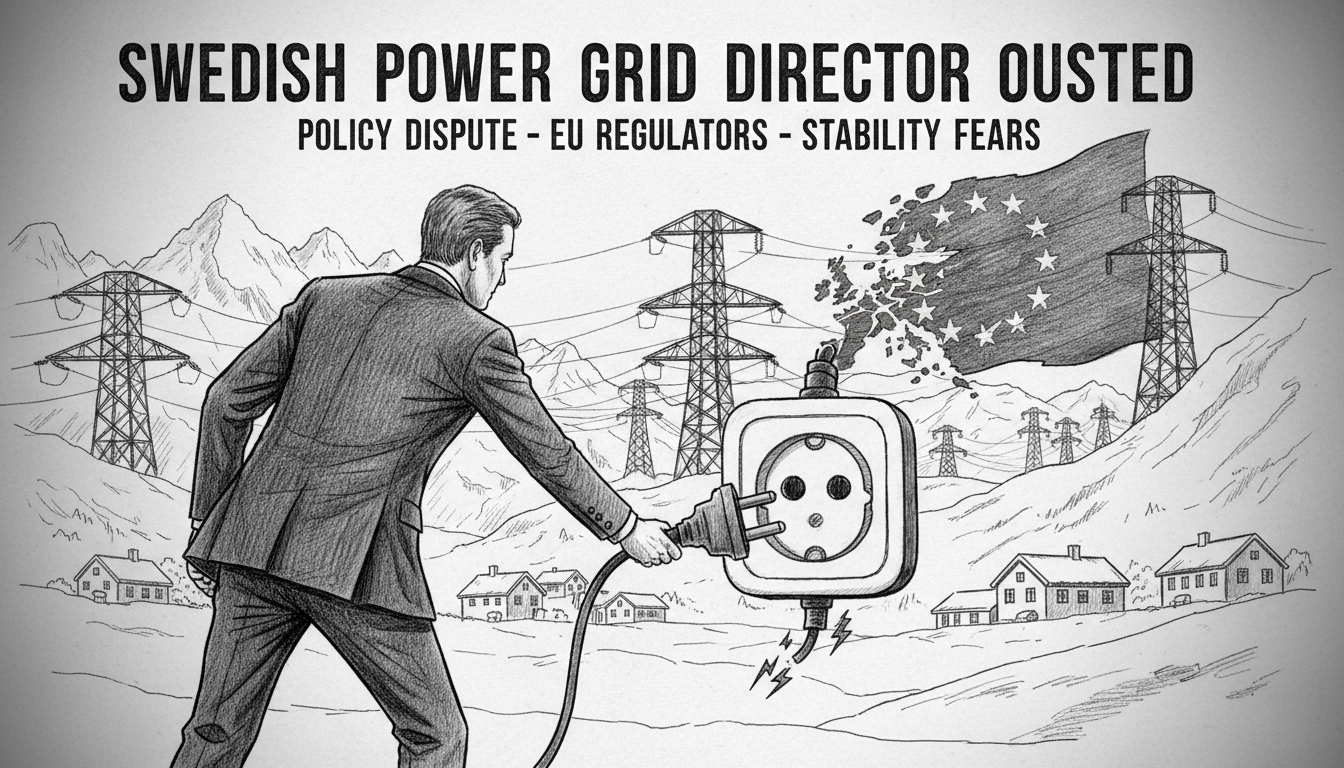
The Swedish government has abruptly removed the Director-General of Svenska kraftnät, the national power grid operator, after just over six months in the role. The decision, announced cryptically from the government offices at Rosenbad late last week, transfers the official to a so-called 'elephant graveyard' administrative post. This move follows a failed procurement for reserve power capacity and escalating tensions between Stockholm and European Union energy regulators. The situation reveals deep fractures in Swedish energy policy execution.
Energy Minister Ida Karkiainen confirmed the personnel change but provided limited public details. Sources within the government district indicate the dismissal stems from a specific procurement failure for emergency backup generation. This failure reportedly created a critical vulnerability in Sweden's national power reserve. The situation worsened when the government found itself in what officials described as 'a strange dialogue' with the European Commission regarding compliance and energy security standards.
Professor Lina Bertling Tjernberg, an expert in electric power systems at the Royal Institute of Technology, assessed the situation as highly serious. She stated that stable leadership at Svenska kraftnät is fundamental for Sweden's energy transition and grid reliability. The professor's comments highlight the technical stakes behind the political decision. The Riksdag has previously allocated substantial funds for grid resilience, making this operational failure particularly acute.
The Director-General's removal points to a significant clash between political objectives and bureaucratic implementation. The Swedish government, led by a coalition facing pressure on energy prices, demanded rapid solutions. The state-owned operator, tasked with complex technical procurements, apparently could not deliver at the required pace. This is not the first time a senior official has been moved to a sidelined position following disputes over EU policy interpretation, a recurring challenge for Swedish administrations.
Analysts note this event reflects broader tensions in Stockholm politics between national sovereignty and EU regulatory alignment. The government must now quickly appoint a successor who can navigate both the technical demands of the power grid and the political demands from Rosenbad. Future Riksdag decisions on energy infrastructure will likely include stricter oversight mechanisms. The immediate task is to rectify the reserve power gap before the high-demand winter period, a clear test for current government policy in Sweden.
The fallout questions the management model for critical state-owned enterprises. These entities operate at the intersection of commercial, technical, and political imperatives. When their directives from the Swedish Parliament conflict with European market rules, leadership crises can ensue. The coming weeks will show if this personnel change stabilizes the situation or merely postpones a deeper debate on Sweden's strategic energy direction.