
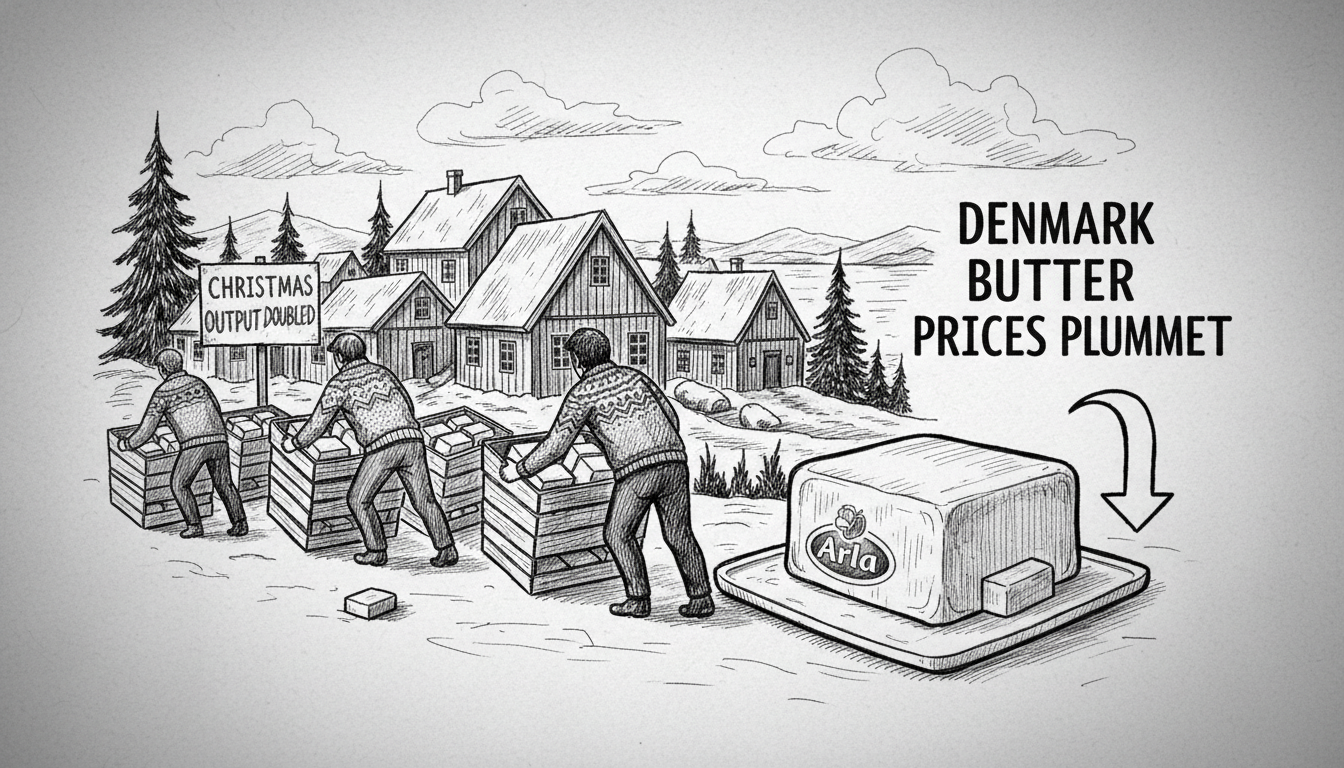
Denmark butter prices have collapsed to a fraction of their usual cost, triggering a consumer rush and forcing dairy giant Arla into a production sprint just weeks before Christmas. A standard 200-gram package of butter, which typically costs around 30 Danish kroner, can now be found for as little as 6 kroner in supermarkets. This dramatic price shift has sent Danes flocking to dairy aisles, creating a surge in demand that Arla's Holstebro dairy is meeting by doubling its normal output. The scene inside the facility is one of controlled chaos, a direct response to a simple economic equation that has reshaped pre-holiday shopping habits across the country.
The Butter Rush at Holstebro
At Arla's Holstebro production site, the rhythm of the machines has accelerated to a holiday tempo. Production chief Søren Dalsgaard confirms the operation is running at full throttle. "We are extremely busy here leading up to Christmas," Dalsgaard says. "It is our high season of the year, when we make Christmas butter for Danish customers." The scale of the increase is staggering. The facility is currently producing the equivalent of one full pallet of butter every single minute. This represents double the standard production volume. Dalsgaard breaks down the numbers: this minute-by-minute output translates to roughly 4,000 individual 200-gram packages of butter. For a nation of 5.9 million people, where butter is a cultural cornerstone for holiday baking and cooking, this industrial effort is fueling a deeply traditional domestic ritual.
A Strategic Shift in Supply
This production boom is not accidental. It results from a deliberate strategic pivot within Arla's supply chain. The company is currently receiving more milk from its cooperative farmer-owners than usual. Simultaneously, management has made a key decision on how to allocate this abundant raw material. Butter that was previously destined for the food service industry—sold in bulk to professional kitchens and bakeries—is now being redirected. That butter is being packaged for retail consumers, filling the bright yellow packages flying off supermarket shelves. This reallocation from commercial to retail channels is a direct market response to the price signal. When consumers see butter for 6 kroner, their demand becomes virtually insatiable, and Arla has moved swiftly to capture that demand by reprioritizing its product flow.
The Cultural Weight of Christmas Butter
To understand the significance of this surge, one must appreciate butter's role in Danish Christmas traditions. It is the essential fat in brunekager (gingerbread), pebernødder (pepper nuts), and the dough for æbleskiver (apple dumplings). A holiday dinner is incomplete without butter-laden sauces and butter-browned potatoes. "The price drop has turned a staple into a sensation," notes Karen Møller, a food sociologist at the University of Copenhagen. "Danes have a very practical relationship with food, but also a deeply emotional one tied to seasonal rituals. A price this low for a product this central to julehygge (Christmas coziness) disrupts normal purchasing patterns. People aren't just buying for next week's baking; they are stocking up, almost instinctively." This cultural driver amplifies the pure economic effect, creating a feedback loop of high demand and increased production.
Analyzing the Price Plunge
The drastic price cut raises immediate questions about its origins. Industry analysts point to a confluence of factors common in agricultural markets. A seasonal increase in milk production across Northern Europe often leads to a glut of raw material in the late autumn. Furthermore, shifts in international export demand or logistical challenges can cause processors like Arla to focus on domestic sales. Jesper Lund, an independent dairy analyst, suggests retailer strategy is also at play. "Butter is a classic 'loss leader' especially before Christmas," Lund explains. "Supermarkets can afford to sell butter at a steep discount because they know the customer who comes in for cheap butter will also fill their cart with high-margin items like champagne, nuts, and Christmas candy. The retailer loses money on the butter but gains significantly on the overall basket." This practice puts pressure on suppliers like Arla to provide sufficient volume at lower wholesale prices to make the promotion viable for chains.
The Cooperative Model in Action
Arla's ability to ramp up production so decisively is rooted in its structure as a farmer-owned cooperative. Decisions can be made with a focus on long-term stability and member benefit rather than short-term shareholder profit. Redirecting butter from commercial to retail buyers is a tactical move that supports the cooperative's farmer-owners by ensuring their milk has a profitable outlet, even at lower consumer prices. It also reinforces brand loyalty among Danish consumers during the most important culinary season. "The cooperative model allows for flexibility," says Lars Fogde, a commentator on Danish agricultural policy. "When you see a market opportunity or a need to stabilize farmer income through a period of high volume, you can make swift operational changes. The response in Holstebro shows the system working as intended: adapting production to meet a sudden shift in domestic demand."
Ripple Effects in the Kitchen and Beyond
The low butter price is changing behavior far beyond the supermarket checkout. Community social centers and cooking schools report a spike in interest for Christmas baking workshops. Home bakers are experimenting more freely, knowing the cost of a failed batch is minimal. For families on tighter budgets, the savings on a foundational ingredient can be redirected to other holiday expenses. However, some economists voice caution. While beneficial for consumers now, a sustained period of very low prices can squeeze farmers' margins over time, potentially impacting the long-term health of the dairy sector. The current situation is likely a short-term market correction, but it highlights the delicate balance within the Danish welfare system's food economy, where stable, fair prices for both producers and consumers are a constant goal.
A Look Beyond the Holiday Season
The pressing question is what happens after the last æbleskiver is eaten in January. Will butter prices rebound to their normal level, or has a new price expectation been set in the minds of consumers? Industry observers predict a gradual normalization. The loss-leader promotions will end, and the post-holiday drop in demand will allow supply chains to rebalance. The butter currently destined for retail may flow back to the food service industry. Yet, this episode serves as a powerful case study in Danish consumer behavior, supply chain agility, and the enduring cultural power of a simple dairy product. It demonstrates how global market forces and local traditions can collide, creating a scenario where a production chief in Holstebro measures success in pallets per minute, and a nation measures its holiday readiness in grams of butter. As the machines in Holstebro hum, they are churning out more than just a spread; they are churning out a key ingredient for the Danish Christmas itself, this year at a price that has made history.