
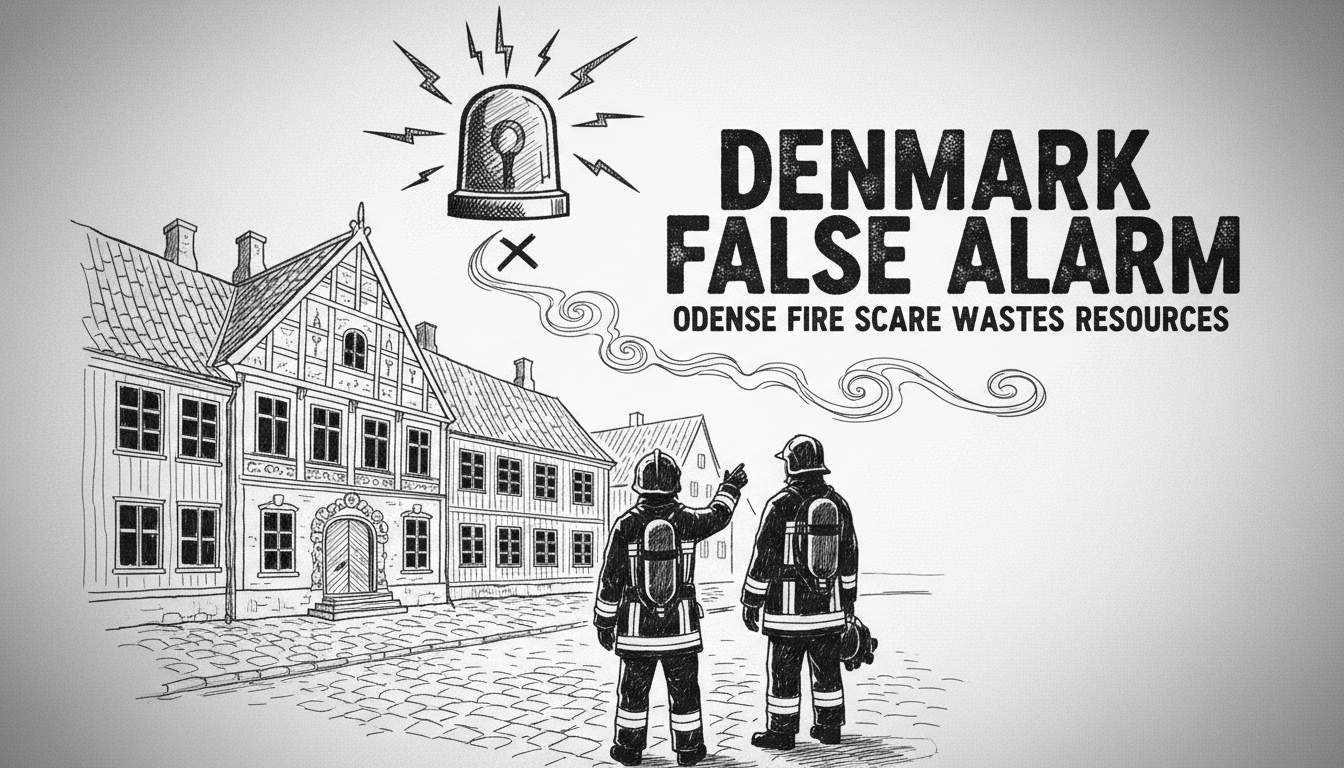
Denmark emergency services deployed a major response to a reported fire in central Odense Saturday afternoon. Police and fire crews arrived in force on Rugårdsvej after a passerby alerted them to a potential blaze in a vacant apartment building. The scene, however, revealed no flames, no smoke, and ultimately, no fire. The incident was declared a false alarm, concluding a significant mobilization of public safety resources for a non-existent threat.
This event highlights a recurring challenge for Danish municipalities: managing the risks and public costs associated with empty urban properties. Vacant buildings, often targets for vandalism or unauthorized entry, can generate false alarms that strain emergency services. Each response diverts personnel and equipment from genuine emergencies elsewhere in the city.
The Cost of Caution in Urban Centers
When the call came in, the protocol was clear. Fyns Police and Beredskab Fyn dispatched multiple units to Rugårdsvej, a central street lined with a mix of residential and commercial buildings. The initial report suggested a fire in an abandoned structure, a scenario that demands a swift and substantial response due to potential rapid spread and structural hazards. "We received a report of a fire in a vacant apartment building," the police duty officer confirmed.
Upon arrival, firefighters found no visible signs of a fire. Despite the absence of flames, the teams conducted a thorough inspection. They moved through the empty buildings on the street to verify the situation. "We have been around looking in the various buildings that stand empty on Rugårdsvej, and there is nothing to it," said Beredskab Fyn's incident commander, Mikael Kristiansen. The confirmation of a false alarm marked the end of the operation but the beginning of a conversation about resource allocation.
The Empty Building Dilemma in Danish Cities
Odense, as Denmark's third-largest city, faces urban management issues common to many growing municipalities. Vacant properties in city centers present a multifaceted problem. They can become eyesores, reduce neighborhood security, and attract activities that lead to emergency calls. From accidental fires started by trespassers to deliberate vandalism triggering alarm systems, these buildings consume a disproportionate amount of public service attention.
Urban planning experts point to this incident as a symptom of a wider issue. "Every false alarm represents a real cost," says Lars Jensen, a professor of urban sociology at the University of Southern Denmark. "It's not just the fuel and the wear on vehicles. It's the opportunity cost. Those firefighters and police officers were on standby, ready to respond to a real crisis. For that period, their capacity was tied up." Jensen notes that municipalities often walk a fine line between securing vacant properties to prevent such calls and the financial burden those security measures impose.
How Emergency Services Manage False Calls
For emergency responders, false alarms are an inevitable part of the job. The fundamental principle of fire safety is to react quickly and decisively to every potential threat. The risk of dismissing a real fire as a false alarm is far greater than the inconvenience of responding to a hoax or mistake. However, services like Beredskab Fyn continuously analyze call patterns to improve efficiency.
Their approach includes public education campaigns about when to call emergency lines and verification protocols where possible. In some cases, alarm companies or building managers can provide initial checks before a full dispatch is ordered. Yet, for a direct call from a concerned citizen reporting visible signs of fire, the response will always be immediate and comprehensive. The system is built on public trust and the imperative to protect life first.
The Ripple Effect on Community Safety
A large-scale response in one neighborhood inevitably affects coverage across the rest of the city. While Odense has multiple stations, a major call draws resources into a concentrated area. During the Rugårdsvej response, other units were placed on heightened alert to cover the broader region. This temporary reallocation is a standard procedure, but it underscores the interconnected nature of urban safety networks.
Local residents often have mixed feelings about these events. While grateful for the rapid response, some express frustration at the disruption and the underlying conditions that lead to such calls. "You see the sirens and the trucks, and your heart stops," said Anna Petersen, who lives two streets over from Rugårdsvej. "Then you find out it was nothing, and you're relieved, but also a bit angry. Those buildings have been empty for too long. It feels like a waste, and it makes you wonder what's happening there the rest of the time."
Balancing Public Concern with Practical Realities
The passerby who made the initial call acted as a responsible citizen. Observing a potential danger and contacting authorities is the correct civic behavior. Emergency services consistently reinforce the message: if you see something, say something. The alternative—where people ignore possible dangers—could lead to catastrophic outcomes. This creates a societal agreement where a certain number of false alarms are accepted as the price of a vigilant community.
Municipalities and property owners bear the responsibility to minimize these incidents. Secure fencing, regular maintenance checks, and active plans for vacant properties are part of the solution. Some Danish cities have implemented registration schemes for empty buildings, requiring owners to submit maintenance and security plans. Others explore temporary uses for such spaces, like pop-up art galleries or community workshops, to keep them active and monitored.
A Look at the Broader Scandinavian Context
This challenge is not unique to Denmark. Across the Nordic region, cities grapple with the lifecycle of buildings. Economic shifts, construction delays, and demographic changes can leave properties temporarily vacant. The Scandinavian model of high public trust in authorities also means people are more likely to report concerns, leading to a high volume of calls that services must treat with utmost seriousness.
The response in Odense reflects a system that prioritizes safety over efficiency. It is a tangible example of the welfare state's promise: that public services will be there when needed, regardless of the ultimate outcome. The financial cost of the false alarm is absorbed by the public budget, a collective investment in a safety net that does not question the legitimacy of a call for help.
When Nothing is Something
So, what is the legacy of an afternoon where nothing happened? It serves as a periodic stress test for the emergency response system. It highlights the physical infrastructure of a city in transition, where empty buildings tell stories of economic change. It reaffirms the social contract between citizens and the state. And it reminds us that the hum of daily safety is maintained by a complex, expensive, and often invisible machinery that springs to life at a moment's notice.
The next call could be the real one. That is the calculation every dispatcher makes, and why the trucks will always roll out with urgency, down streets like Rugårdsvej, toward a threat that may or may not be there. In the end, the cost of caution is woven into the fabric of a society that chooses to err on the side of protection. The real question for Odense and other cities is how to reduce the frequency of these tests without damping the public's willingness to sound the alarm.