
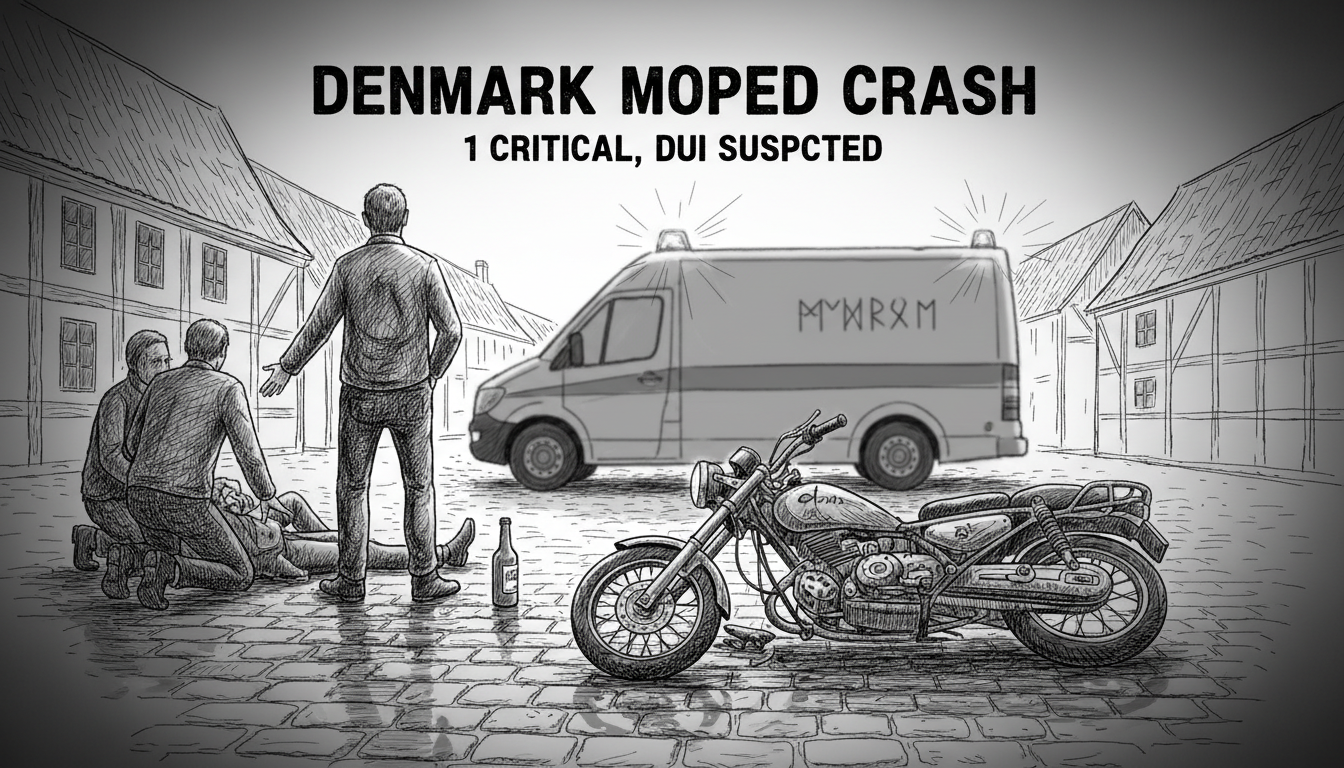
Denmark police are investigating a serious moped accident in Grindsted that left a 51-year-old man in critical condition. The Sunday evening collision occurred at an intersection near a Kvickly supermarket, where the moped reportedly failed to yield and drove directly into the path of a moving car. Preliminary police assessments indicate the moped driver is at fault for not observing his right-of-way obligation. Authorities also suspect the driver was under the influence of alcohol and have taken a blood sample for analysis.
The 51-year-old driver was airlifted by helicopter to Odense University Hospital with life-threatening injuries. A 55-year-old male passenger on the moped sustained a minor head injury and was transported by ambulance to a hospital in Esbjerg. The driver of the car, a 41-year-old woman from Grindsted, was physically unharmed in the crash. Police confirm the moped driver will face charges for failing to yield, with potential additional charges pending toxicology results.
A Sunday Evening Shattered
The quiet of a Sunday evening in the central Jutland town of Grindsted was broken by the sound of impact. For residents near the intersection, the aftermath was a stark reminder of how quickly routine travel can turn tragic. The collision involved a common sight on Danish roads—a 'knallert,' or moped—and a car. These small-engine vehicles, limited to 30 km/h for the classic model and 45 km/h for the '45-knallert,' are a popular mode of transport, especially in smaller towns and among younger riders or those without a car license. Their vulnerability in a collision with a larger vehicle is immense, a fact tragically underscored by the critical injuries sustained.
Police were swift to secure the scene and begin their investigation. Their initial findings point to a clear traffic violation. "The preliminary police assessment is that it was the moped driver who should have stopped at the intersection," a police spokesperson said in a statement. The rules are unambiguous: the driver entering from a minor road must yield to traffic on the major road. Failure to do so is a direct breach of Denmark's stringent traffic laws, which treat such violations seriously due to the potential consequences.
The Shadow of Impaired Driving
The investigation took a more serious turn with the suspicion of alcohol involvement. In Denmark, the legal blood alcohol content (BAC) limit for driving any vehicle, including a moped, is 0.05%. Driving under the influence is a criminal offense that carries severe penalties, including hefty fines, license suspension, and potential imprisonment, especially if an accident causes injury. The decision to take a blood sample from the critically injured driver indicates strong grounds for this suspicion, possibly based on witness statements or evidence at the scene.
This potential element transforms the incident from a tragic accident to a potential crime. Traffic safety experts consistently highlight impaired driving as one of the most significant and preventable risk factors on the roads. "Alcohol impairs judgment, reaction time, and coordination—skills that are absolutely critical for navigating traffic safely, particularly for vulnerable road users like moped riders," says Lars Tvede, a road safety consultant with the Danish Road Safety Council. "There is never an excuse for getting behind the handlebars after drinking."
The presence of a passenger on the moped adds another layer of gravity to the situation. The 55-year-old passenger, who suffered a head injury, entrusted his safety to the driver. This dynamic often leads to broader legal and moral ramifications in cases where impairment is confirmed.
The Aftermath and the Road to Recovery
The human cost of the crash is still unfolding. The 51-year-old driver fights for his life in Odense, a major trauma center. The distance from Grindsted to Odense—requiring a helicopter medevac—illustrates the severity of his injuries. His passenger, while less critically hurt, faces the physical and psychological trauma of the event. For the 41-year-old driver of the car, the shock of being involved in a serious collision, even without physical injury, can have lasting emotional effects. Such events often trigger post-traumatic stress, with drivers replaying the unavoidable impact.
The community of Grindsted, a town of around 10,000 people, is left to absorb the news. In close-knit communities, traffic tragedies resonate deeply, prompting conversations about road safety at local intersections and the behavior of all road users. The Kvickly intersection itself will now be a point of reflection, a location marked by a sudden, violent event that changed multiple lives.
Navigating Denmark's Traffic Safety Landscape
This accident occurs within the context of Denmark's generally strong traffic safety record, built on rigorous laws, extensive cycling infrastructure, and a cultural emphasis on road rule adherence. However, moped and motorcycle riders remain disproportionately represented in serious injury and fatality statistics. Their lack of physical protection makes them what safety officials term 'vulnerable road users.'
Danish traffic law does not differentiate between vehicles when it comes to core responsibilities like yielding, stopping at signals, and sobriety. A moped driver holds the same legal obligations as a truck driver. The 'vigepligt' or duty to yield is a cornerstone of the system, designed to create predictable flow and prevent exactly this type of intersection conflict. Enforcement is strict, and violations that lead to accidents are prosecuted.
The case also touches on the ongoing societal challenge of impaired driving. Despite decades of public awareness campaigns and stiff penalties, some individuals continue to make the lethal choice to drive after drinking. Each incident renews calls for even stricter enforcement, such as more random breathalyzer checkpoints, or higher penalties for DUI that results in injury.
A Case with Broader Implications
As the police await toxicology results, the legal path forward is clear in one aspect and conditional in another. The charge for failing to yield is certain. If the blood test confirms a BAC over the legal limit, the driver will face separate, more severe charges for driving under the influence. If his condition improves, he will have to answer to these charges in court. The consequences could reshape his life permanently, a sobering outcome from a single decision on a Sunday evening.
For the public, the Grindsted crash serves as a grim reminder. It underscores the non-negotiable importance of traffic rules designed for collective safety. It highlights the acute dangers faced by those on two wheels. And it powerfully reiterates the deadly incompatibility of alcohol and driving, regardless of the vehicle. The hope among safety advocates is that this story, beyond the headlines, leads to personal reflection among drivers and riders across Denmark. Will this tragedy make anyone think twice before ignoring a yield sign or riding after a drink? The prevention of the next accident depends on that quiet, individual answer.