
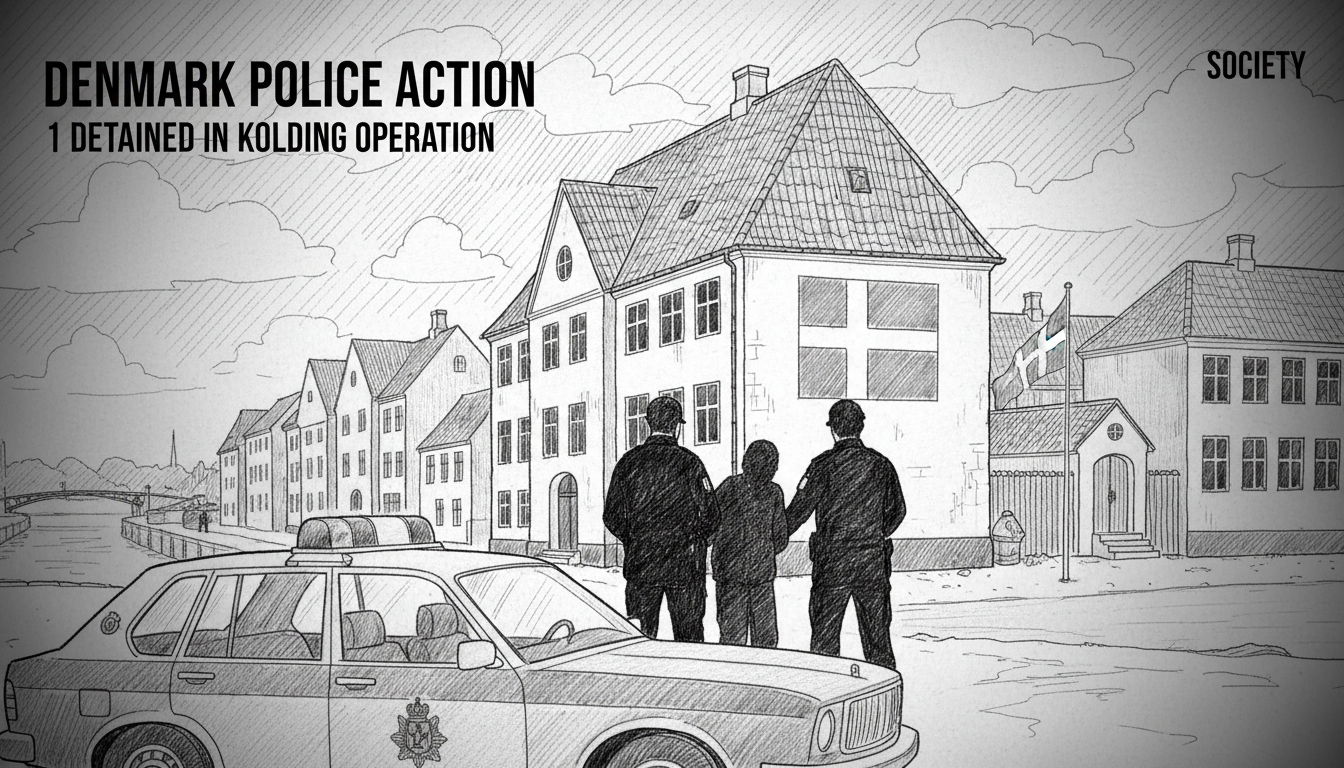
Denmark police launched a significant operation on Haderslevvej in Kolding Wednesday afternoon, deploying a large contingent of officers to the scene. Southeast Jutland Police confirmed one person was taken away for questioning following a report of a suspicious circumstance. No injuries were reported during the incident, which drew attention from local residents and prompted a standard investigation into the nature of the call.
Vagtchef Andreas Juul of Sydøstjyllands Politi provided a brief initial statement. "We have received a report about a suspicious circumstance, and now we are in the process of investigating the case," he said. His words reflect the procedural and measured approach typical of Danish police communications during ongoing operations. The scale of the police presence, described as 'talstærkt' or numerically strong, suggests the response was calibrated to the perceived level of the reported threat or the requirements of a planned action.
Understanding Police Response Protocols
A substantial police deployment in a Danish residential area like Haderslevvej is not an everyday occurrence, though police actions themselves are routine. The decision to send multiple units hinges on the initial information received by the operations center. Factors include the potential for violence, the need for specialist personnel, or the execution of a pre-planned warrant where securing the area is paramount. The Southeast Jutland Police force, like others in Denmark, operates on a principle of proportional response, aiming to resolve situations with minimal disruption and maximum safety.
Without specific details on the 'mistænkeligt forhold' or suspicious circumstance, the public is left to speculate. It could range from a concern about an individual's welfare to a tip related to criminal activity. The police's primary goal in such scenarios is to secure the scene, ensure public safety, and gather facts. The swift removal of a person from the location indicates officers moved to isolate and assess the individual at the heart of the report.
The Framework of Danish Policing
This incident offers a window into the decentralized but coordinated nature of law enforcement in Denmark. Sydøstjyllands Politi is one of twelve independent local police districts, each with deep knowledge of its own community's dynamics. This structure allows for tailored responses that consider local context, which is a cornerstone of Denmark's community policing model. Trust between the public and police is actively maintained through transparency about actions, even when specific case details remain confidential during investigations.
Kolding, a municipality of over 90,000 people, generally experiences low crime rates by international standards. A visible police action therefore stands out. It disrupts the quiet normalcy residents expect, generating concern and conversation. The police's immediate confirmation that no one was hurt is a crucial part of managing public anxiety. It provides reassurance while the investigative work continues behind the scenes.
Community Impact and Public Perception
Events like these ripple through neighborhoods. Residents witnessing multiple police vehicles and officers in tactical gear understandably seek answers. In the Danish context, there is an expectation that authorities will communicate the essential facts without compromising an investigation. The statement from Vagtchef Juul fulfills that basic need, acknowledging the event and its non-violent outcome without venturing into speculation.
This balance is delicate. Too little information fuels rumor; too much can jeopardize legal proceedings or privacy rights. Danish police have increasingly used social media to provide timely, brief updates on ongoing situations, a practice that helps anchor public discourse in facts. For the people living on or near Haderslevvej, the aftermath involves a return to calm, but with lingering questions about what prompted such a response in their community.
Analysis: Proportionality and Prevention
From a policy perspective, this operation highlights the Danish principle of proportionality in policing. A large presence can be a tool for de-escalation, demonstrating overwhelming capability to prevent resistance. It also allows for the containment of a scene, protecting both officers and bystanders. The outcome—a person detained without injury—aligns with the ideal resolution for any police intervention.
Experts in Danish law enforcement operations often note that the majority of such calls end without incident, a testament to training and procedural discipline. The focus is on resolving the situation peacefully and gathering evidence methodically. The investigation that follows will determine whether the initial report pointed to a criminal act, a mental health crisis, or a misunderstanding. Each path leads to different societal systems, from the judicial to the health services, illustrating how police often act as the first point of contact for complex social issues.
Looking Beyond the Incident
While this single event in Kolding will likely conclude with a standard police report, it connects to broader conversations about safety, resources, and civic trust. Danish municipalities fund and work closely with their local police districts, emphasizing preventive measures. Community policing initiatives, where officers engage with citizens outside of emergencies, are designed to build relationships that make streets like Haderslevvej safer.
The efficient handling of this report demonstrates the system functioning as intended: a concern was raised, a response was mobilized, and a potential situation was neutralized. For the individual detained, the process now shifts to questioning and determining the appropriate next steps, which could involve release, charges, or referral to other services. Their rights and the reasons for their detention will be scrutinized within Denmark's legal framework, which provides strong protections for individuals in police custody.
As the sun sets on Haderslevvej, the police tape will come down and the patrol cars will depart. The normal rhythm of life in Kolding will resume, underpinned by the quiet assurance that a report of something suspicious triggers a serious and professional response. This incident, now a brief entry in a police log, reaffirms a fundamental contract: the public reports concerns, and the state acts to investigate them. The true measure of the system's success is not in the scale of the response, but in the swift restoration of peace and the thorough pursuit of facts.