
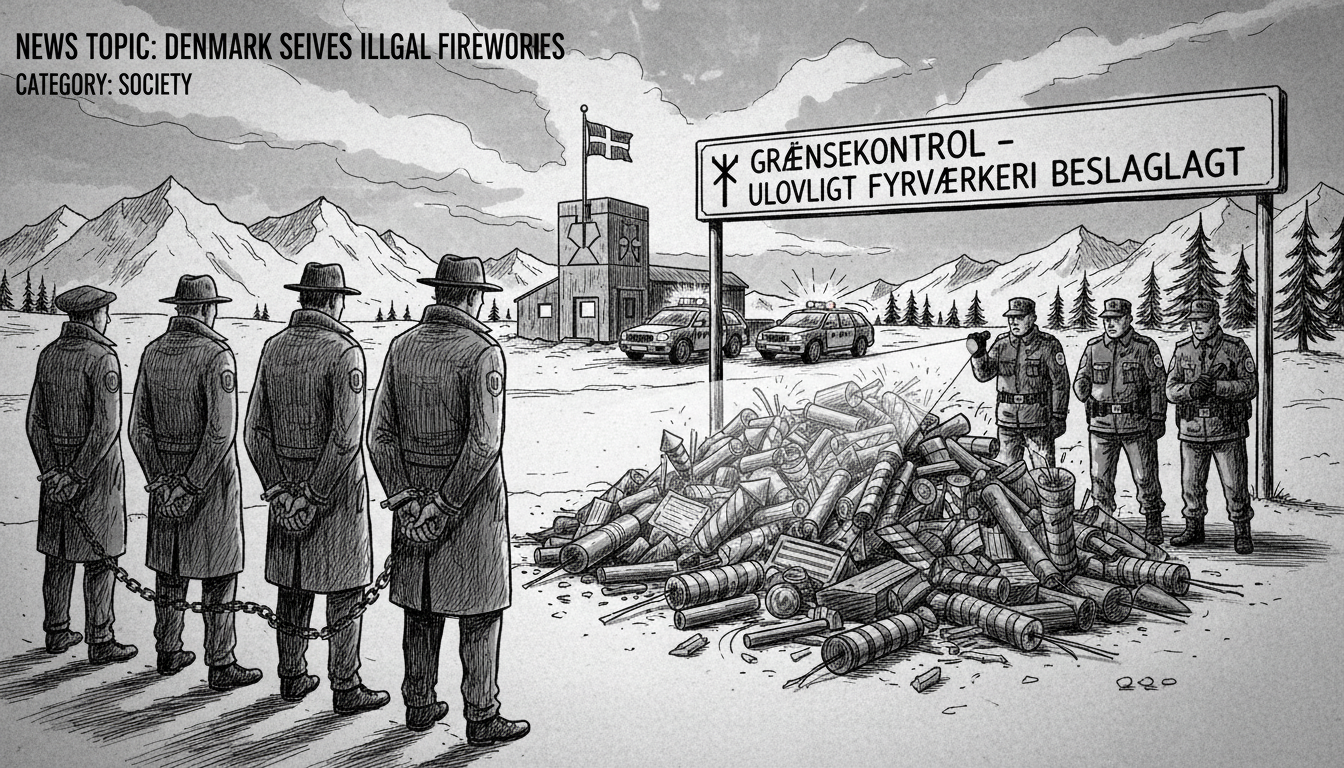
Denmark's police have intercepted multiple attempts to smuggle illegal fireworks across the German border this week. Officers at the Rødbyhavn border crossing made several significant seizures as New Year's Eve approaches, confiscating large quantities of pyrotechnics and issuing fines. The crackdown highlights an annual struggle to control the flow of unregulated explosives into a country with strict safety laws.
A 33-year-old man from Copenhagen was the first to be caught, his package of fireworks promptly confiscated. Shortly after, police stopped a Dutch-registered car containing various illegal fireworks, leading to an 18-year-old man being charged under Denmark's fireworks law. A 23-year-old man from Maribo was also stopped and found with three 'bomberør' or mortar tubes in his trunk. Each of these men faces a 2,000 kroner fine for their violations.
The most substantial seizure involved two men in a Swedish van. During a thorough search, police discovered 28 full boxes of New Year's fireworks. The men, aged 19 and 31, lacked sufficient travel identification. They were each fined 3,000 kroner and charged with violations of the Danish Aliens Act, in addition to fireworks infractions.
An Annual Border Battle
This week's seizures are not an isolated incident but part of a predictable, yearly pattern. As December 31st nears, Danish police significantly bolster surveillance and random checks at border crossings, particularly those connecting to Germany. The difference in regulations between the two nations creates a powerful incentive for smuggling. Certain types of fireworks, especially larger and louder category F4 consumer pyrotechnics, are more accessible or have different legal statuses in Germany compared to Denmark's tightly controlled market.
"Our focus at this time of year is unequivocally on prevention and public safety," a police spokesperson for South Zealand and Lolland Falster Police said in a statement regarding the recent operations. "Illegally imported fireworks often do not meet Danish safety standards. They pose a significant risk of causing serious injury, property damage, and public disturbance." The police døgnrapport, or daily report, where these incidents were listed, serves as a public log of such enforcement actions.
The High Stakes of Illegal Pyrotechnics
The rationale behind Denmark's strict fireworks laws is rooted in a history of accidents and a strong cultural emphasis on collective safety within the welfare system. Legal, approved fireworks sold in Denmark undergo rigorous testing for stability and predictable behavior. Illegally imported items bypass these controls entirely. They can be defective, unpredictably powerful, or prone to tipping over, directing explosions toward crowds rather than the sky.
Experts point out that the black market for fireworks is not merely a nuisance but can have wider implications. "While many individuals are simply seeking a bigger bang for their buck, the organized smuggling of fireworks in large quantities can intersect with other criminal activities," notes a security analyst familiar with border trade. "The profits are attractive, and the seasonal demand is guaranteed. It draws resources away from other police work and normalizes circumventing state controls."
The fines issued—2,000 and 3,000 kroner—are substantial but are often considered by authorities as a necessary penalty to deter what is seen as a serious breach of public order. The additional charge under the Aliens Act for the two men without proper papers underscores how border transgressions for profit are treated with particular severity.
A Cultural Clash at the Frontier
The phenomenon touches on a deeper cultural and regulatory tension within the European Union's borderless Schengen area. While people and goods move freely, national laws on specific products like fireworks, alcohol, and tobacco still apply. The Danish-German border, especially the Fehmarn Belt crossing at Rødbyhavn, becomes a frontline for this clash every December. Danish citizens and residents traveling back from Germany are routinely reminded of the limits of what they can bring home.
For local Danish municipalities, especially those in border regions, the illegal use of powerful fireworks presents a concrete annual challenge. Fire departments and emergency medical services are placed on high alert. Unregulated explosions lead to calls about fires, injuries, and distressed animals, stretching public resources. Social media in Danish towns often fills with complaints in early January about debris, noise, and the anxiety caused by illegal pyrotechnics.
Enforcement and the Public Dilemma
The police strategy is a mix of deterrence and interception. High-visibility checkpoints and the publication of seizure reports aim to discourage attempts before they happen. However, the long coastline and numerous crossing points make total control impossible. Public awareness campaigns run by authorities and safety organizations repeatedly stress the dangers, but the allure of more impressive, louder, and sometimes cheaper fireworks from abroad persists for a segment of the population.
This creates a perennial debate. Some argue for even stricter penalties and year-round investigations into supply chains. Others suggest a cultural shift is needed, perhaps through community-organized professional fireworks displays that reduce the demand for private, dangerous alternatives. A few voices even question if the current level of restriction is proportionate, though they remain a minority in the public discussion where safety is the paramount concern.
The individuals caught this week will have their fines processed, and the confiscated fireworks will be destroyed. The police presence at Rødbyhavn and other crossings will remain intense until the clock strikes midnight on January 1st. Yet, as one border officer privately acknowledged, it is a game of statistical reduction, not total victory. For every van loaded with 28 boxes of fireworks that is stopped, the fear is that another might get through. The annual crackdown is a testament to Denmark's commitment to its social contract of safety, even as it battles the persistent human desire for a more spectacular blast to mark the new year. The real measure of success will be found not in seizure reports, but in quieter, safer streets across Denmark when the celebrations conclude.