
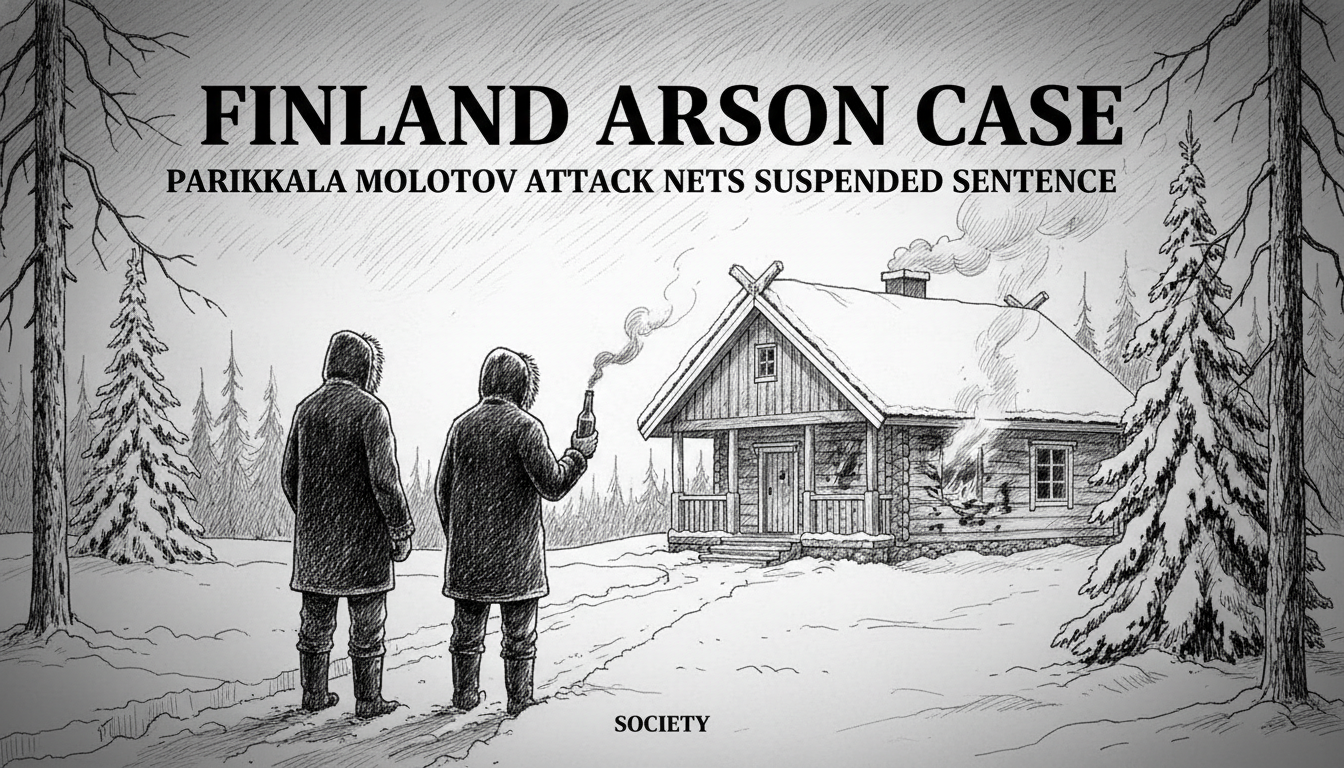
Finland's Etelä-Karjala District Court has handed a suspended prison sentence to a man convicted of throwing a Molotov cocktail into a car parked outside a Parikkala home. The late-night arson attack, fueled by a personal dispute between neighbors, caused significant property damage and forced the homeowner to flee with his dogs. This case highlights the Finnish judicial system's approach to balancing punishment with rehabilitation for non-violent offenders.
A Late-Night Attack in Rural Parikkala
The incident occurred at a detached house in the municipality of Parikkala, located in Finland's southeastern South Karelia region. According to court documents, the victim was awakened by the sound of his dogs barking and general commotion outside his home. He looked out to see the convicted man standing in his yard. Without speaking, the perpetrator smashed the car's window, threw a lit petrol bomb inside the vehicle, and left the scene on a motorcycle. The victim reported the assailant was "laughing like a witch" as he departed.
The car was parked dangerously close to the residential building, approximately 1.5 to 2 meters away. By the time the local fire department arrived, the vehicle was fully engulfed in flames. The intense fire caused collateral damage to the house itself, melting electrical wiring above the front door and damaging a window next to the entrance. The proximity of the blaze to the dwelling created a serious risk of the fire spreading, which could have led to far more severe consequences.
The Finnish Legal Framework for Arson
Finnish law treats arson as a serious crime under the Criminal Code, with penalties designed to reflect the danger it poses to life, property, and public safety. The legislation distinguishes between different degrees of the offense. Aggravated arson, which carries heavier sentences, involves circumstances like endangering human life, causing major economic damage, or using explosives. The Parikkala case was likely tried as basic arson, given the specific circumstances and the resulting sentence.
Finland maintains one of Europe's lower overall crime rates, but isolated arson cases do occur, often stemming from personal conflicts, insurance fraud, or vandalism. The judicial system examines each case meticulously, weighing factors such as intent, premeditation, the value of damage, and any risk to human life. The suspended sentence in this instance suggests the court viewed the act as a targeted crime arising from a personal feud, rather than random violence or terrorism.
Analysis of a Suspended Sentence
The court's decision to issue a suspended, or conditional, prison sentence offers a clear window into Finland's correctional philosophy. This type of sentence means the convicted individual will not serve time in prison unless they commit another crime during a set probation period. It is a common outcome for first-time or non-violent offenders where the court believes incarceration is unnecessary for public safety or the individual's rehabilitation.
Legal experts point to several factors that likely influenced this judgment. The perpetrator had no prior criminal record relevant to this offense. The act, while dangerous and destructive, appeared to be a targeted attack against property in the context of a soured personal relationship, not a random act of terror. The court also considered that no one was physically injured. The sentence aims to hold the offender accountable while allowing them to remain in the community, maintain employment, and make restitution, aligning with Finland's strong focus on rehabilitative justice over purely punitive measures.
The Human and Community Impact
Beyond the legal specifics, the case underscores the disruptive impact of such crimes on small, close-knit communities like Parikkala. With a population of around 4,500, Parikkala is a typical Finnish rural municipality where neighbors often know each other. A violent breach of trust between residents shakes the community's sense of security. The victim's experience—being awakened in the night to confront a flaming vehicle on his property—represents a profound violation of personal safety that extends far beyond the monetary value of the damaged car and house fittings.
The psychological impact on the victim is significant. The description of the assailant laughing as he fled paints a chilling picture of the event's malicious nature. Recovering from such an event involves more than repairs; it requires restoring a sense of safety in one's own home. For the community, it serves as an unsettling reminder that interpersonal conflicts can escalate to criminality, demanding vigilance and functional conflict resolution mechanisms at the local level.
A Contrast in Crime and Punishment
International observers might find the sentence lenient compared to penalties for arson in other jurisdictions. However, it fits consistently within the Nordic model of justice, which emphasizes proportionality and reintegration. Finland's prison population rate is among the lowest in Europe, a fact often attributed to this very approach of using conditional sentences and fines for less serious crimes. The system operates on evidence showing that for many offenders, especially in cases of isolated criminal acts, community-based sentences can be more effective at preventing re-offending than short-term imprisonment.
The court's ruling sends a clear message: the act was criminal and serious, warranting a prison sentence. Yet, the suspension of that sentence adds a second message about the court's belief in the offender's capacity to abide by the law moving forward. The convicted man now carries a criminal record and the constant threat of imprisonment hanging over him for the duration of his probation. This outcome is designed to be a substantial deterrent in itself.
Looking Ahead for Parikkala and Finnish Justice
The Parikkala case will soon fade from the headlines, but its lessons remain. For local authorities, it highlights the importance of community mediation services to help resolve neighbor disputes before they reach a boiling point. For the justice system, it represents another application of a well-established sentencing principle. The true test will be whether the sentence achieves its dual goals: delivering justice for the victim and successfully reintegrating the offender as a law-abiding citizen.
Ultimately, this incident is a microcosm of a broader societal challenge. Even in a nation known for its low crime and social harmony, personal conflicts can turn destructive. The Finnish response, as seen in this Etelä-Karjala courtroom, is to meet that destruction with a measured, principled application of the law that seeks to repair harm rather than simply inflict punishment. The effectiveness of this approach is a continuous subject of national debate, balancing ideals of rehabilitation with the public's rightful demand for security and justice.