
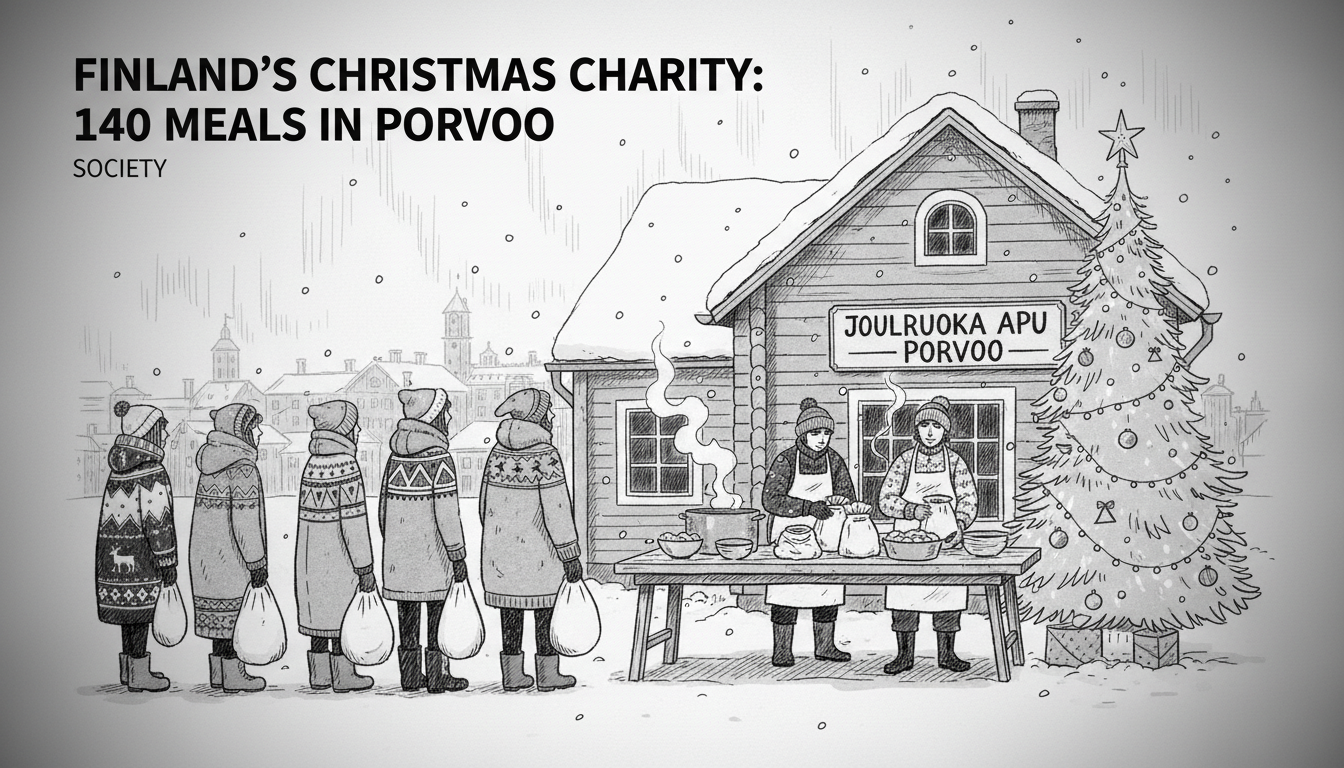
Finland's Christmas charity tradition saw the Porvoo Finnish Parish host 140 low-income residents for festive lunches this week. In the historic parish hall, long tables were set with traditional Christmas fare—ham, casseroles, and pastries—for 60 guests on Monday. The scent of glögi and coffee filled the air as volunteers served meals, creating a warm atmosphere that contrasted sharply with the cold December weather outside. This scene of communal support highlights a deeply ingrained Nordic practice of welfare provision, where civil society and religious organizations actively complement the state's social safety net.
A Tradition of Communal Care
The event in Porvoo is not an isolated act but part of a widespread Finnish tradition. During the holiday season, parishes, charities, and volunteer groups across the country organize similar gatherings. These events address two critical issues: food insecurity and social isolation. For many attendees, the meal represents a guaranteed nutritious dinner during an expensive time of year. Perhaps more importantly, it offers a place of community and belonging, countering the loneliness that can intensify during family-centric holidays. The Finnish Evangelical Lutheran Church, which the Porvoo parish belongs to, has a long history of such social work, operating within a society where it remains a significant cultural and social institution despite declining formal membership.
Dr. Liisa Häikiö, a professor of social policy at the University of Tampere, explains the broader context. "These parish-led events are a vital part of Finland's welfare ecosystem," she said in an interview. "They provide immediate, dignified assistance that is low-threshold. No extensive bureaucracy, just an invitation. This complements the municipal and state services, often reaching people who might hesitate to apply for formal aid. During Christmas, the focus on companionship is as valuable as the food itself."
The Practicalities of Parish Welfare
The logistics behind the Porvoo lunches reveal a well-organized effort. The parish hall event on Monday catered to 60 people, requiring significant volunteer coordination for cooking, serving, and cleaning. A second, larger event was scheduled for Tuesday at the Gammelbacka Parish Center, with meals prepared for 80 guests. Combining these, the parish reached its goal of serving 140 Porvoo residents identified as needing support. Funding typically comes from parish collections, private donations, and sometimes small municipal grants. The food is often prepared by volunteer teams, sometimes using ingredients donated by local supermarkets or farmers.
This model is efficient and community-embedded. Volunteers frequently include parish members, local students fulfilling civic engagement hours, and sometimes previous guests who return to help. The setting is deliberately informal and festive, with Christmas decorations and music, to reduce any stigma associated with receiving help. The mayor of Porvoo, Jukka-Pekka Ujula, attended the Monday lunch, not just as a dignitary but by sitting at the piano to play Christmas carols. His participation underscored the local government's tacit support and the event's cross-societal importance.
The Larger Landscape of Need
While heartwarming, these charitable events also point to underlying social challenges. Finland has a strong, universal welfare state, but relative poverty and inequality persist. Rising living costs, particularly for energy and food, have stretched household budgets. For pensioners on fixed incomes, single-parent families, and the long-term unemployed, the holiday season can bring financial stress. Municipal social services provide basic assistance, but charitable meals fill specific gaps, especially for social and emotional support that falls outside official welfare mandates.
"The data shows that material deprivation, while lower than in many countries, still exists," notes social researcher Markus Kainu from the Finnish Institute for Health and Welfare. "Especially in urban areas and among certain groups. What these Christmas lunches highlight is the 'soft' dimension of poverty—loneliness. The role of civil society in building social capital and networks is irreplaceable. It's something a state cannot directly administer."
This interplay between state and civil society is characteristically Nordic. The state ensures a baseline of security through benefits and services, while organizations like the church, the Mannerheim League for Child Welfare, and the Finnish Red Cross provide targeted, flexible support and human connection. The Porvoo lunch is a microcosm of this partnership.
Cultural Significance and Seasonal Ritual
Christmas holds profound cultural weight in Finland, the self-proclaimed "Home of Santa Claus." Traditions are deeply observed, from the peace declaration in Turku to families visiting cemeteries to light candles for departed loved ones. The expectation of a warm, abundant holiday meal is central. Community lunches ensure that this cultural experience is not limited by economic circumstance. They uphold the Finnish concept of "joulurauha," or Christmas peace—a time of tranquility, goodwill, and communal responsibility.
The act of sharing a meal is powerfully symbolic. It normalizes assistance, framing it as hospitality rather than charity. For the 140 guests in Porvoo, it was an invitation to partake in a national ritual. The menu itself is symbolic: the Christmas ham, the prune and carrot casseroles, the star-shaped pastries. These are tastes of a shared Finnish Christmas, offered without precondition.
Challenges and the Path Forward
Reliance on volunteer-driven charity raises questions about scalability and consistency. Parish resources fluctuate, and volunteer availability can be uneven. The need for such services is not confined to December; food insecurity is a year-round issue for some. Many parishes and charities now run regular food distribution or "friendship cafe" services throughout the year, recognizing that need is not seasonal.
Furthermore, experts debate the proper balance between state responsibility and voluntary action. Should the existence of a vibrant charity sector let the state off the hook for deeper systemic solutions? Most Finnish analysts see it as a symbiotic relationship, not a substitute. "The ideal," says Dr. Häikiö, "is a welfare state so effective that these meals are purely for celebration and companionship, not nutritional necessity. We are not there yet, so these initiatives remain essential. They also keep the spirit of communal obligation alive, which benefits society as a whole."
As the guests left the Porvoo Parish Hall, many carried with them small gift bags—another common feature of these events, containing perhaps chocolates, socks, or hygiene products. The immediate impact was clear: 140 people had been fed, warmed, and included. The longer-term impact is subtler. These events reinforce a social contract that extends beyond legislation. They are a living reminder that in Finland, even amidst modern complexities, the well-being of one's neighbor remains a collective concern. The quiet work of setting tables in parish halls across the country each December is a powerful testament to a society checking in on itself, ensuring no one is left entirely in the cold.
Will this model of blended welfare, where state security meets community hospitality, remain robust enough to meet future challenges? As economic pressures evolve, the continued relevance of the parish hall Christmas lunch may be one of the most telling indicators of Finnish social health.