
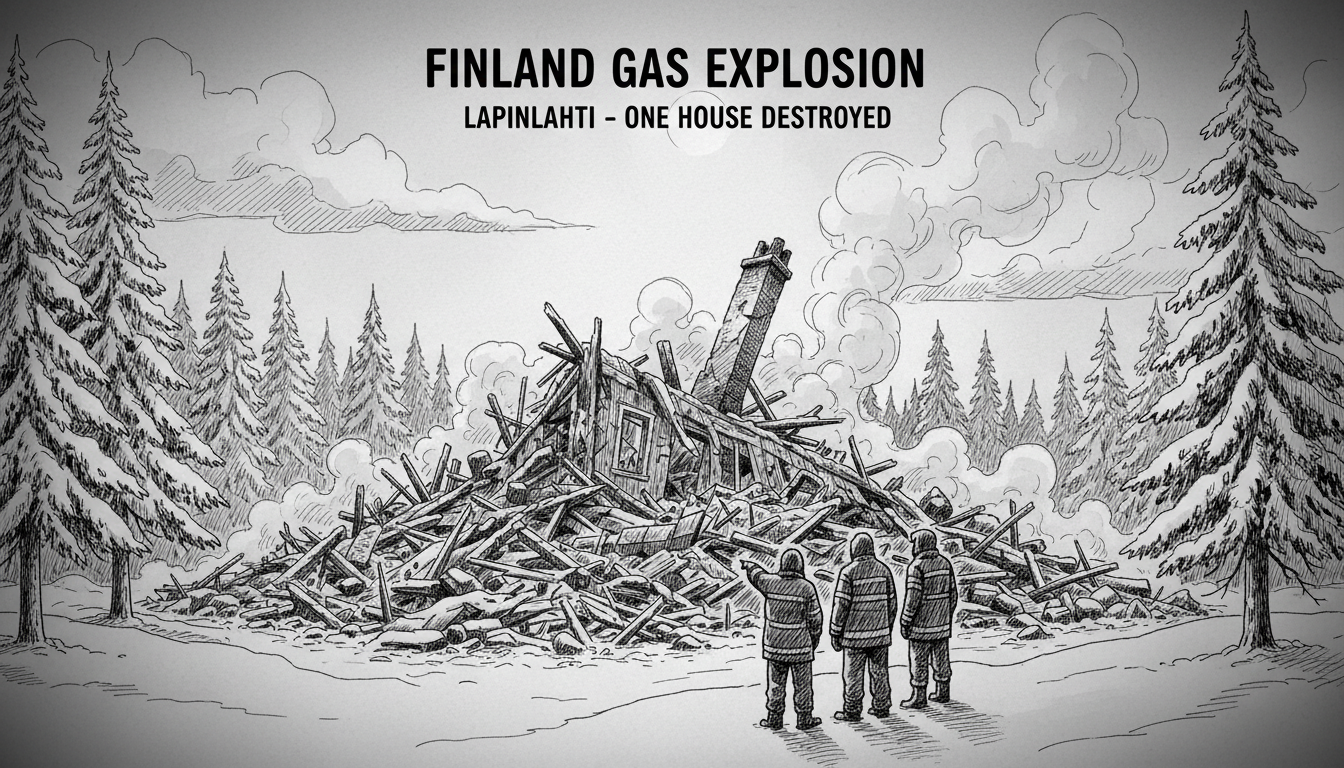
Finland's Pohjois-Savo region witnessed a devastating residential explosion this past weekend that has drawn national attention to gas cylinder safety. A powerful blast in the municipality of Lapinlahti on Saturday afternoon destroyed a detached house and its garage, with preliminary police investigations pointing to a leaking liquefied petroleum gas (LPG) cylinder as the probable cause. The force of the explosion was such that the garage collapsed completely, and its double doors were hurled across the street onto a neighboring property.
Authorities confirmed the detached house and garage were rendered likely beyond repair. "The explosion caused significant economic damage," a police spokesperson said in a statement issued on Monday, December 22. Officers from the Pohjois-Savo police department quickly ruled out criminal explosives or technical faults in the building's own systems. Their focus narrowed to a gas bottle stored in the garage as the sole remaining plausible ignition source for the catastrophic event.
A Scene of Sudden Devastation
Residents in the quiet Lapinlahti neighborhood described the moment of the blast as a sudden, thunderous noise that shook nearby homes. Emergency services, including fire brigades and police, responded to the scene promptly. Their first priority was to secure the area and ensure no one was injured in the wreckage. Fortunately, initial reports indicate the homeowners were not in the immediate vicinity of the garage at the time of the explosion, preventing potential fatalities.
Visual assessments by rescue officials revealed the full extent of the structural failure. The garage was reduced to a pile of splintered timber and twisted metal. The main house sustained severe damage from the shockwave, with windows blown out and parts of the structure compromised. The trajectory of the garage doors, landing far from their original location, illustrated the immense energy released in a fraction of a second.
The Investigation Focuses on Propane Safety
The police investigation now centers on forensic analysis of the debris and the remains of the gas cylinder. In Finland, liquefied petroleum gas, commonly stored in red cylinders for use in grills, patio heaters, or some rural heating systems, is a regulated substance. "When the police have ruled out other obvious causes, a gas leak that found an ignition source becomes the leading theory," said a safety official familiar with such incidents, speaking on background.
Experts note that propane and butane are heavier than air. A leak from a cylinder stored in a confined space like a garage can allow gas to pool at floor level, creating an invisible, highly flammable mixture with air. A single spark from an electrical appliance, light switch, or even static electricity can then trigger a violent explosion. "Proper storage is critical. Cylinders should be kept upright, in well-ventilated areas, and away from potential ignition sources," the expert added. "Even a small, persistent leak can have catastrophic consequences."
Finland's Regulatory Framework for Gas Storage
This incident brings Finland's national safety regulations into sharp focus. The Finnish Safety and Chemicals Agency (Tukes) oversees the regulations concerning the storage and handling of pressurized gas containers. Their guidelines are explicit: gas cylinders must be stored in a well-ventilated location, preferably outdoors in a protected cage or shelter, and never in basements, stairwells, or living areas. Connections and hoses must be regularly checked for wear and leaks.
For decades, Finnish building codes and safety advisories have emphasized these rules, particularly for detached houses and summer cottages where gas grill cylinders are ubiquitous. The Ministry of the Interior and the Finnish National Rescue Association (SPEK) routinely run public information campaigns, especially before the summer grilling season and the winter holidays when portable gas heaters see more use. Despite this, human error or equipment failure can still lead to dangerous situations.
A Broader Pattern of Preventable Accidents
While large-scale gas explosions remain relatively rare in Finland, similar incidents have occurred in the past, often with tragic results. Each event typically prompts a review of safety guidelines and public messaging. This explosion in Lapinlahti, given its timing in late December, may also raise questions about winter storage practices. Cylinders stored in unheated garages can be subject to temperature fluctuations, though modern valves and tanks are designed to withstand typical Finnish winter conditions if undamaged.
The economic toll is immediate for the homeowners, involving not just the loss of property but also complex insurance assessments. The psychological impact on the neighborhood, witnessing such sudden and violent destruction next door, is another layer of community cost. Local authorities in Lapinlahti are likely to coordinate with social services to provide support if needed.
What the Lapinlahti Blast Reveals
This event serves as a stark, real-world reminder of the potent energy contained in common household fuel sources. The investigation's findings, once finalized, will be added to the corpus of data used by safety authorities to refine their guidelines. For the public, the images from Lapinlahti reinforce a simple message: vigilance with gas equipment is non-negotiable.
It highlights the silent danger of a leak that produces no flame until it is too late. Safety professionals consistently recommend installing gas detectors in areas where cylinders are stored, a measure that is not always mandated by law but can provide an early warning. Checking valve seals, ensuring hoses are in good condition, and smelling for the distinct odorant added to LPG before use are basic but essential habits.
As the police conclude their technical investigation, the conversation will shift from cause to prevention. Will this event lead to stricter enforcement of existing storage rules, or new public safety campaigns from Tukes and SPEK? For now, a family in Pohjois-Savo faces the new year dealing with the aftermath of a single, preventable point of failure. Their loss underscores a universal truth in safety engineering: regulations are written in the language of past accidents, and compliance is the only barrier between daily life and disaster.