
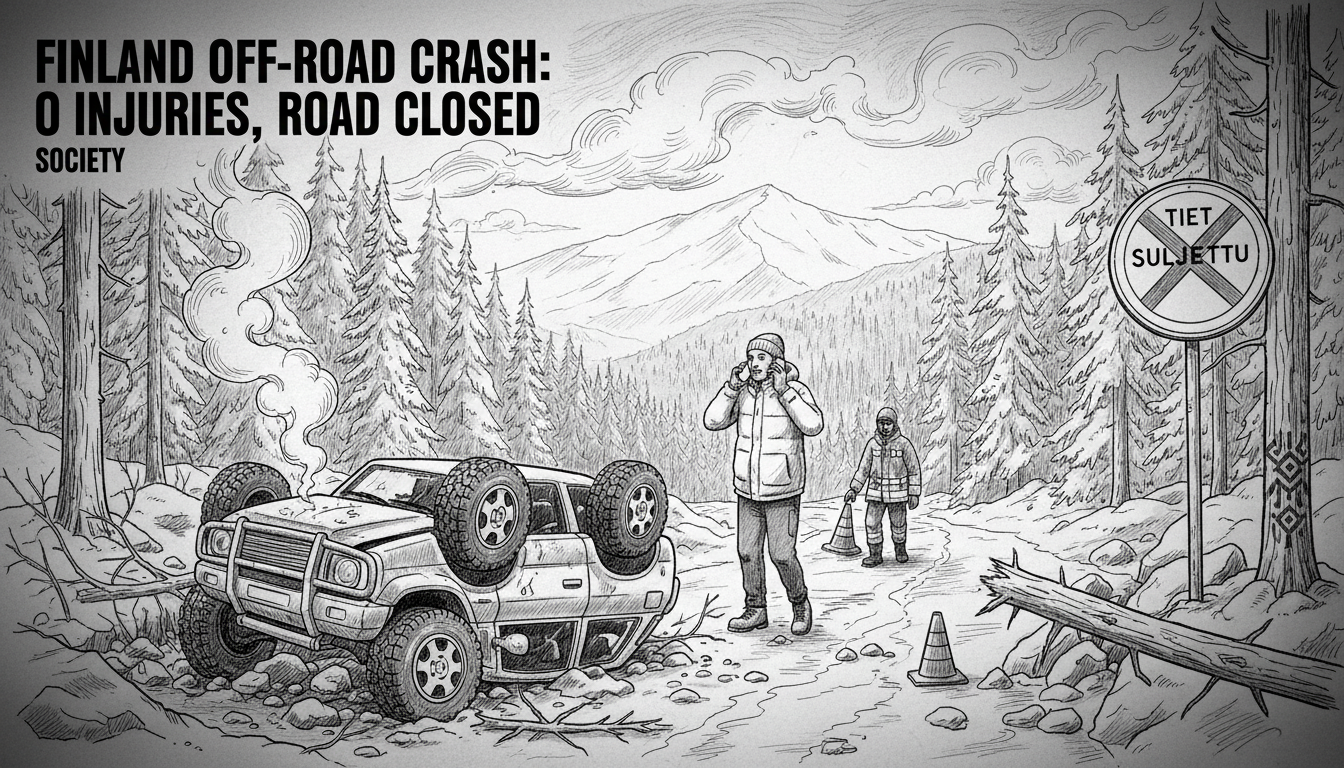
Finland car accident response prevented injuries Friday evening when an off-road vehicle towing a trailer veered into a ditch at a rural intersection. The incident occurred at the junction of Kuusjärventie and Sarvenperäntie in the Korpilahti district of Jyväskylä, forcing a temporary road closure during rescue operations. Emergency services received the call at 17:51 local time and quickly secured the scene, with police confirming no personal injuries resulted from the crash.
Rescue personnel from the Central Finland Rescue Department managed traffic around the site for several hours. They worked to recover the maastoauto, a type of SUV or 4x4 vehicle common in Finland's countryside, and its trailer from the roadside ditch. The operation required closing a section of Kuusjärventie, a local road numbered 16607 that connects Korpilahti to surrounding villages and lakeside communities. This closure caused minor disruptions for local residents but ensured a safe recovery process.
A Routine Response on a Rural Road
The crash site lies within the merged administrative area of Jyväskylä, Finland's seventh-largest city. Korpilahti, once an independent municipality, became part of Jyväskylä in 2009. This region features a mix of forest, lake, and scattered settlements, with roads like Kuusjärventie serving as vital connectors. Traffic volumes are generally low compared to urban centers, but these roads see regular use by locals, forestry vehicles, and those towing boats or recreational equipment.
Friday's accident highlights a common challenge in Finnish road safety: managing vehicle combinations on narrower regional routes. "Towing requires extra attention, especially on curves and at intersections," said a veteran driving instructor from the region, who asked not to be named in official reporting. "The dynamics of a car with a trailer change dramatically. Sudden maneuvers or misjudged speed can lead to a loss of control, even for experienced drivers."
The Anatomy of a Non-Injury Accident
While the specific cause of this incident remains under routine police review, several factors are typical in such events. Intersections, even in rural areas, present points of potential conflict and decision-making. A driver may need to brake or steer abruptly, actions that place different stresses on a vehicle-hitched combination. The weight and load distribution of the trailer are critical; an improperly loaded trailer can sway or fishtail, potentially pulling the towing vehicle off its path.
Finland's climate and road conditions also play a background role. While this accident occurred in the evening, road surfaces can be unpredictable. Patches of gravel, wet leaves, or minor frost can reduce traction. Finnish drivers are generally highly trained for these conditions, with mandatory winter driving lessons as part of the licensing process. However, the added complexity of towing elevates the risk profile for any journey.
The successful outcome—zero injuries—speaks to both fortune and the built-in safety of modern vehicles. It also underscores the effectiveness of Finland's emergency response protocols. The time from call to arrival for rescue services in rural areas is a key metric for authorities. The swift establishment of a traffic management plan prevented secondary incidents, a common danger at crash sites where rubbernecking or unexpected obstacles can cause further collisions.
Infrastructure and Safety in Focus
This minor incident connects to broader discussions within Finnish transport policy. Maintaining and improving the vast network of local roads, which far exceeds the length of the main highway network, is a perpetual task for municipal and state budgets. Road width, signage, intersection visibility, and ditch design are all factors that influence safety outcomes. The ditches common along Finnish roads, while necessary for drainage, can be hazardous if a vehicle leaves the roadway.
From an EU perspective, Finland's road safety record is among the best in the Union. The country consistently has one of the lowest rates of road fatalities per million inhabitants. This is attributed to strict alcohol policies, extensive safety education, and a Vision Zero strategy that aims to eliminate all serious traffic accidents. Every non-injury accident, like the one in Korpilahti, is still a data point that feeds into this long-term safety work. It provides information on vehicle types, road locations, and conditions that, when aggregated, help planners identify potential risk patterns.
Local politicians in Jyväskylä's city council, which now governs Korpilahti, regularly debate infrastructure spending. Balancing the needs of growing urban cores with maintaining services in outlying districts is a constant challenge. A single vehicle in a ditch does not prompt policy change, but a pattern of similar incidents at a specific intersection could lead to a review of speed limits, signage, or even minor engineering modifications.
The Human Factor Beyond the Statistics
Behind the official report of a non-injury accident is a driver who experienced a stressful and likely frightening event. Even without physical harm, the shock and potential vehicle damage represent a personal setback. The process of dealing with insurance, possible fines if traffic rules were breached, and arranging vehicle recovery can be a significant hassle, particularly in areas with less immediate access to services.
For the community, such events are reminders of shared vulnerability. Rural areas rely on a few key roads. A closure, even temporary, can mean detours, delays for deliveries, or isolation for some households. The social contract in these communities often involves neighbors checking on each other and offering help. The efficient work of the rescue services to clear the road restores normalcy quickly, minimizing communal disruption.
Finland's approach to these incidents is characteristically systematic. The police will file a report. Rescue services will log their response times and actions. The road maintenance authority may note any damage to signage or the roadside. This data collection is not bureaucratic overreach but part of the meticulous process that underpins the nation's high safety standards. Every response is also a training exercise, keeping skills sharp for more serious emergencies.
A Reminder on the Road to Summer
As Finland moves further into spring, road activity increases. Recreational towing—for boats, caravans, and utility trailers—becomes more frequent. The Korpilahti incident serves as a timely, low-stakes reminder for all drivers to conduct pre-trip checks on their vehicles and trailers. Ensuring correct tire pressure, functional lights, secure coupling, and proper load balance are simple steps that drastically improve safety.
Experts recommend that drivers practice maneuvering with a trailer in a safe, empty area before embarking on longer trips. They also advise increasing following distances and reducing speed, as stopping distances are longer and wind from passing trucks can affect stability. The driving instructor we spoke to emphasized, "The car you drive every day handles completely differently once you hook something to the back. Respect that difference."
The story of an off-road vehicle in a ditch in Korpilahti will not make national headlines. There is no scandal, no tragedy, and no major policy announcement. Yet, it is a perfect snapshot of everyday safety management in Finland. It demonstrates a system that works: an accident happened, the response was professional and effective, and the outcome was the best possible. In a world of constant bad news, a story where everything functioned as it should is perhaps the most unexpected twist of all. How many nations can say their most routine traffic incidents are case studies in successful prevention and response?