
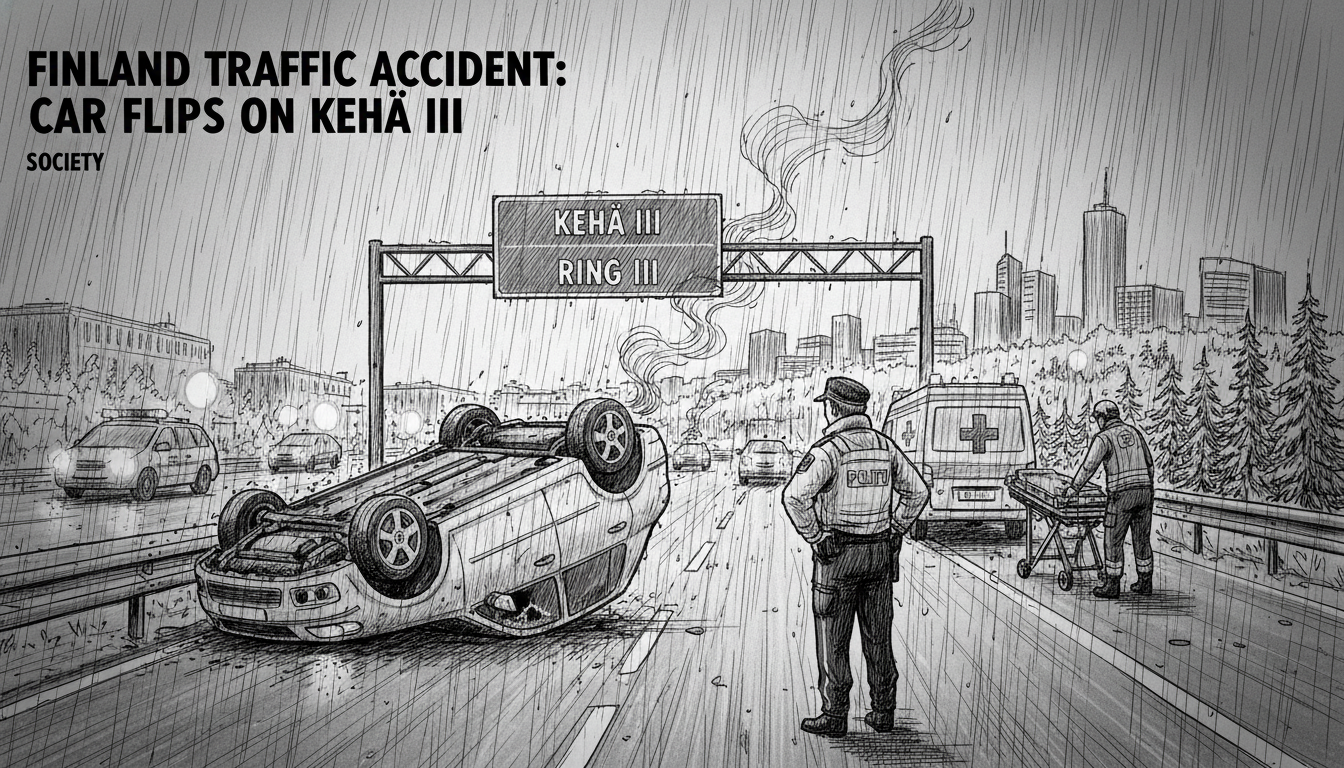
Finland traffic accident investigators are examining a dramatic single-vehicle crash on the busy Kehä III ring road near Helsinki. A car flipped completely over onto its roof near the Vehkala interchange in Vantaa on Monday afternoon, yet the driver emerged without serious injury and walked away from the wreckage. The Keski-Uusimaa Rescue Department confirmed the driver managed to exit the vehicle unaided, a fortunate outcome on a highway known for heavy traffic and high speeds.
Rescue services dispatched one unit to the scene following reports the vehicle had begun to swerve uncontrollably before rolling over. The driver, who was the sole occupant, could not explain why the car started to heittelehtimään, or swerve, according to Mikko Kangasmaa, the on-duty fire chief who spoke about the incident. Authorities noted the road surface was not slippery at the time, ruling out one common cause for loss of control on Finnish roads during the transitional spring season.
A Close Call on a Critical Artery
The Kehä III, or Ring III, is the outermost and busiest of Helsinki's three beltways, a vital conduit for commuters and freight moving between Espoo, Vantaa, and Helsinki's city center. Accidents on this road frequently cause severe traffic congestion, impacting thousands of drivers and the flow of goods. This incident occurred near the Vehkala interchange, a complex junction serving a significant industrial and logistics zone, making the lack of major traffic disruption noted by rescue services particularly noteworthy.
“The driver got out on their own, and there was no harm to traffic from the situation,” the rescue department's statement read. This outcome is exceptional given the violent nature of a full vehicle rollover. The fact the car ended up on its roof after flipping “katon kautta ympäri” – over its roof – typically indicates a high-energy impact. Finnish road safety experts often stress that modern vehicle safety standards, including robust roof strength and side-curtain airbags, are critical for survival in such events.
Searching for Causes Beyond the Surface
With icy conditions ruled out, investigators and traffic safety analysts will consider other potential factors. The driver's reported uncertainty points toward possible mechanical failure, driver distraction, or a sudden avoidance maneuver. “The driver did not know why the car began to swerve,” Fire Chief Kangasmaa stated, highlighting the mystery surrounding the crash's initiation. This aligns with a common challenge in traffic incident analysis where the immediate cause is not always apparent to the person behind the wheel.
Vehicle maintenance becomes a focal point in such investigations. Worn tire treads, failing suspension components, or sudden brake issues could cause a vehicle to behave unpredictably at highway speeds. Kehä III has long, straight sections where speeds can be high, and any loss of control can quickly escalate. The Finnish Transport and Communications Agency, Traficom, regularly campaigns for regular vehicle checks, especially before long journeys or after winter, when potholes and road salt can accelerate wear.
Finland's Broader Road Safety Landscape
This accident occurs against the backdrop of Finland's ongoing efforts to improve road safety, a cornerstone of national transport policy. In 2022, Finland recorded 345 road fatalities and 4,213 injury accidents. While these numbers represent a long-term downward trend thanks to safer cars, improved infrastructure, and strict enforcement of laws against drunk driving, each incident prompts renewed scrutiny. The government's target, aligned with the EU's Vision Zero, is to halve serious injuries and fatalities by 2030.
Single-vehicle accidents, where no other car is involved, are a significant part of this statistic. They often result from a combination of speed, road conditions, and driver error or impairment. The Finnish National Police Board emphasizes the importance of the “three E's”: Engineering (safe roads and vehicles), Education, and Enforcement. On roads like Kehä III, engineering includes clear signage, well-designed interchanges, and consistent road surfaces, while enforcement involves frequent speed monitoring.
The Human Factor in Highway Safety
Beyond engineering, the human element remains the most complex variable. Driver fatigue, use of mobile phones, or momentary lapses in concentration can have catastrophic consequences at 100 km/h. Finnish driving instruction is rigorous, but safety advocates like the Finnish Road Safety Council (Liikenneturva) continuously promote defensive driving techniques. They advise drivers to maintain a safe following distance, scan ahead for potential hazards, and adjust their speed not just to the limit, but to the actual conditions and traffic flow.
The psychological impact on the driver in this Vantaa case, while physically unharmed, can be substantial. Surviving a serious crash can lead to post-traumatic stress, affecting one's willingness to drive again. Finland's healthcare system provides support for such trauma, recognizing that road safety encompasses both physical and mental well-being. The quick, professional response from the Keski-Uusimaa Rescue Department also plays a role in mitigating long-term harm.
Infrastructure and Future Prevention
This incident may lead to a review of the specific stretch of road near the Vehkala interchange. While not indicated as slippery, could road geometry, surface wear, or drainage issues contribute to unexpected vehicle dynamics? The Finnish Transport Infrastructure Agency (Väylävirasto) is responsible for maintaining state highways like Kehä III and conducts regular safety audits. Data from accidents feed into these audits, potentially leading to targeted improvements like better lighting, rumble strips, or even minor realignments.
Technological solutions are also part of Finland's safety toolkit. Many new vehicles sold in Finland come equipped with advanced driver-assistance systems (ADAS) like electronic stability control (ESC), which is mandatory for new models in the EU. ESC is specifically designed to prevent the kind of skidding and loss of control that can lead to a rollover. Autonomous emergency braking (AEB) and lane-keeping assist are also becoming more common, acting as digital co-pilots to prevent accidents.
A Wake-Up Call Without Tragedy
The Kehä III rollover serves as a potent reminder of the ever-present risks on high-speed roads, even for a single driver on a dry Monday afternoon. It underscores the fragile margin between a normal commute and a life-altering event. The driver's escape without major injury is a testament to modern vehicle safety design and perhaps a degree of luck. However, it should not breed complacency.
For other drivers, the takeaway is clear: regular vehicle maintenance, unwavering attention on the road, and adherence to speed limits are non-negotiable responsibilities. For authorities, it is another data point in the relentless pursuit of safer roads. As Finland continues its drive toward Vision Zero, every accident, especially those where people walk away, provides crucial lessons. The question now is what investigators will find when they look beyond the overturned car and the driver's uncertainty, searching for the definitive cause that turned a routine trip into a sudden, violent spin.