
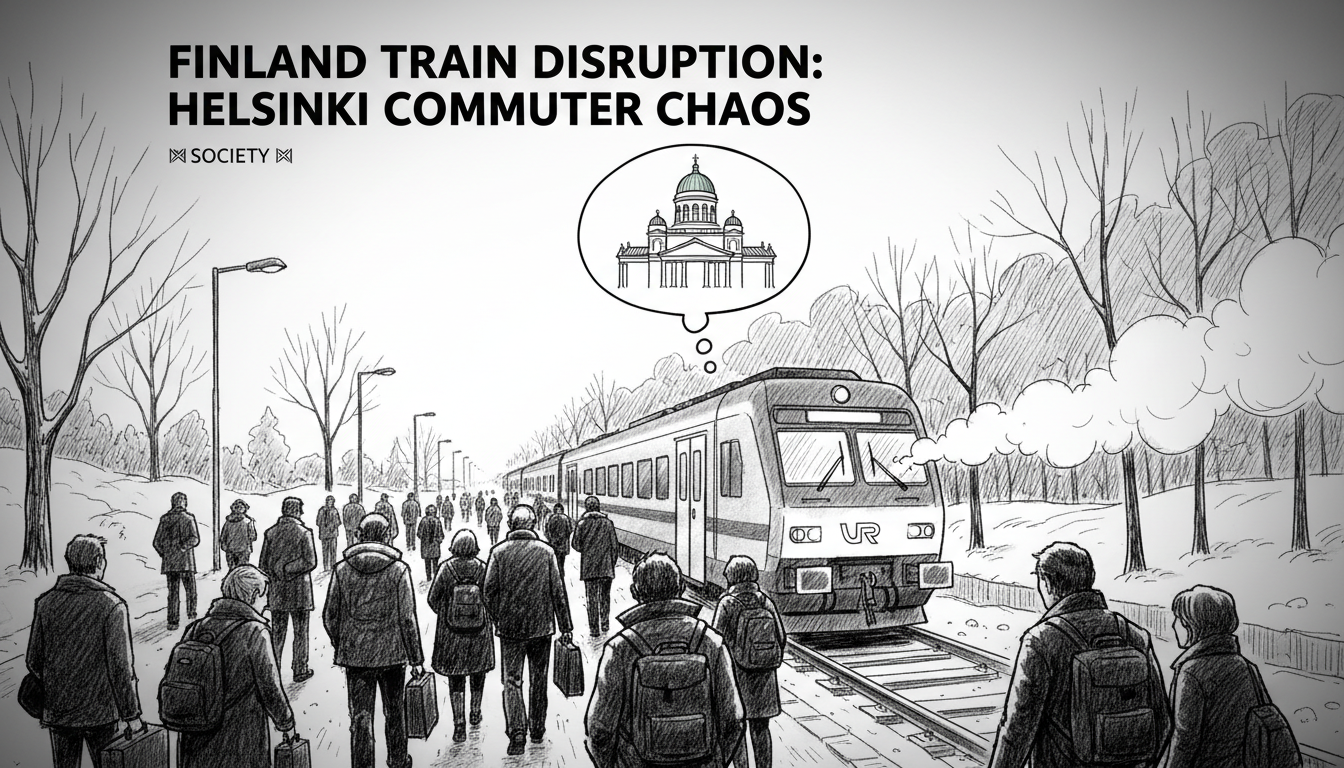
Finland's Helsinki commuter rail network faced severe disruption on Friday, January 2nd, after a track damage incident forced the cancellation of half of all services. The Helsinki Regional Transport Authority (HSL) confirmed that only every other K-line train would operate, with significant delays also affecting I and P line services. The disruption, which began on Thursday due to combined track damage and a switch failure, left thousands of commuters scrambling for alternative transport options on a busy post-holiday workday. This incident highlights the fragility of a system that serves approximately 70 million passengers annually across the capital region.
A Region Grinding to a Halt
The ripple effects of the cancellation of every other K-line train spread rapidly across the Helsinki metropolitan area. The K-line is a critical artery, connecting central Helsinki to eastern suburbs and cities like Kerava and Riihimäki. With the I and P lines also experiencing major deviations, the network's capacity was critically reduced during the morning rush hour. Commuters faced overcrowded platforms at central stations like Helsinki Central and Pasila, with replacement bus services struggling to accommodate the surge in demand. The disruption impacted the daily routines of residents in Helsinki, Espoo, Vantaa, and six other municipalities within the HSL service area.
Passenger frustration was palpable, compounded by what many described as insufficient real-time information. While HSL issued service alerts on its website and app, the chaotic scenes at stations suggested communication systems were overwhelmed. "The information flow broke down when people needed it most," said one commuter waiting at Tikkurila station. "You see a crowd, you know there's a problem, but no one can tell you when the next train might come or what bus to take instead." This gap between official alerts and on-the-ground reality is a recurring criticism during Finnish public transport failures.
Infrastructure Under Pressure
The immediate cause was identified as track damage and a faulty switch, a common yet disruptive combination. The Finnish Transport Infrastructure Agency (Väylävirasto) is responsible for maintaining the nation's rail tracks, while the state-owned operator VR runs the trains. This separation of duties can sometimes blur accountability during crises. Finland's railway infrastructure faces particular stress from extreme weather, with freezing temperatures, snow, and thaw cycles contributing to track wear and mechanical failures in switches and signaling equipment.
Experts point to a systemic need for increased and predictable infrastructure investment. "Preventive maintenance is key, but it requires funding and planning that looks decades ahead," said a railway engineering consultant familiar with the Nordic network, who spoke on condition of anonymity. "When you operate a system at or near capacity, as the Helsinki commuter network often does, any single point of failure creates disproportionate chaos. The focus must be on resilience and redundancy." The consultant emphasized that while such disruptions are not unique to Finland, the high public dependence on rail in the capital region makes their social and economic cost exceptionally high.
The Broader Transport Policy Context
This disruption occurs against a backdrop of ongoing political debate about Finland's transport funding. The government allocates resources to Väylävirasto, and competing priorities between long-distance rail, freight lines, and urban commuter networks exist. Helsinki's growth has consistently outpaced infrastructure upgrades on some rail corridors. Furthermore, Finland's climate goals, which heavily promote public transport use, are undermined when the system proves unreliable, potentially pushing commuters back towards private cars.
Politicians from the capital region are likely to use this incident to argue for a greater share of national infrastructure spending. "Every time the trains stop, the economic heartbeat of the nation skips a beat," said a Helsinki city councilor from the Green League. "We are trying to build a sustainable, dense urban region, but that model collapses if people cannot trust the rail network. This isn't just about convenience; it's about the viability of our climate and urban planning policies." The incident provides tangible evidence for arguments often made in budget negotiations in the Eduskunta, Finland's parliament.
Passenger Rights and Economic Impact
For affected passengers, the immediate question revolves around compensation. HSL's terms typically allow for the refund of a single ticket price in cases of significant delay, but season ticket holders have fewer clear options. The indirect economic impact is substantial, including lost productivity from delayed workers, missed appointments, and reduced spending in city centers. The service sector, which relies on punctual customer and staff arrivals, is particularly vulnerable to these sudden transport shocks.
The disruption also tests the interoperability of Helsinki's integrated public transport system. While buses, trams, and the metro attempted to absorb extra passengers, each has limited spare capacity during peak hours. The incident demonstrates that despite a unified payment system (HSL's travel card), the network's resilience depends on each mode's ability to support the others, which is often physically and logistically constrained.
Looking Down the Track
As service slowly returned to normal on Friday afternoon, the focus shifted to accountability and prevention. Väylävirasto and VR will conduct a standard post-incident review. The key outcomes to watch will be whether any specific maintenance lapse is identified and what procedural changes, if any, are recommended for crisis communication. For regular commuters, the event is a stark reminder of the system's vulnerabilities. It strengthens the public case for the massive ongoing investment projects, like the Helsinki-based Ring Rail Line and the planned cross-city tunnels, designed to add redundancy to the network.
Ultimately, the January 2nd disruption is more than a one-day inconvenience. It is a stress test for Finland's public transport philosophy. The country has made a strategic choice to concentrate population growth in the capital region supported by rail. Each failure of that rail system questions the wisdom of that choice and challenges the authorities to deliver the corresponding level of investment and operational excellence. The true measure of success will be how this incident translates into concrete actions that reduce the frequency and impact of the next inevitable disruption. Can Finland's infrastructure keep pace with its ambitions, or will commuters continue to pay the price for aging tracks and strained systems?