
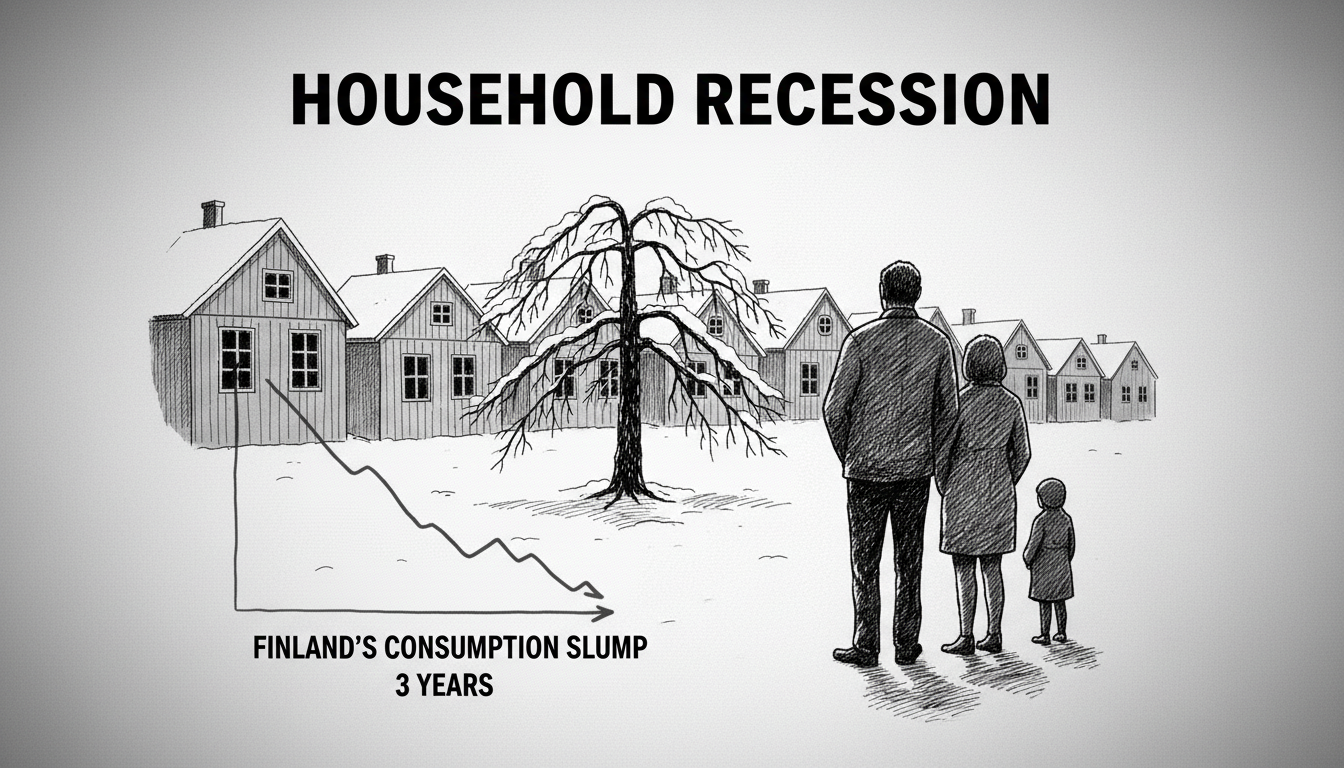
Finland's economy is being held back by a powerful but often invisible force: a household balance sheet recession. According to Hannu Nummiaro, the newly appointed chief economist at LähiTapiola, Finnish consumers are trapped in a cycle of increased saving and debt repayment, a phenomenon known as 'tasetaantuma,' which is stalling private consumption and prolonging the nation's economic stagnation. This domestic deleveraging is occurring despite a recent recovery in purchasing power, creating a paradox that complicates the path out of a technical recession that has seen the economy contract for four consecutive quarters.
Nummiaro, who began his role on January 1st, explains that a balance sheet recession shifts focus from income flows to the state of household assets and liabilities. "In my view, Finland is now in such a situation, but unlike in Japan and the United States, where the balance sheet recession also affected companies, here it is testing households," Nummiaro said in an analysis. "In real terms, private consumption has not risen in over three years, and for the entire last year the economy has been in a so-called technical recession."
The Core of the Contradiction
The central contradiction lies in the data. While nominal wages and purchasing power have begun to recover from the inflation shock, households are not spending. Instead, they are prioritizing repairing their balance sheets. The real value of savings has been severely eroded, and the inflation-adjusted value of housing—the largest asset for most Finns—has plummeted. Nummiaro points out that the rising cost of living "took such a big bite out of the purchasing power of Finns' savings that the real value of deposits has not even recovered by half." Compounding this, the inflation-adjusted value of homes and properties has fallen by as much as 25% from its pandemic-era peak.
This dual assault on wealth—depleted savings and deflating housing assets—has triggered a deep-seated caution. Consumers are choosing to rebuild financial buffers rather than spend, even as their monthly disposable income improves. This behavior makes traditional economic stimulus measures less effective, as increased income is simply saved, not circulated back into the economy.
A Historical Pattern with a Finnish Twist
The concept of a balance sheet recession is not new. Economists have used it to explain Japan's 'Lost Decade' and aspects of the 2008-2009 financial crisis in the United States. In those cases, both corporations and households were deleveraging. Finland's current episode, however, is notably concentrated in the household sector. The prolonged slump in private consumption, now exceeding three years, underscores how deeply this trend is rooted.
The psychological dimension is critical. Nummiaro highlights that consumption will only return to previous levels "when consumers again feel that the value of their savings and other assets is sufficient to meet life's surprises and an uncertain future." This sentiment is shaped by more than just interest rates or tax policies; it is a broad assessment of economic security in a world of geopolitical tension and shifting global trade patterns, particularly following the severance of key energy and trade ties with Russia.
Policy Challenges in a Deleveraging Economy
This situation presents a complex challenge for policymakers in Helsinki and at the European Central Bank. Standard monetary policy, which works by influencing borrowing costs and encouraging investment, can have a muted effect when the primary goal of economic actors is to pay down debt, not take on new loans. Fiscal policy, such as government spending or tax cuts, can provide a direct boost to demand, but its impact may be diluted if a significant portion of any financial relief is funneled into savings rather than consumption.
The debate among economists is sharp. Some argue for aggressive public spending to jump-start growth and pull households out of their defensive posture through increased employment and confidence. Others caution that this could lead to unsustainable public debt without addressing the underlying weakness in household balance sheets, suggesting that a period of adjustment, however painful, is necessary. The Finnish government's upcoming budget framework will be a key test of its chosen strategy.
The Path Forward: Housing and Investment Returns
The duration of Finland's household-led balance sheet recession hinges on two main factors, according to Nummiaro. First is the trajectory of housing prices. A stabilization or recovery in the property market would directly improve perceived household wealth, potentially unlocking consumption. Second is the ability of households to generate returns on their rebuilt savings through investment. If safe, reliable investment avenues provide growth, confidence could return more swiftly.
Nummiaro estimates that this household balance sheet recession "can slow down the economy for a long time but not forever." The endpoint is not predetermined by a calendar but by the restoration of financial confidence. For now, the data shows a nation cautiously rebuilding its foundations. Bank accounts may hold more nominal euros than ever, but the real value of that security—the psychological benchmark that drives economic decisions—remains diminished.
This internal rebalancing acts as a powerful drag, separating Finland's experience from other Eurozone nations facing different inflationary or growth dynamics. It suggests the recovery will be domestically driven and potentially slower than headline GDP figures might indicate once growth resumes. The true end of the recession will come not with a single quarter of growth, but when Finnish households collectively decide their balance sheets are once again strong enough to face the future.