
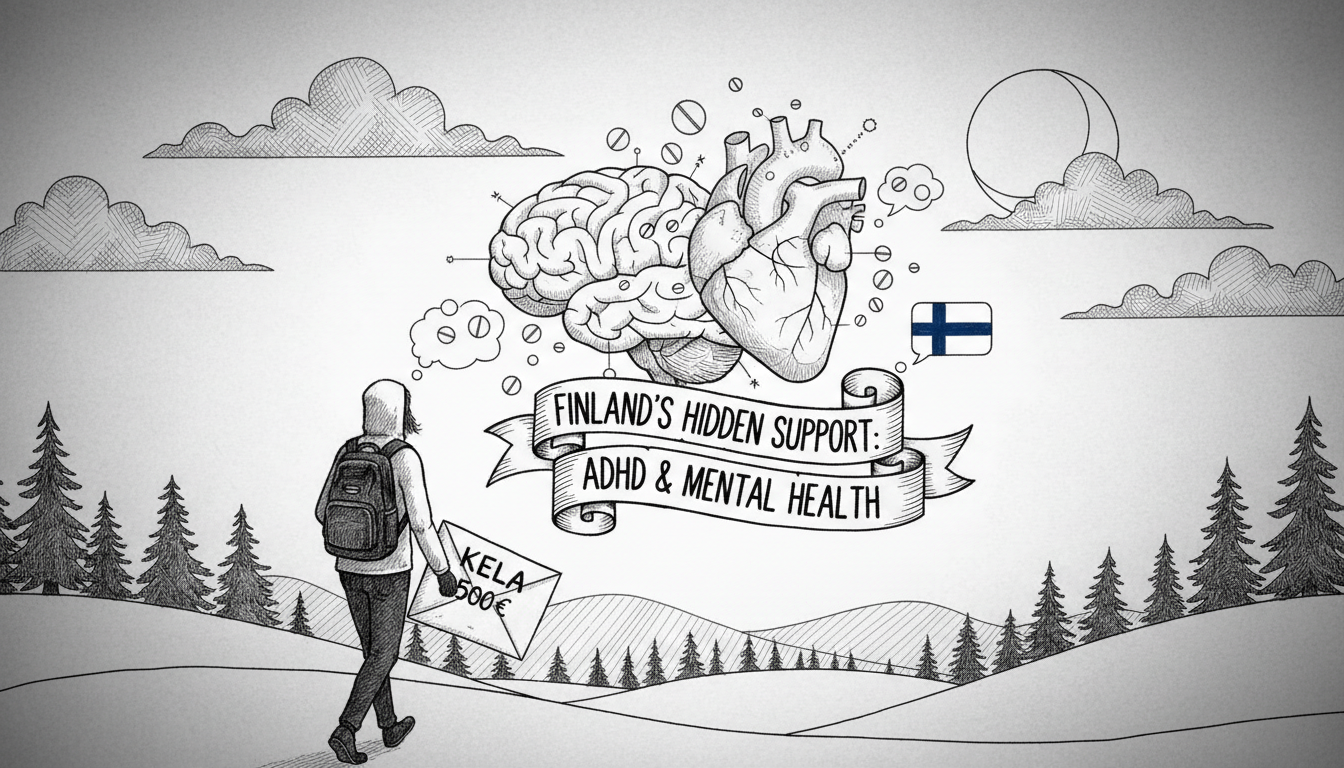
Finland's social security system offers a tax-free disability allowance of up to 500 euros per month for conditions like ADHD and mental health disorders, yet thousands of eligible residents remain unaware of their right to claim it. This benefit, known as vammaistuki, is designed to offset the extra costs and burdens of daily life for those with long-term health challenges, but a lack of public awareness and a complex application process create a significant gap between policy and practice.
A Benefit Hidden in Plain Sight
The core paradox of this Kela support is its simultaneous simplicity and obscurity. The allowance is tax-free and income-independent, meaning a recipient's earnings from work or other benefits do not reduce it. It can be granted based on an individual's own need for increased assistance in daily activities or due to the extra care required by a close relative, such as a child with a neurodevelopmental condition. Despite its broad potential reach, experts note that many who qualify never submit an application. They may not know the benefit exists, assume their income disqualifies them, or feel daunted by the medical evidence required. "The system is built on the principle of application; benefits are not automatically granted," explains a social policy researcher from the University of Helsinki. "This creates an inherent inequality where the most informed and persistent individuals access support, while others in equal need miss out."
Recent data highlights a dramatic surge in uptake within specific demographics, suggesting awareness is spreading unevenly. In certain family types with children, the number of recipients has skyrocketed by 349 percent over a short period. This spike is widely attributed to growing diagnosis rates of conditions like ADHD and autism, coupled with targeted information sharing within parent support networks and on social media. The trend reveals the benefit's critical role for families managing neurodiversity, but also underscores that knowledge of it remains compartmentalized rather than universal.
Navigating the Application Maze
The path to securing the disability allowance hinges on one central requirement: demonstrating a significant and long-term increase in daily expenses or effort due to a health condition. A diagnosis alone is insufficient. The applicant, often with a doctor's assistance, must concretely describe how their condition—be it ADHD, chronic depression, anxiety, or a physical disability—translates into tangible extra costs or labor. This could include the need for specialized tools, therapy not fully covered by public health, more expensive dietary requirements, or the sheer additional time and energy required for basic tasks that others perform effortlessly.
Kela's decision-makers assess the permanence and severity of this increased burden. The maximum monthly support, around 500 euros, is reserved for the most substantial cases. The application process itself is frequently cited as a major barrier. It requires gathering detailed medical statements, filling out extensive forms that ask for personal and sometimes distressing details about one's limitations, and navigating Kela's bureaucratic protocols. For someone already struggling with the demands of a mental health condition or the executive function challenges associated with ADHD, this process can feel insurmountable. "The irony is palpable," notes a disability rights advocate. "The system designed to help those facing extra burdens places a considerable burden of proof and procedure right at the doorstep."
The EU Context and National Policy
Finland's disability allowance exists within a broader European framework of social protection. While social security remains primarily a national competence, the EU actively promotes the social inclusion and rights of persons with disabilities through strategies like the European Disability Rights Strategy 2021-2030. Finland's provision of a tax-free, income-independent benefit is generally viewed as progressive within this context, aligning with EU goals of deinstitutionalization and independent living. However, the low uptake rate for eligible individuals points to a common challenge across member states: the gap between legislated rights and their real-world accessibility.
Domestically, the benefit sits at the intersection of healthcare and social policy, two pillars of the Finnish welfare state. Its existence is rarely contested politically; it is seen as a non-controversial fulfillment of the state's duty to its citizens. The political discussions, rather, focus on the adequacy of the amount in the face of inflation and the efficiency of Kela's administration. Recent government coalitions have grappled with balancing welfare spending against economic constraints, but direct attacks on this specific allowance are uncommon. The real political failure, critics argue, is the continued lack of investment in proactive information campaigns and application assistance to ensure the policy fulfills its intended purpose.
A Silent Struggle for Many Families
The human impact of this unseen support is most acute in Finnish homes. For a parent of a child with severe ADHD, the 500 euros might cover the cost of a crucial behavioral therapy session, specialized learning materials, or simply allow one parent to reduce working hours to manage the child's needs. For an adult with debilitating anxiety, it could mean the ability to afford a cleaner or pre-prepared meals during periods of crisis, preventing a total functional collapse. The benefit is not about replacing income but about providing the financial means to manage a reality that is inherently more expensive and exhausting.
Without this support, families and individuals absorb these costs themselves, leading to increased financial stress, caregiver burnout, and worsened health outcomes. The allowance can be the difference between coping and crisis, between participation in society and isolation. Its tax-free nature is crucial, as it ensures the support is a net gain, not a calculation tangled in other benefit cliffs. Recipients do not need to nervously monitor their monthly earnings, a feature that provides rare stability for those with unpredictable health and capacities.
Closing the Awareness Gap
Addressing the low uptake requires a multi-pronged approach. Experts unanimously call for Kela and the Ministry of Social Affairs and Health to launch clear, plain-language information campaigns. This information should be disseminated not just online, but through healthcare centers, schools, and mental health organizations where those in need are already in contact with the system. Simplifying the application form and providing clearer guidelines for medical professionals on how to write supporting statements would lower the procedural hurdle.
Perhaps most importantly, there is a need to destigmatize the benefit. The reluctance to apply is sometimes rooted in not identifying with the label "disabled" or fearing societal judgment. Reframing the allowance as a legitimate right for extra costs incurred by a medical condition, rather than a welfare handout, is essential. Peer support networks, which have driven the 349% increase in some family groups, are powerful tools in this regard. When one parent in a support group successfully applies, they demystify the process for a dozen others.
Finland's hidden 500-euro support represents both the strength and the soft underbelly of its welfare model. The strength is a system designed to provide concrete, meaningful aid without means-testing it into irrelevance. The weakness is a passive bureaucracy that expects citizens to navigate complex gates to access their rights. As diagnoses of neurodevelopmental and mental health conditions continue to rise, bridging this gap is not just an administrative task, but a fundamental question of social equity. How many more must struggle in silence before finding the key to a benefit that was theirs all along?