
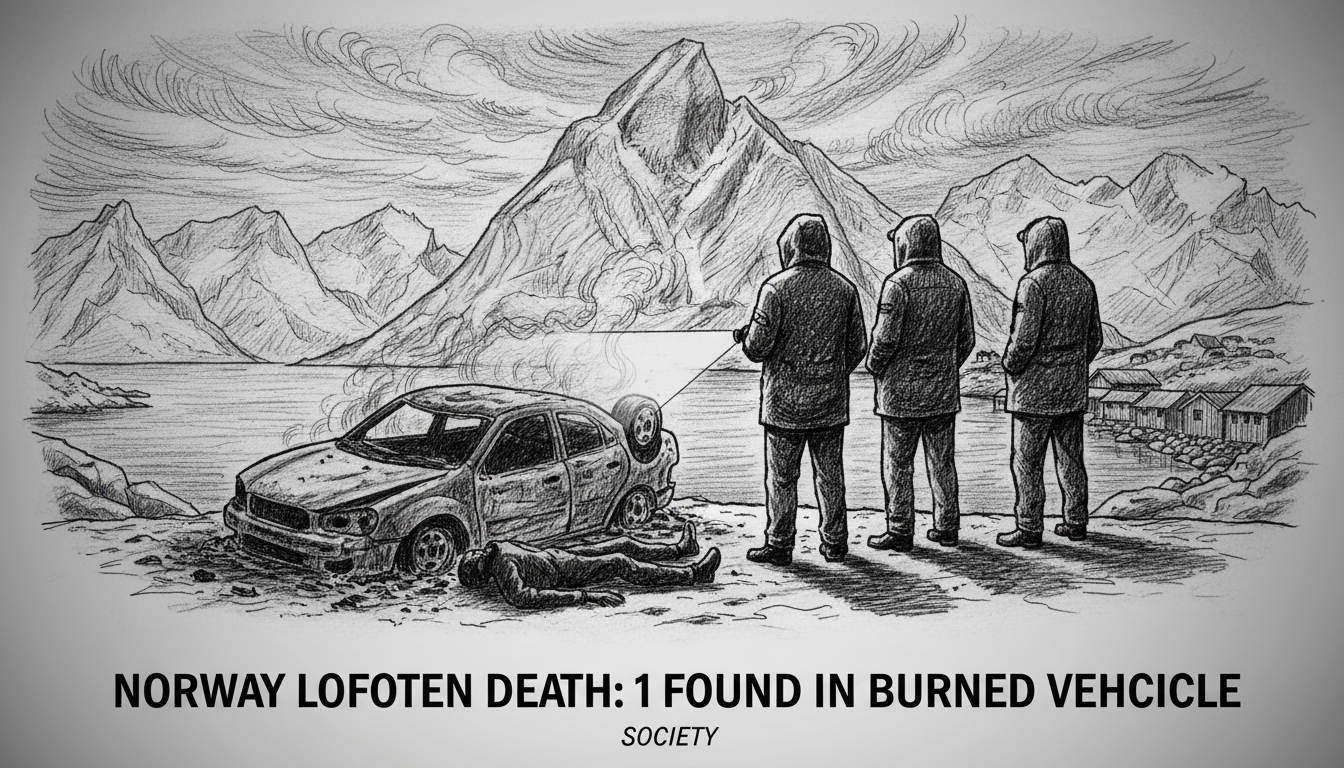
Norway's Lofoten archipelago is the scene of a police investigation after a person was found dead in a burned vehicle. The discovery was made in the early hours, with the car described as significantly damaged by fire. Police are now working to identify both the deceased and the vehicle's registered owner, a process complicated by the fire's intensity.
"The scene is quite extensively burned, so we are conducting investigations to try to identify who the car may be registered to," said Police Prosecutor Eirik Magnus Blomli. The body of the deceased has been sent for an autopsy, a standard procedure in such cases. Authorities have not released the exact location within Lofoten where the vehicle was found, nor have they indicated whether foul play is suspected.
A Remote and Rugged Investigation
The incident presents distinct challenges for the Nordland Police District. Lofoten's geography, a chain of islands connected by bridges and ferries off Norway's northwestern coast, can complicate emergency response and forensic work. While the region has a well-developed infrastructure for its size, some areas remain remote. Transporting specialist equipment and personnel to certain locations can take time, especially outside the peak summer tourist season.
"Investigations in remote areas always require more logistical planning," said a former police investigator with experience in Northern Norway, who spoke on background. "A fire scene, in particular, requires careful forensic examination to determine origin and cause. The condition of the vehicle suggests this will be a meticulous process." The police have not stated whether the fire originated inside or outside the vehicle, a key detail that will guide the investigation's direction.
The Dual Challenge of Identification
Police Prosecutor Blomli's statement highlights the immediate hurdle: identification. The process is two-fold. First, investigators must work to identify the vehicle itself through chassis or engine numbers that may have survived the fire. This will lead them to the registered owner. Second, forensic pathologists will work to identify the deceased through dental records, DNA, or any personal effects that may have been partially preserved.
This dual-track investigation is standard but crucial. Confirming the identity of the deceased is the first step toward notifying next of kin and understanding the circumstances that led to the tragedy. The police have not released the gender or approximate age of the deceased, indicating that this level of identification has not yet been established. The autopsy results will be pivotal in determining the cause of death and may provide initial clues about whether it occurred before, during, or after the fire.
Life and Tourism in Lofoten
The news casts a shadow over Lofoten, a region whose economy and identity are deeply tied to its breathtaking natural beauty. Known for its dramatic mountains rising directly from the sea, picturesque fishing villages like Reine and Nusfjord, and phenomena like the Midnight Sun and Northern Lights, Lofoten draws hundreds of thousands of visitors annually. This influx peaks in summer but continues year-round with dedicated hikers, climbers, and aurora hunters.
With tourism comes increased traffic on the region's roads, which include narrow stretches along fjords and mountain passes. While generally safe, the combination of unfamiliar drivers, potentially challenging weather conditions, and winding roads can increase risk. Local authorities consistently run safety campaigns aimed at tourists, particularly regarding responsible driving and preparedness for rapidly changing Arctic weather. It is too early to know if this incident is related to tourism, a local resident, or other factors.
The Path Forward for Police
The Nordland Police District's immediate focus will be on completing the forensic examination of the scene. This involves mapping the area, collecting any physical evidence, and documenting the vehicle's position and condition. Specialized technicians may be brought in from larger centers like Bodø or Tromsø to assist. Concurrently, the autopsy findings will be integrated into the investigation.
Depending on the findings, the case could be classified as an accident, a tragic incident with no criminal intent, or a potential crime. The police have been careful not to speculate. Their public communications so far have been factual and focused on the ongoing process, which is typical for Norwegian police in the early stages of a sensitive investigation. Further updates will likely hinge on the results of the technical and medical examinations.
A Community Awaits Answers
For the tight-knit communities of Lofoten, an event like this resonates deeply. The population across the archipelago is relatively small, and news travels quickly. The lack of an identified person means a cloud of uncertainty hangs over several municipalities until the police can provide clarity. Local leaders and community members will be awaiting information, hoping for a swift resolution for the sake of any affected family.
The tragedy is a stark reminder of the vulnerabilities that exist even in places of immense beauty and relative safety. It underscores the vital, often difficult, work of police and emergency services in Norway's vast and varied geography. As the investigation continues quietly behind the scenes, the iconic landscapes of Lofoten hold a new, somber story—one that authorities are now tasked with carefully and compassionately unraveling. The ultimate question remains: what series of events led to a life ending in such a devastating way on the edge of the Arctic Circle?