
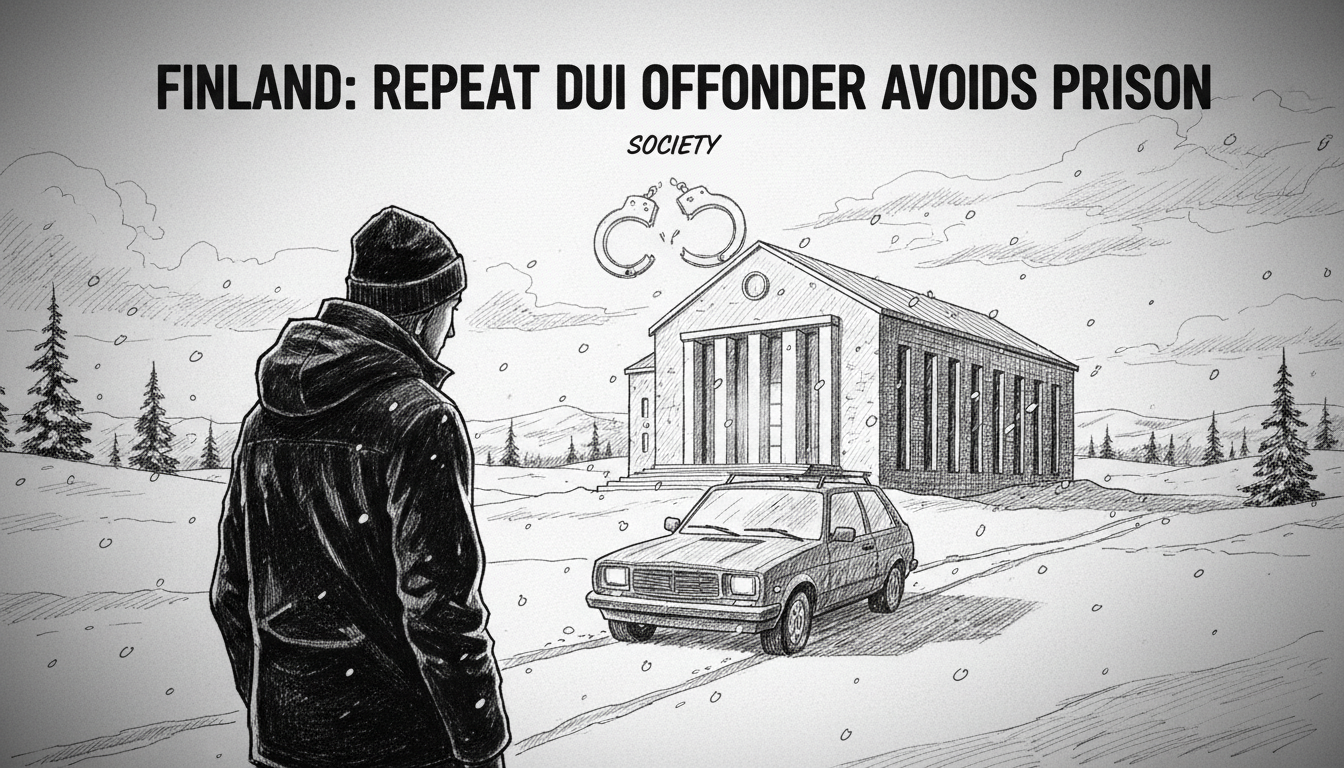
Finland recorded 12,500 drunk driving cases in 2022, yet a recent court decision highlights the complex reality behind the statistics. A man in his sixties, convicted of four separate driving under the influence offenses within a short period—three of them aggravated—has been sentenced to community service instead of prison. The Etelä-Savon District Court ruling involving incidents in Mikkeli and Pieksämäki puts a spotlight on Finland's sentencing philosophy for repeat traffic offenders, balancing punishment with rehabilitation in a system known for its strict laws.
A Case That Tests Sentencing Philosophy
The court handled four distinct rattijuopumus charges against the same defendant. Three met the threshold for törkeä rattijuopumus, or aggravated drunk driving. In Finnish law, this typically requires a blood alcohol content of 0.12% or higher, double the standard legal limit of 0.05%. The series of offenses, committed within a narrow timeframe, demonstrates a pattern of repeated criminal behavior. Despite the severity and frequency, the final sentence was yhdyskuntapalvelu, or unpaid community service work. This outcome is permitted under Finnish law for certain crimes where the prison term would otherwise be under eight months and the offender is deemed suitable for non-custodial rehabilitation. The sentence aims to provide a punitive yet constructive consequence that maintains the offender's ties to society.
Legal experts note that such decisions are not uncommon but are always case-specific. "The court considers the totality of the circumstances," explains a Helsinki-based legal scholar who focuses on criminal sentencing. "This includes the precise details of the offenses, the defendant's level of impairment, any damages or risks caused, and the individual's background and susceptibility to rehabilitation. A string of high-BAC offenses would weigh heavily, but the court's ultimate goal is to prevent future crime." The use of community service is governed by the 2004 Community Service Act, which mandates that the work must be beneficial to the community and supervised by probation officials.
The Steady Decline of Drunk Driving
Finland's approach to combating drunk driving is often cited as a success story in public safety policy. The number of incidents has plummeted over recent decades. In the early 1990s, police recorded over 30,000 DUI offenses annually. By 2022, that figure had fallen to 12,500. This dramatic decrease is attributed to a multi-pronged strategy involving strict legislation, near-zero-tolerance social attitudes, and persistent enforcement. The introduction of day-fines scaled to income (päiväsakko) for lesser offenses and mandatory prison sentences for aggravated cases created a strong deterrent framework.
Public awareness campaigns have also played a critical role. Organizations like Liikenneturva (The Finnish Road Safety Council) run hard-hitting campaigns highlighting the consequences of impaired driving. Furthermore, Finland employs widespread random breath-testing by police, a practice upheld by the European Court of Human Rights. This creates a tangible sense of risk for would-be offenders. "The cultural shift has been profound," says a traffic safety researcher. "Driving after even one drink is now socially unacceptable for most Finns. The challenge lies with a smaller, persistent group of repeat offenders who are less influenced by these broad societal norms."
The Persistent Problem of Repeat Offenders
While overall numbers are down, the case in Etelä-Savo underscores a lingering challenge: the hard core of repeat offenders. These individuals, often struggling with substance abuse issues, account for a disproportionate share of DUI incidents and pose a significant risk to road safety. The debate among policymakers and experts centers on the most effective response. Is the primary goal punishment, rehabilitation, or the protection of the public? The community service sentence leans toward rehabilitation, but critics argue it may not adequately address the underlying addiction problem or provide sufficient deterrence for someone who has already been caught multiple times.
Some advocate for the wider use of technological solutions. Alcohol interlock devices, which require a sober breath sample to start a vehicle, are already used in Finland. Their use can be mandated as a condition of a driving license reinstatement for convicted drunk drivers. Proposals exist to make them compulsory for all repeat offenders, a practice adopted in some other Nordic regions. "The interlock is a tool that directly separates drinking from driving," an expert from the Finnish Transport and Communications Agency Traficom noted in a recent seminar. "It protects the public during the rehabilitation period, which community service alone does not."
Others point to the need for more integrated health and social services interventions. A sentence of community service is often combined with probation supervision, which can include mandatory substance abuse assessment and treatment programs. The effectiveness hinges on the quality and availability of these support services across different municipalities, from Helsinki to more rural areas like Etelä-Savo.
EU Context and National Sentencing
Finland's legal approach operates within broader European Union frameworks on road safety and judicial cooperation. While DUI laws remain a national competence, the EU has pushed for stronger measures against cross-border traffic offenders through directives like the 2015 Cross-Border Enforcement Directive. Finland's strict regime is often at the stricter end of the European spectrum. Comparing sentences across borders is complex, but Finland's use of community service for non-violent crimes aligns with wider Scandinavian penal principles that emphasize rehabilitation over incarceration where possible.
This philosophy, however, is constantly tested in the court of public opinion, especially in high-profile traffic cases. When a repeat offender receives a non-custodial sentence, it can provoke public concern about the adequacy of justice. The Ministry of Justice periodically reviews sentencing guidelines to ensure they reflect societal values and public safety needs. The ongoing balance is between a merciful, rehabilitative system and one that the public trusts to keep dangerous drivers off the roads.
A Look Ahead at Policy and Prevention
The Etelä-Savo case is a single data point, but it feeds into a larger national conversation. As Finland aims for its Vision Zero goal of zero road deaths and serious injuries, tackling repeat impaired driving remains a key frontier. Future policy measures may include stricter mandatory minimums for multiple aggravated offenses, increased funding for mandatory treatment programs tied to sentencing, and expanded interlock programs. Legislative proposals are frequently discussed in the Eduskunta, Finland's parliament, where parties across the spectrum agree on the goal but sometimes differ on the methods.
The core question persists: can a system be both relentlessly strict in its deterrents and meaningfully rehabilitative in its sentencing for those who repeatedly breach its rules? The community service sentence handed down in Mikkeli suggests one judicial answer. Its true test will be whether this individual, and others like him, finally stop getting behind the wheel after drinking. The effectiveness of that sentence will only be measured by the absence of a future headline.