
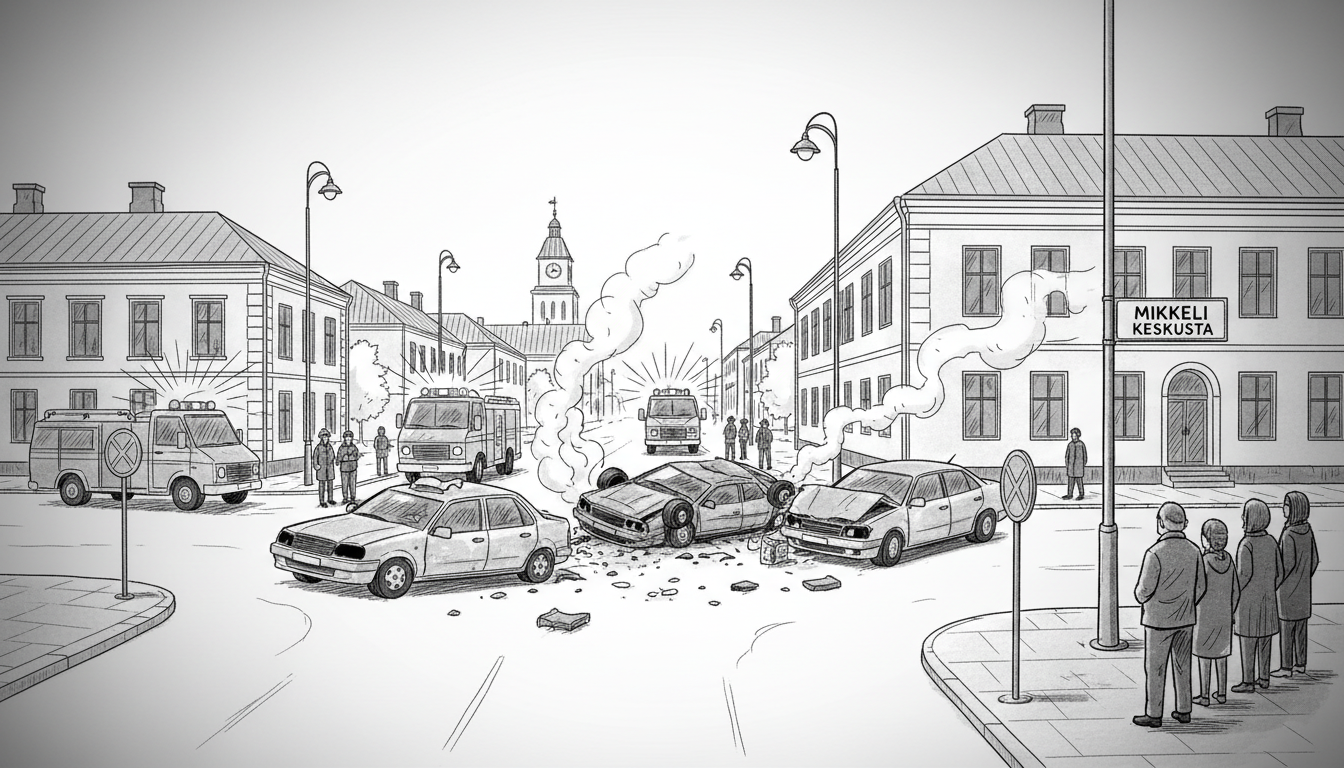
A three-car collision occurred in central Mikkeli on Thursday evening, rendering two vehicles undrivable. The accident happened at the intersection of Savilahdenkatu and Yrjönkatu. Three individuals were involved, but none sustained injuries according to rescue service reports. Emergency services managed traffic flow and cleaned the accident scene. The cause remains under investigation. Janne Vehviläinen, the on-duty fire chief for the South Savo Rescue Department, provided initial observations. He said one vehicle entered the intersection and collided with another, with a third car then driving into the rear. The investigation into the precise sequence and contributing factors is ongoing.
This incident highlights ongoing traffic safety discussions within Finnish municipalities. Mikkeli, as the capital of the South Savo region, serves as a key transport hub. Local government officials frequently debate urban planning and traffic calming measures. Such debates occur against a backdrop of national road safety targets. Finland has long pursued a 'Vision Zero' policy aiming to eliminate traffic fatalities and serious injuries. This policy framework influences municipal decisions on intersection design and speed limits.
Accidents like this one prompt reviews of specific high-traffic junctions. The intersection of Savilahdenkatu and Yrjönkatu is a central point in Mikkeli's street network. It connects residential areas with commercial districts. Local police and urban planners often analyze collision data to identify patterns. They look for common factors like visibility issues, signage clarity, or driver behavior at particular times of day. The lack of serious injuries in this case is fortunate, but it does not preclude a formal safety assessment.
The response by Etelä-Savon pelastuslaitos (South Savo Rescue Department) follows standard Finnish emergency protocols. Rescue services in Finland integrate firefighting, emergency medical services, and technical rescue. Their prompt arrival and scene management are typical of the country's decentralized emergency response system. Each municipality contributes to funding and organizing these services. This structure ensures coverage even in less populous regions like South Savo.
For international readers and residents, understanding local context is key. Finnish traffic law places a strong emphasis on driver responsibility and insurance. All motorists must carry mandatory third-party liability insurance. In no-injury collisions, drivers typically exchange information and notify their insurance companies. Police involvement usually increases if there are injuries, suspicion of intoxication, or significant traffic disruption. The efficient cleanup in Mikkeli minimized disruption, which is a standard priority.
This event is a routine traffic incident, but it connects to broader Finnish societal values. Safety, efficiency, and rule-following are deeply ingrained. The immediate and coordinated response by authorities reflects this. It also shows the high level of public trust in institutions like the rescue services. For expats, it's a reminder of the comprehensive social systems in place, even for mundane events. The system is designed to handle incidents methodically, from initial response to final insurance settlement.
Looking ahead, the investigation's findings may influence local policy. If a specific hazard is identified at that intersection, the city council could propose modifications. Such proposals would go through the standard municipal budgeting and planning process. It is a clear example of how local governance operates in Finland, with even minor incidents potentially informing public works decisions. The process is deliberate, evidence-based, and transparent, characteristic of the Nordic model of administration.