
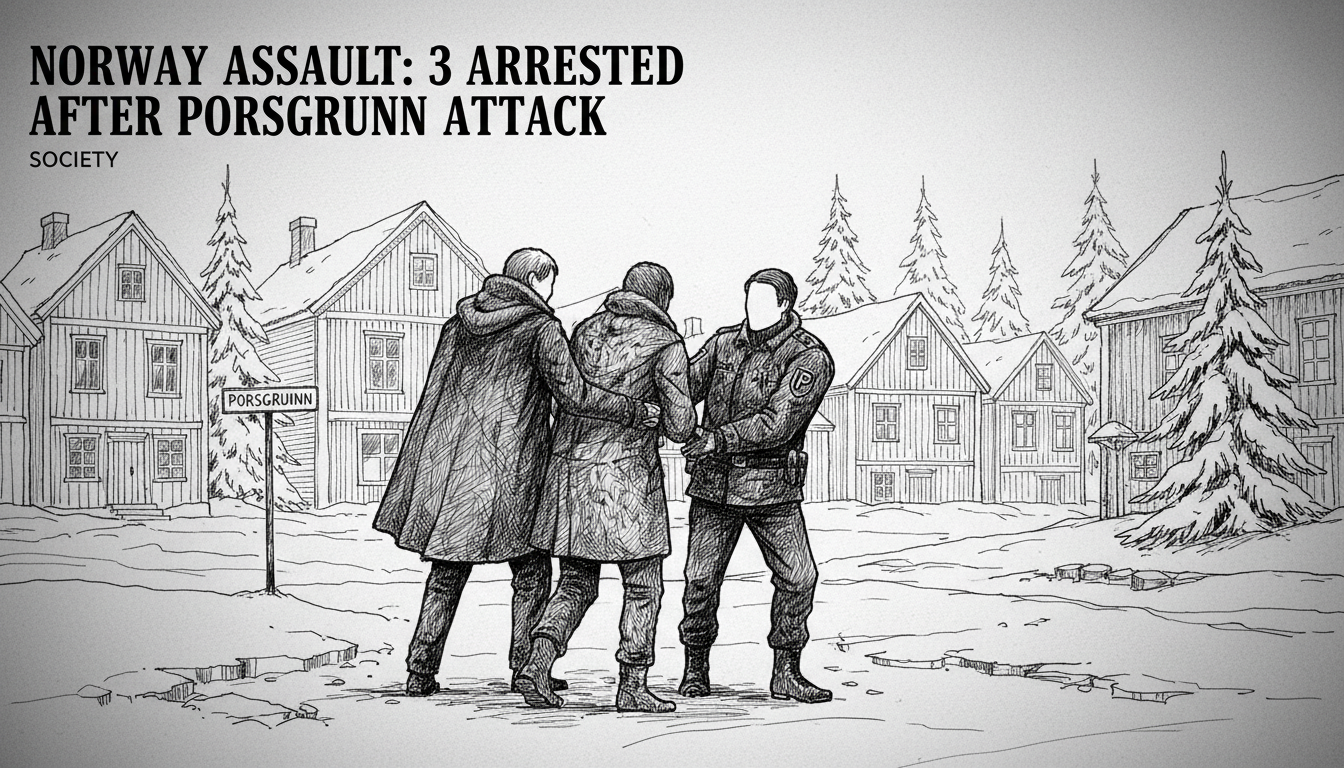
Norway police arrested three young men after a violent assault in Porsgrunn left a man hospitalized with head and facial injuries. The incident occurred on Slottsbrugata in the early hours of Sunday morning, marking a serious breach of public order in the industrial Telemark city. Emergency services received the alert at 03:27 via the AMK coordination center, prompting a rapid police response that led to the swift apprehension of the suspects.
Operational commander Tom Richard Skuggedal of the South-East Police District detailed the attack in an official police log. "The victim sustained injuries to the head and face after being kicked while he was lying on the ground," Skuggedal wrote. "The victim was driven to the hospital." The exact extent of the man's injuries remains unknown, and his current condition has not been disclosed by authorities. The three arrested individuals are currently in custody as the investigation proceeds.
A Quiet Street Disrupted by Violence
Slottsbrugata, the location of the assault, is a central street in Porsgrunn, a municipality of approximately 37,000 residents known for its deep industrial roots in shipbuilding and the historic Porsgrund porcelain factory. The city forms part of the wider Grenland region in Vestfold og Telemark county. Incidents of this severity draw significant attention precisely because they contrast with Norway's generally low levels of violent crime. Statistics from the Norwegian Council for Crime Prevention (KRÅD) consistently show Norway has one of the lowest homicide rates in the world, typically below 0.5 per 100,000 inhabitants. Serious assaults, while not commonplace, are most frequently linked to specific risk factors.
"When we see violent incidents like this, especially involving multiple perpetrators and occurring late at night, we often find a connection to intoxication, either from alcohol or other substances," says Kari Hauge, a senior researcher at the University of Oslo's Department of Criminology. "Norway's low crime rate is a real strength, but it doesn't mean violence is absent. It tends to cluster in specific contexts—around nightlife, in certain social settings, or within limited criminal milieus." Hauge notes that the police's ability to quickly arrest suspects is a positive indicator of effective response protocols, but the underlying causes of such confrontations require continued social and preventive work.
The Anatomy of a Nighttime Police Response
The police log entry provides a clinical snapshot of the incident's aftermath. The specific mention of the victim being kicked while on the ground is a legally significant detail that prosecutors may use to argue for a more severe charge of grievous bodily harm. Norwegian law treats the vulnerability of a fallen person as an aggravating circumstance. The use of the AMK (Akuttmedisinsk Kommunikasjonssentral) system for the initial alert is standard procedure. This center coordinates between callers, ambulance services, and police, ensuring a unified emergency response. The 03:27 timestamp places the event squarely within the highest-risk period for public order incidents, typically in the hours following the closure of bars and nightclubs.
Local police have not released the ages of the arrested men, referring to them only as "young men." They have also not commented on a possible motive or whether the victim and the suspects were known to each other. The next steps in the process will involve formal questioning of the suspects, who have the right to a defense lawyer. Police will also seek to interview the victim as soon as his medical condition allows. Evidence collection on Slottsbrugata, including any CCTV footage from nearby buildings, will be crucial for building the case.
Porsgrunn in a National Context
For residents of Porsgrunn, news of a violent assault in the city center is unsettling. The city's identity is intertwined with industry, innovation, and a strong sense of community, factors that normally contribute to social stability. Nationally, Norway invests heavily in preventive policing and social welfare systems designed to mitigate the root causes of crime. The country's prison system focuses on rehabilitation rather than pure punishment. However, experts caution that no society is immune to spontaneous violence, particularly when alcohol is involved.
"We have to be careful not to over-interpret a single event," Hauge emphasizes. "One assault does not signal a crime wave. What it does signal is that the conditions for violence—disinhibition, conflict, opportunity—can arise anywhere, even in Norway's safest communities. The key metrics to watch are long-term trends in police reports and victim surveys." Those national surveys have shown relative stability in rates of exposure to violence over the past decade, with a slight increase reported among young men in urban areas.
The Road Ahead for Justice and Prevention
The immediate legal pathway is clear. The South-East Police District will forward its investigation to the Norwegian Prosecuting Authority. Prosecutors will decide whether to charge the suspects with assault or the more serious charge of aggravated assault, which carries a maximum prison sentence of six years, or even longer if the victim's injuries prove to be life-altering. The suspects can be held in custody for an initial period while the investigation continues if police argue they are a flight risk or may interfere with evidence.
Beyond the courtroom, the incident may prompt local discussions in Porsgrunn. Municipal authorities often work with police on nighttime safety initiatives, such as improving street lighting in central areas or funding outreach patrols that mix social workers with security personnel. These patrols, known in some Norwegian cities as "Byvakter" or "Utekontakter," aim to de-escalate situations before they turn violent and to connect intoxicated or vulnerable individuals with help rather than entering them into the justice system.
For now, the community awaits updates on the victim's health and the formal charges against the three arrested men. The case serves as a stark reminder that public safety requires constant vigilance, even in nations celebrated for their low crime statistics. The efficient police response demonstrates system readiness, but the human cost of the assault—the pain, fear, and trauma—lingers long after the suspects are apprehended. As Porsgrunn moves forward, the balance between maintaining its peaceful character and acknowledging the reality of isolated violence will be a quiet conversation held in homes, community meetings, and the offices of local government. The true test is not just in solving this crime, but in understanding what, if anything, could have prevented it.