
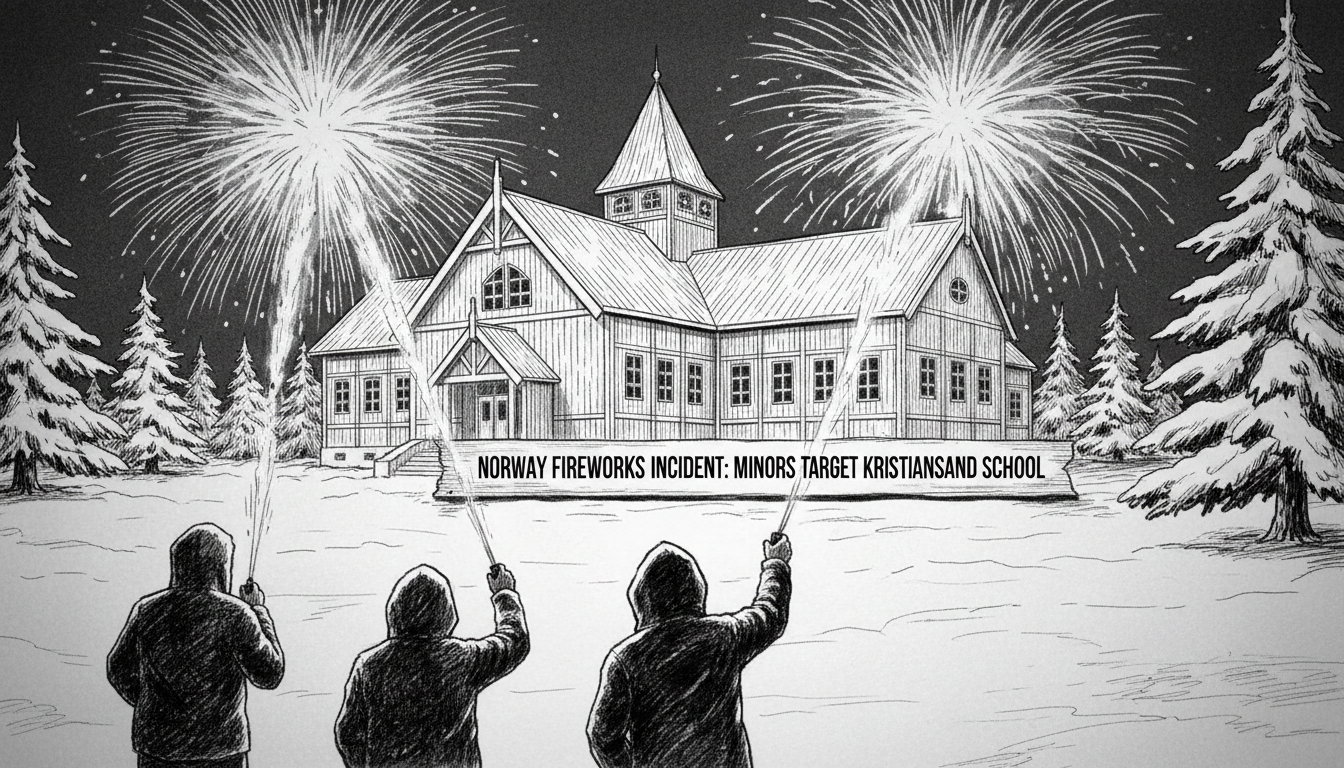
Norway police have detained three minors after fireworks were launched at a school building in Kristiansand. The incident occurred around 7:45 PM at a school in the Lund borough. Police operations leader Knut Odde confirmed the youths' parents were notified and a small quantity of fireworks was confiscated. No damage to the school property was found. This event highlights ongoing concerns about underage access to pyrotechnics outside the sanctioned New Year period.
A Disruptive Evening in Lund
Police responded swiftly to reports of youths firing rockets at a school building and inside a bicycle shed. The Lund borough, typically a quiet residential area of Norway's fifth-largest city, was disrupted by the illegal activity. Authorities quickly identified and secured the three individuals involved. All were confirmed to be under the age of 18, the legal threshold for purchasing and using consumer fireworks in Norway. The timing, early on a weekday evening, suggests the act was planned rather than a spontaneous misuse of leftover New Year's stock.
Knut Odde's statement was measured. "All three are minors, and guardians have been notified," he said. "They were relieved of minor quantities of fireworks." The police emphasis on the small amount seized indicates this was likely a limited stash, not large-scale industrial pyrotechnics. The fact that no damage was inflicted on the school building is a fortunate outcome in a situation with clear potential for serious property damage or injury.
The Legal Framework for Pyrotechnics in Norway
Norwegian law strictly regulates fireworks. The sale of category F1, F2, and F3 fireworks to consumers is permitted only from December 27 to 31 each year. Their use is generally allowed from December 31 at 18:00 to January 1 at 02:00, though municipalities can set stricter local rules. The legal age for purchase and use is 18. This incident in Kristiansand, occurring months outside this window, immediately raises questions about the source of the fireworks. Were they old stock improperly stored, or were they obtained through illegal channels?
Violations of the Fireworks Regulations can result in fines. For minors, the responsibility often extends to parents or guardians, who can be held financially liable for any damages caused by their children. The police's immediate contact with the parents underscores this legal link. In cases involving deliberate vandalism or endangerment, charges beyond simple fireworks violations could be considered, though the police have not indicated this so far.
Expert Perspective on Risk and Responsibility
Safety experts consistently warn of the dangers fireworks pose in untrained hands. "Fireworks are explosive devices, not toys," says a former advisor to the Norwegian Directorate for Civil Protection (DSB). "When used by minors without supervision, the risks of severe burns, eye injuries, and hearing damage skyrocket. Aiming them at a structure introduces the risk of fire, especially if they enter an opening or strike flammable material."
The psychological and social motivations behind such an act are also a concern. Targeting a school building can be seen as a symbolic attack on authority. Child and youth psychology professionals suggest these actions often stem from boredom, a desire for thrill-seeking, or peer pressure within small groups. The lack of permanent damage may indicate the intent was to create a disturbance rather than destroy property, but the line between the two is perilously thin.
Parental responsibility is a key theme in prevention. "It's not enough to just not buy your children fireworks," the safety expert adds. "Parents need to be aware of what their children have access to and store any legal fireworks from New Year's securely. They also have a role in educating about the very real consequences of misuse, both legal and physical."
A Broader Pattern of Youth and Pyrotechnics
While this single event in Kristiansand is minor in scale, it fits a recurring pattern across Norway, particularly in the weeks surrounding New Year's Eve. Police and fire services annually report numerous incidents involving underage individuals. These range from nuisance noise and premature lighting to deliberate acts of vandalism and dangerous pranks. The post-holiday period often sees a spike as youths sometimes use or misplace leftover rockets.
An incident months after New Year's is less common, suggesting these fireworks were specifically sourced or held back for later use. This presents a different challenge for authorities, moving beyond seasonal control of sales to addressing persistent illegal possession. Community policing strategies often focus on dialogue with young people about the risks, but enforcement actions like the one in Lund remain a necessary tool.
Community Impact and Official Response
The local community in Lund is likely to view this incident with a mix of relief and concern. Relief that no one was hurt and no property was damaged, but concern that their local school was targeted. Schools are community anchors, and attacks on them, however minor, feel like violations of a shared space. Such events can erode the sense of security in a neighborhood.
The Kristiansand municipality and school administration will likely review security protocols. While preventing every act of minor vandalism is impossible, ensuring good exterior lighting and secure storage sheds can deter opportunistic acts. The police response, which was effective in this case, demonstrates the importance of residents reporting suspicious activity promptly.
Authorities balance a corrective response with a preventative one. The minors involved will likely face interventions from both the police and child welfare services (Barnevernet). The goal is not merely to punish but to correct behavior and understand the underlying causes. This may involve conversations with the youths and their families about responsibility and the consequences of their actions.
Looking Ahead: Prevention and Policy
This event in Kristiansand is a small but clear signal. It tests the effectiveness of Norway's restrictive fireworks regime outside its core seasonal focus. It raises questions for consumer safety agencies: Is the public education campaign around fireworks sufficiently far-reaching? Should there be stronger emphasis on the dangers of storing fireworks long-term in homes?
For parents, it is a reminder of their legal and moral responsibilities. Knowing where your children are and what they have in their possession is a fundamental aspect of parenting, made more critical when the items in question are inherently dangerous. Community leaders and schools may see this as an opportunity to engage youth in constructive activities, providing alternatives to destructive behavior.
Norway's approach to fireworks is among the more controlled in Europe. Yet, as the Lund incident shows, no law is foolproof. The ultimate safeguard is a combination of vigilant enforcement, responsible retail practices, proactive parenting, and youth education. The quiet resolution to this evening's disruption is the best possible outcome, but it must serve as a cautionary tale, not just a closed case. Will the coming New Year's season see a renewed focus on preventing underage access, or will these sporadic incidents continue to punctuate the calendar?