
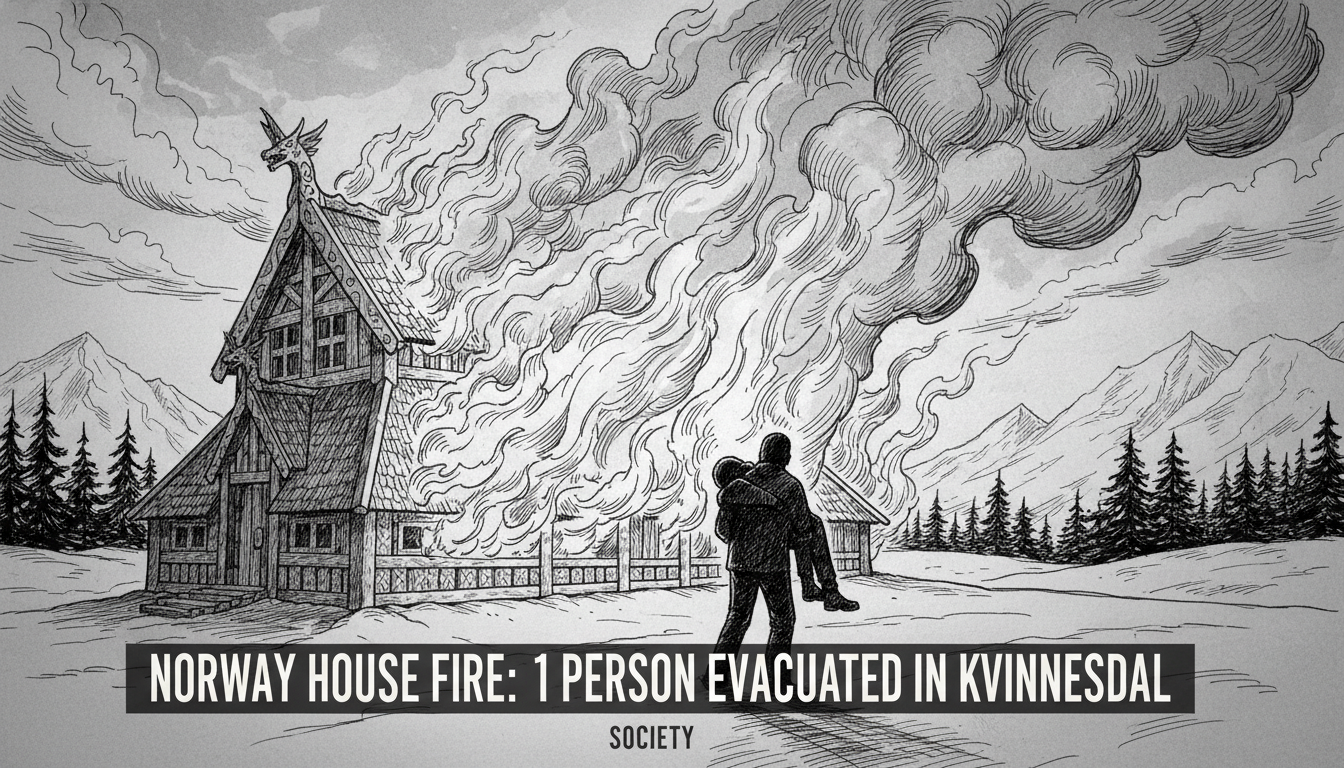
Norway emergency services responded to a house fire in Kvinesdal early Saturday morning. One resident evacuated the detached house before firefighters arrived. The incident highlights ongoing fire safety challenges in Norwegian residential areas, particularly in rural municipalities.
Firefighters from the local brigade were dispatched to the scene in the municipality of Kvinesdal in Agder county. The call came in during the early hours, a time when fire risks in homes can be heightened. Operasjonsleder Ole Robert Strandhagen from the Agder Police District confirmed the initial details in a police log entry at 03:56.
"One person is reported to be out of the building. There should be no persons left inside. The fire service is entering with smoke divers," Strandhagen said in the statement. His update provided a clear snapshot of the immediate response protocol. Emergency services prioritize accounting for all occupants before initiating aggressive interior firefighting operations.
A Swift and Controlled Response
By 04:09, just thirteen minutes after the initial update, police reported the fire was under control. This rapid containment suggests an effective response from the Kvinesdal fire brigade. The resident who self-evacuated was examined by ambulance personnel on site. The presence of smoke divers indicates significant smoke inhalation risk, a primary cause of fire-related fatalities.
"The resident who got out of the house themselves is being examined by ambulance personnel," Strandhagen noted in a subsequent log entry. This examination is standard procedure following smoke exposure. Norwegian health services treat potential smoke inhalation with extreme seriousness due to delayed respiratory complications.
The fire did not produce visible flames from the exterior, according to initial reports. Strandhagen noted there was "a lot of smoke from the building, but no flames." This characteristic is common in smoldering fires, which can be particularly dangerous due to toxic fume buildup. Such fires often originate from electrical faults or overheated materials within walls or insulation.
The Rural Fire Safety Challenge
Kvinesdal, a municipality in southern Norway's Sørlandet region, presents typical rural fire response challenges. Detached houses, or 'enebolig', are spread across varied terrain. Response times can be longer compared to urban centers, placing greater emphasis on early detection and resident action. This incident's positive outcome—a single evacuation and quick control—underscores the importance of prepared residents and efficient local brigades.
Winter months in Norway see a documented increase in residential fires. The National Fire Protection Association statistics point to heating systems, electrical overloads from lighting, and indoor cooking as frequent causes. Older wooden houses, common in Norwegian rural architecture, can be vulnerable if not properly maintained. This fire's occurrence aligns with this seasonal risk pattern, though the specific cause remains under investigation by local fire authorities.
Fire Chief Arne Larsen of the Southern Norway Fire Directorate, commenting generally on residential fires, emphasized prevention. "A working smoke detector is the simplest and most effective life-saving device in any home," Larsen said in a previous safety briefing. "In a rural setting, it buys crucial minutes for evacuation and for our teams to arrive." Norwegian law mandates smoke detectors in all bedrooms, hallways, and escape routes.
Analysis: Systems and Safety Gaps
The Kvinesdal event was a minor incident with a safe outcome, but it serves as a microcosm of national safety issues. Norway has a strong fire service, but its effectiveness hinges on early alarm. The resident's successful self-evacuation before heavy smoke infiltration is the key success story here. It suggests either early-stage detection or fortunate timing.
Expert analysis often points to the need for interconnected alarms and scheduled equipment checks. "We respond to calls where a single detector in a basement finally alerts sleeping residents upstairs, but the smoke has already filled escape routes," noted a veteran firefighter from the Agder region, speaking on background about common scenarios. "Modern, interconnected systems that alarm the entire house simultaneously are becoming the new standard we advocate for."
From a policy perspective, municipalities like Kvinesdal balance resource allocation for emergency services against other needs. Investing in community prevention programs, subsidizing modern alarms for elderly residents, and ensuring brigade readiness are ongoing discussions in local council meetings across Norway. This fire, while controlled, will likely be reviewed internally by the Kvinesdal fire chief to identify any potential improvements in tactic or communication.
The Human Element in Emergency Logs
The dry, procedural language of a police operations log tells a compressed human story. The sequence—"person out," "no persons left inside," "being examined"—maps a crisis from danger to stabilization. Each notation carries immense weight for the individuals involved. For the resident, it was a terrifying night ending in a medical check beside their home. For the responders, it was a successful intervention following their training.
Norway's decentralized emergency response model relies on local brigades supported by regional police coordination. The Agder Police District's operations center, logging this event, plays a crucial role as the communication nerve center. Their accurate, real-time information flow between the scene, ambulance services, and headquarters is a foundational component of public safety often taken for granted.
Community resilience in towns like Kvinesdal is built on these local networks. The firefighters who responded likely live in the same municipality. This embeddedness can enhance response effectiveness through intimate knowledge of local geography and building styles. It also personalizes the stakes of every call.
A Look Ahead: Prevention as Priority
The ultimate investigation into the fire's cause will determine if it was preventable. Common culprits in such investigations include faulty electrical wiring, unattended heating appliances, or chimney fires. The findings contribute to national data used to shape public safety campaigns.
The Norwegian Directorate for Civil Protection (DSB) continuously emphasizes a multi-layered approach: detection, alert, evacuation, and response. This incident in Kvinesdal tested all four layers. The detection and alert led to resident evacuation, which enabled firefighters to focus on containment without life-saving searches. This is the ideal sequence, but it does not always occur.
As Norway's building stock ages and new materials are introduced, fire safety strategies must adapt. The DSB recommends that all households not only install detectors but also practice escape plans. For a single resident in a detached house, the plan is straightforward, but no less critical to rehearse.
The quiet resolution of this Kvinesdal fire is a testament to a system working as intended. Yet, it prompts a necessary public reflection: When was the last time you tested your smoke alarm? For one resident in Agder county, the answer to that question was clearly recent enough. For others across Norway, this minor Saturday morning incident serves as a stark, silent reminder to check.