
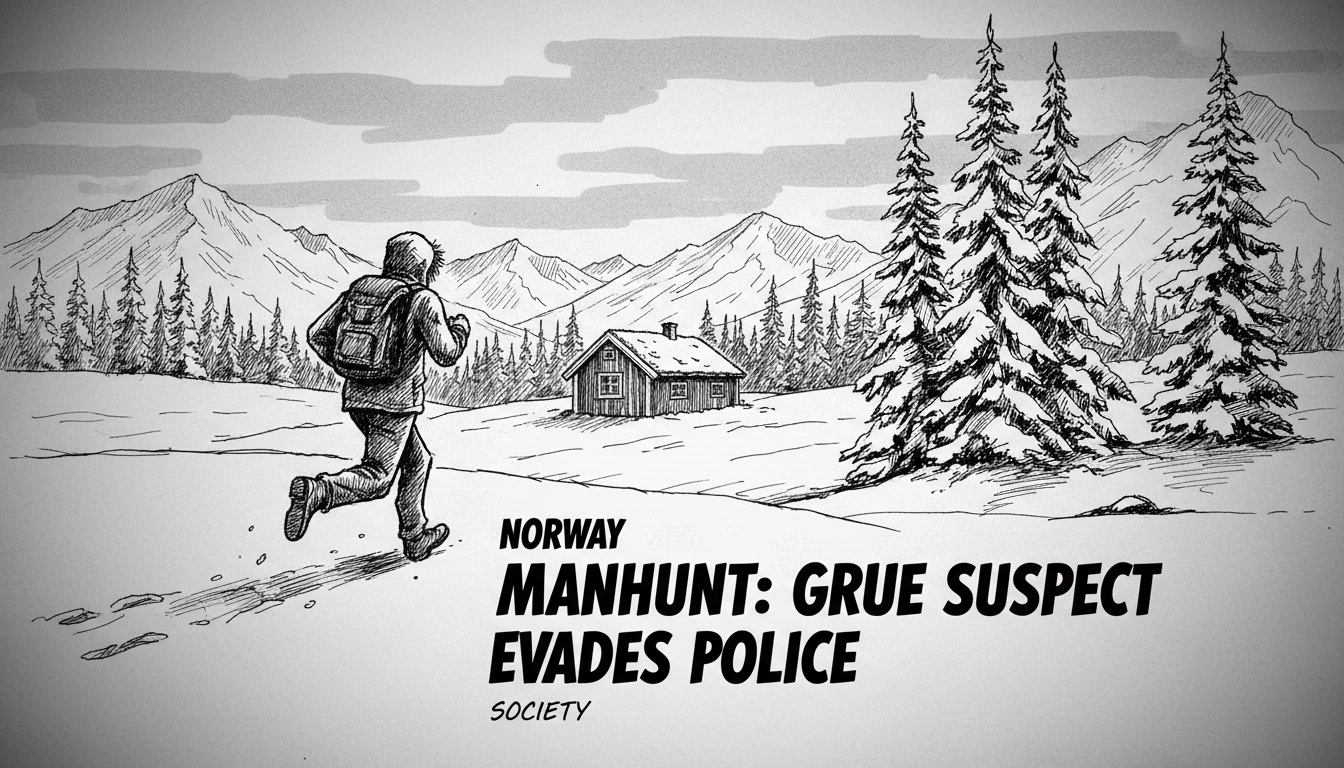
Norway police are searching for a 60-year-old man suspected of killing a woman in her 40s, as a quiet eastern municipality grapples with a domestic tragedy. The victim was found dead Saturday evening at a private address in Grue, Innlandet. Police have formally charged the man with murder but have been unable to locate him for two days, launching a public appeal for information.
“It has not been possible for the police to either find or make contact with him,” said Police Attorney Marit Fiskerud Welo of the Innlandet Police District. “The police are asking the man to turn himself in, and are also urging anyone who may know his whereabouts to contact us.” The suspect has prior convictions for violence, Welo confirmed. Police are investigating the death as a murder based on evidence at the scene and on the victim.
A Community in Mourning
By Monday morning, the impact of the death was visible in the small community of Grue. Residents arrived at the address to light candles, lay flowers, and pay their respects. The victim and the suspect were known to have been in a cohabiting relationship, according to sources familiar with the case.
“It is absolutely terrible,” said local resident Linda Nilo, one of those who came to the scene. “I hope the police arrest the person who did this. This affects all of us.” The sentiment was echoed by others in the municipality, where such violent crimes are rare and deeply felt.
Vaktmester Bjørn Vidar Sæle, who knew both individuals, described a tragic situation. “I actually knew both of them quite well. They have lived here for six or seven years, and I have been the caretaker for almost as long. It is sad,” Sæle said. When asked about the ongoing manhunt, he expressed concern but added, “I can probably agree with the police that I don't think he is dangerous to others. I don't believe that.”
A History of Prior Violence
Police revealed a troubling history between the suspect and the victim. Welo stated that the man was, several years ago, charged with an offense involving bodily harm against the same woman. That case was ultimately dropped due to insufficient evidence. It is not known if the man had previous convictions for violence specifically against the deceased.
This detail highlights a challenging and common pattern in domestic violence cases, where previous reports or investigations do not always lead to convictions or interventions sufficient to prevent escalation. The police are now working at full capacity on the investigation, having seized several items for digital analysis.
“Several seizures have been made in the case, but for the sake of the investigation, the police cannot say what has been seized,” the police stated in a press release. The investigation began Saturday night after police received a welfare concern call leading them to the woman's home.
Norway's Domestic Violence Challenge
This incident in Grue brings into sharp focus the persistent issue of domestic violence in Norway. The country is known for its strong legal frameworks and comprehensive support systems for victims, including shelters, crisis centers, and dedicated laws against violence in close relationships. Despite these robust structures, intimate partner violence and femicide remain a grim reality.
According to the latest official data from Statistics Norway (SSB), police recorded 17,663 offenses related to violence and abuse in close relationships in 2022. This figure represents a significant portion of all violent crime in the country. In the same year, there were 25 homicides in Norway; a number that, while low in international comparison, often includes deaths stemming from domestic disputes.
Experts in criminology and sociology point to a complex web of factors behind such violence. Socioeconomic stress, mental health issues, substance abuse, and deep-seated societal norms regarding gender and power can all contribute. They consistently emphasize that while legal consequences are crucial, prevention requires a multi-faceted approach: early intervention programs, accessible support services for victims, and broader societal efforts to address root causes and change attitudes.
The Search and the Systemic Questions
The immediate priority for authorities in Innlandet remains locating the suspect. The extended period where a person charged with a serious violent crime remains at large is unusual in Norway and adds a layer of public anxiety to the community's grief. The police appeal suggests they have exhausted immediate leads and are relying on public assistance.
Beyond the manhunt, the case prompts difficult questions about systemic responses to domestic violence. The prior investigation into the suspect for violence against the victim, which was closed, will likely be examined in the context of what could have been done differently. It underscores the perpetual challenge for law enforcement and social services: accurately assessing risk and intervening effectively in complex, private, and often underreported situations.
Norway has invested heavily in coordination between police, health services, and child welfare to protect victims. Yet, as this tragedy shows, predicting and preventing every act of lethal violence remains an immense challenge. Each case forces a re-evaluation of protocols and support networks.
A Quiet Municipality Changed
For the residents of Grue, a municipality known for its forests and quiet pace of life, the past few days have been a shocking departure from normality. The gathering of mourners at the crime scene is a poignant display of communal solidarity and shock. Such events disrupt the sense of security in small, close-knit communities, where everyone is connected in some way.
The coming days will see the police investigation continue its meticulous work, analyzing digital footprints and forensic evidence. The judicial process will seek accountability. Meanwhile, support services will be engaged to help those affected in the community cope with the trauma.
This death is more than a crime statistic; it is a personal catastrophe that has altered many lives. It serves as a somber reminder that behind Norway's low crime rates and high quality of life, hidden struggles within homes can have the most violent of outcomes. The nation's continued work to eradicate domestic violence is a mission that, as Grue now understands all too well, remains critically urgent. Will this tragedy lead to renewed focus on early intervention and support for at-risk individuals?