
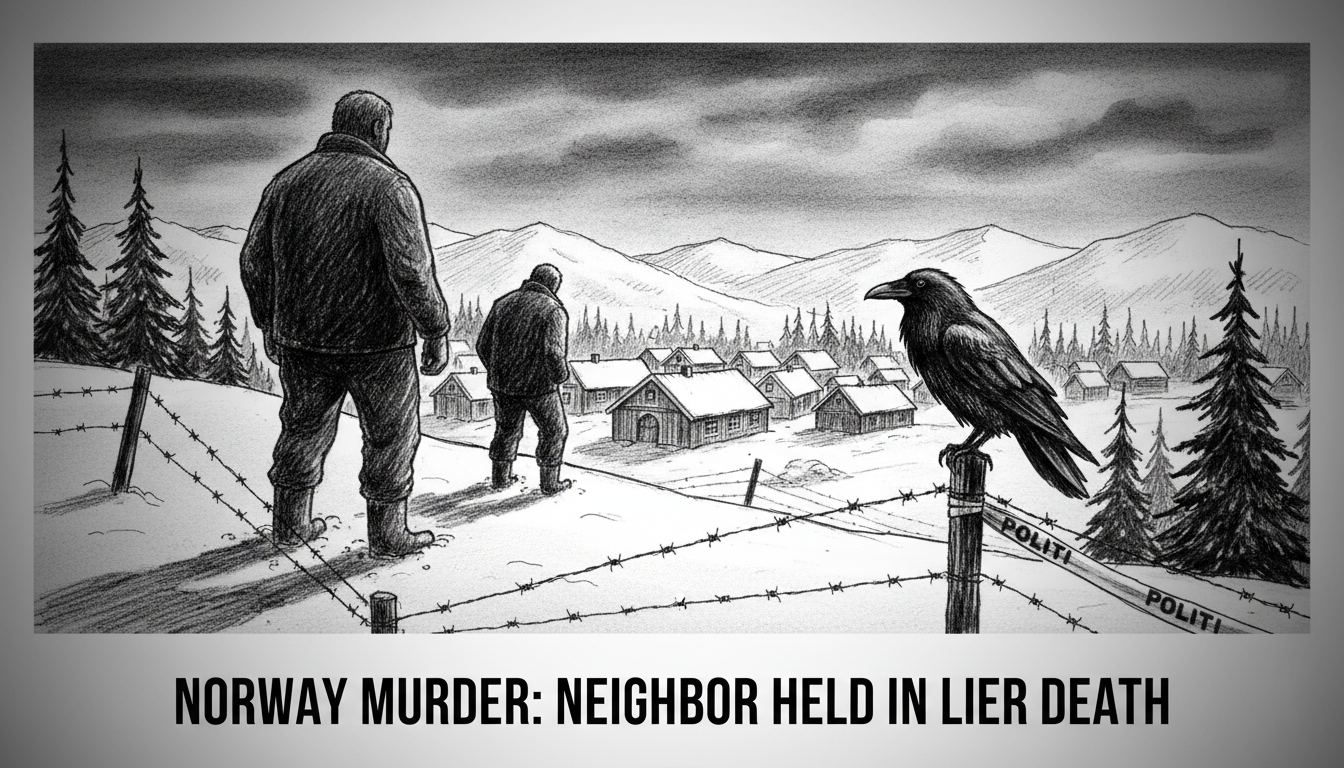
Norway's low homicide rate was shattered by a violent incident in a quiet residential block in Lier. A man in his 30s was found unconscious outside an apartment building in Tranby early Saturday morning and later died from his injuries. Police have charged a neighbor, a man in his 40s from the same building, with murder, marking a rare and severe case of violent crime in the typically peaceful municipality west of Oslo.
Police prosecutor Ann Iren Svane Mathiassen confirmed the arrest. "It is what the police saw when they arrived at the scene, both the injuries to the victim and the surrounding circumstances, that led us to charge him with murder," Mathiassen said. The suspect, through his lawyer Chamkor Singh Nagra, has denied criminal guilt but consented to pre-trial detention to aid the police investigation.
A Community in Shock
The incident occurred in Tranby, a residential area in Lier municipality. Lier is part of Viken county and lies just west of Drammen, a short drive from the capital. Such violent crimes are uncommon here, making the event particularly jarring for local residents. Police have been deliberately tight-lipped about the specifics of the case, citing an ongoing investigation and the need to interview all potential witnesses.
"All potential witnesses have not yet been questioned. We do not wish to go out and say anything particularly detailed about what happened at the scene. Therefore, I also cannot say if any weapon was used," stated prosecutor Svane Mathiassen. She confirmed that while there were no direct witnesses to the assault itself, other people were present both shortly before and after the event. The two men were acquainted. "We know they knew each other. They were not next-door neighbors, but they lived in the same building block," she explained.
Justice System Responds with Strict Measures
Buskerud District Court has ordered the suspect remanded in custody for four weeks. The court imposed strict conditions, including a ban on letters, visits, and media contact. Two of those four weeks will be spent in isolation. This type of pre-trial detention reflects the Norwegian justice system's serious approach to violent crime, especially when a homicide charge is involved. It allows police to conduct their investigation without risk of evidence tampering or witness intimidation.
The suspect's consent to detention, despite denying guilt, is a procedural step that acknowledges the gravity of the situation. It provides investigators with crucial time to gather forensic evidence, complete witness interviews, and build their case. The isolation period is often used in serious cases to prevent any external influence on the suspect's account of events.
Norway's Homicide Rate in Context
This case stands out starkly against Norway's general crime statistics. The country maintains one of the lowest homicide rates in the world, typically hovering around 0.5 killings per 100,000 inhabitants. In 2022, the total number of homicides across the entire nation was 31. For perspective, a single large city in many other Western countries can record that number in a month. This low rate is a point of national pride and a key indicator of societal stability.
Violent crimes that do occur are treated with immense gravity by law enforcement and the judicial system. Investigations are thorough, and the courts do not hesitate to impose strict pre-trial conditions when the evidence warrants it. The system balances a generally rehabilitative penal philosophy with firm measures to ensure public safety and the integrity of investigations for the most severe offenses.
The Complex Dynamics of Acquaintance Violence
Criminologists note that homicides where the victim and perpetrator know each other, as in this Lier case, often involve complex interpersonal dynamics. These are rarely random acts of violence. Underlying conflicts, whether personal, financial, or otherwise, can escalate tragically. The investigation will likely focus heavily on the relationship between the two men, seeking to establish a motive and a clear sequence of events leading to the fatal confrontation.
"Thorough investigation is paramount in cases like this," explains a criminology expert familiar with the Norwegian context. "When individuals are known to each other, the motive is often buried in a history of interactions that aren't immediately visible. The police must piece together not just the 'how' of the incident, but the 'why,' which requires interviewing a wide circle of contacts and examining all aspects of their lives." The absence of direct witnesses makes this forensic and circumstantial evidence even more critical.
A Quiet Municipality Grapples with Uncommon Violence
Lier is not a place accustomed to front-page crime news. It is a municipality known for its natural surroundings, including parts of the Lier Valley, and its proximity to both Drammen and Oslo. The community is a mix of residential areas, agricultural land, and small industry. News of a fatal assault between neighbors in an apartment block is the type of event that resonates deeply, shaking the sense of security in a tight-knit community.
Local police presence and community policing models in Norway are generally effective at maintaining order and preventing crime. An incident of this severity triggers a significant response from the South-East Police District, which oversees the area. The priority now is a meticulous, by-the-book investigation to ensure justice is served. The police's current reluctance to share details, while frustrating for public curiosity, is standard protocol to avoid compromising the legal process.
What Comes Next in the Legal Process
The four-week custody period ordered by the court is just the first phase. During this time, police will finalize their investigation. The suspect will be formally questioned, and his defense will be given access to the evidence. At the end of the four weeks, prosecutors must apply for an extension if they need more time before formally indicting him. The case will then proceed through Norway's court system, which could take many months.
If charged and convicted of murder, the suspect would face a maximum sentence of 21 years under Norwegian law, though time served pre-trial counts toward the total. Norway does not have life sentences without the possibility of parole; the maximum custodial sentence is 21 years, with a provision for preventive detention if the individual is deemed a continuing threat to society after serving their term.
A Sobering Reminder
This tragedy in Lier serves as a sobering reminder that no society is entirely immune to violent crime. Even in a nation with statistics as favorable as Norway's, personal conflicts can escalate with deadly consequences. The case will now follow the slow, deliberate path of the Norwegian justice system, which emphasizes thoroughness over speed. For the community in Tranby, the sense of safety has been fractured, and the wait for answers and closure begins. The quiet hallways of the apartment block now hold a story that contrasts painfully with the peaceful reputation of the country it sits in. How a dispute between neighbors reached such a fatal extreme is the question that will haunt the investigation and the community for a long time to come.