
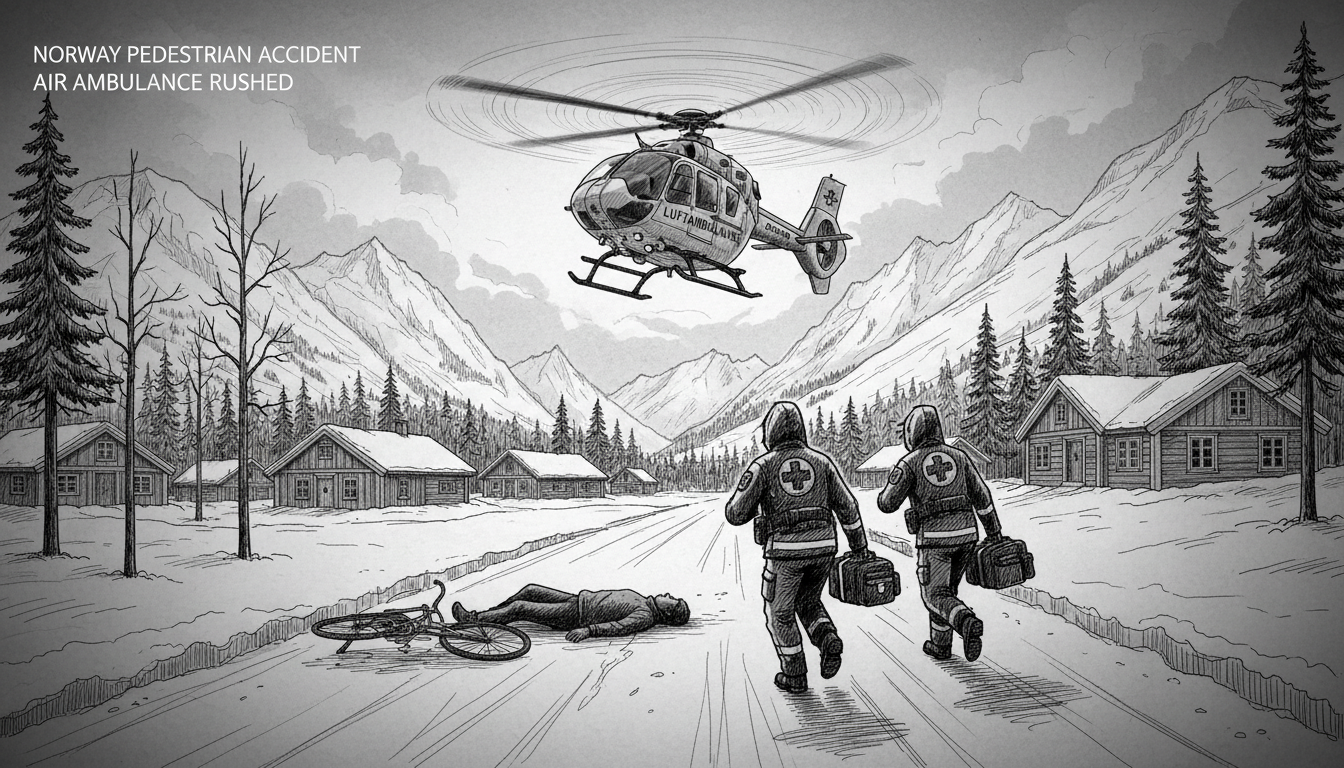
Norway traffic accident statistics showed another grim entry Sunday as a serious collision in Porsgrunn required an air ambulance to Ullevål Hospital. A pedestrian suffered life-threatening injuries after being struck by a vehicle in an area without a designated crossing, according to local police. The incident has again placed Norway's pedestrian safety infrastructure under scrutiny.
Emergency Response Activated
Police and emergency services converged on the scene in Porsgrunn, a key industrial municipality in Vestfold og Telemark county. The South-East Police District confirmed the injured individual was conscious when ground transport left the scene at 3:23 PM to meet the air ambulance. “The patient was flown with air ambulance to Ullevål Hospital,” said on-scene commander Arnhild Saubrekka Holmlimo. Multiple witnesses were interviewed by investigators who worked to secure the area and document evidence. The road remained closed for over an hour as police conducted their initial investigation, finally clearing the scene just after 4:00 PM.
Investigation Focuses on Crossing Point
A critical detail emerged from police statements: the accident did not occur at a marked pedestrian crossing. “We register that there is not a pedestrian crossing where we believe the patient crossed the road,” Holmlimo stated. This fact immediately raises questions about urban planning and driver awareness in areas with high foot traffic. Investigators are now tasked with reconstructing the exact sequence of events. Police have stated they do not initially suspect impairment by alcohol or drugs played a role for any involved party. However, a criminal case has been initiated, which is standard procedure in accidents involving serious injury.
The Human Toll Beyond the Crash
The immediate physical trauma represents only the first chapter in a long recovery process. Ullevål Hospital in Oslo, where the victim was airlifted, is Norway's largest trauma center, specializing in treating the most severe injuries. The psychological impact on the victim, the driver, and witnesses can be profound and lasting. Police noted the driver is also receiving care. “The person has received follow-up from health services and is being looked after by us as well,” Holmlimo confirmed. This dual focus underscores the wide-ranging human cost of a single traffic incident.
Porsgrunn's Traffic Safety Context
Porsgrunn, with its population of approximately 36,000, is a municipality where industrial and residential zones often intersect. Its role as a hub for Norway's chemical and process industries means freight and commuter traffic share roads with local residents. While Norway boasts one of the world's lowest road mortality rates overall, pedestrian safety in urban and suburban areas remains a persistent challenge. Accidents away from formal crossings highlight a particular vulnerability. Traffic safety experts consistently argue that infrastructure must account for natural pedestrian desire lines, not just vehicle movement.
Norway's Road Safety Paradox
This accident illustrates a paradox in Norwegian traffic safety. The country is a global leader in reducing overall traffic fatalities, with ambitious Vision Zero policies. Yet, pedestrians and cyclists still account for a significant portion of serious injuries. In 2022, the latest full year of official statistics from the Norwegian Public Roads Administration, 28 pedestrians were killed in traffic. Hundreds more sustained serious injuries. Each incident triggers a local review, but critics argue systemic changes to street design in older towns like Porsgrunn happen too slowly.
The Legal and Insurance Process Ahead
With a police case opened, the driver now faces a formal investigation. Norwegian law on traffic accidents focuses on establishing whether rules were broken, such as speed limits or right-of-way regulations. The absence of a crossing does not automatically absolve a driver of responsibility; motorists have a general duty of care. The investigation will examine witness accounts, possible vehicle data, and road conditions. Simultaneously, insurance claims for personal injury and vehicle damage will begin, a process that can take months or years, especially when long-term medical outcomes are uncertain.
A National Conversation on Infrastructure
Incidents like Sunday's in Porsgrunn inevitably renew debate about Norway's street design priorities. Urban planners and safety advocates call for more traffic calming measures, raised crosswalks, and better lighting in areas with predictable pedestrian activity. “The safest pedestrian is one separated from traffic by time or space,” noted a recent report from the Institute of Transport Economics. When that separation fails, either by infrastructure lack or human error, the consequences are severe. Municipalities often face budget constraints when retrofitting existing neighborhoods with safer designs.
Looking Forward: Prevention and Policy
The ultimate goal of any accident investigation is prevention. Data from this crash will feed into national statistics and local safety audits. For Porsgrunn's municipal government, the pressure may increase to audit high-risk corridors and implement physical changes to protect vulnerable road users. This could mean installing new signaled crossings, building curb extensions, or even reducing speed limits in certain zones. The Norwegian Public Roads Administration frequently uses such case studies to update national guidelines for urban road design.
Sunday’s clear skies allowed for a rapid airlift, possibly saving a life. But the clear fact on the ground—the lack of a safe crossing point—poses a harder, more expensive question for the community. How many more serious injuries must occur before the map of pedestrian infrastructure is redrawn to match where people actually walk? The investigation in Porsgrunn continues, and so does the national struggle to make every journey safe, whether by car or on foot.