
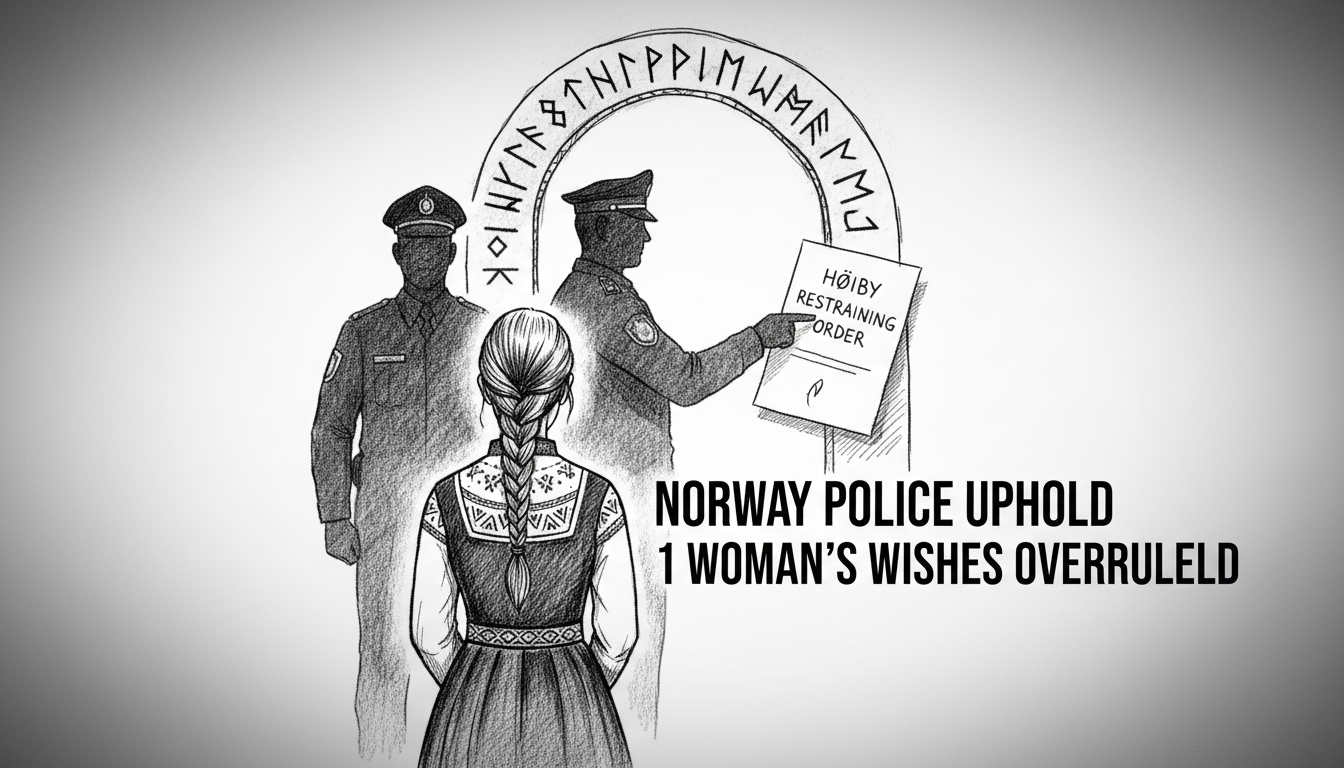
Norway police have maintained a restraining order against Marius Borg Høiby to protect a woman in Oslo's Frogner district, directly contradicting her stated wishes. The Oslo Police District confirmed the order remains active based on 'general considerations,' a legal standard allowing authorities to prioritize perceived risk over an individual's consent. This decision places Norwegian law enforcement in a rare position of acting against the expressed desires of both the protected person and the subject of the order, highlighting a contentious power within the country's protective legislation.
Police Attorney Andreas Kruszewski stated the order was imposed for the woman's protection. "We are aware that she no longer wants this restraining order, but we have decided that it should still apply to safeguard her interests," Kruszewski said. The woman, identified in media only as the 'Frogner woman,' is one of the aggrieved parties in a criminal case against Høiby. Her legal aid lawyer, Mette Yvonne Larsen, confirmed her client no longer sees a need for the legal barrier.
Høiby's defense lawyer, Petar Sekulic, also stated his client wants the order lifted. Despite this mutual agreement, the police have not received a formal court review request from either legal representative. "As of now, neither the legal aid lawyer nor the defense counsel has asked the police to bring it before the court. It is therefore still in effect," Kruszewski explained. This procedural gap leaves the restraining order—a significant limitation on personal freedom—firmly in place.
The Legal Mechanism of 'General Considerations'
The core of this case rests on the Norwegian legal concept of 'allmenne hensyn,' or general considerations. This provision grants police and courts the authority to issue protective measures like restraining orders even when the person to be protected does not request them, or in this case, actively wants them removed. The rationale is rooted in a societal duty to prevent potential harm, particularly in contexts of domestic violence or intimidation, where victims may be under pressure or unable to assess risk objectively.
Legal experts note this power is used sparingly. "It is a significant intervention into personal autonomy," says Professor Eva Smith, a legal scholar at the University of Oslo specializing in criminal procedure. "The state is essentially saying, 'We know better than you what is good for you in this situation.' The threshold for invoking general considerations must be high, typically requiring concrete evidence of a serious and probable threat that the individual may be underestimating."
The police have not disclosed the specific evidence or assessment leading to their decision, citing operational confidentiality. This lack of transparency is a standard practice to protect investigative methods and the privacy of those involved, but it also limits public scrutiny of a decision that overrides personal choice.
Restraining Orders in the Norwegian Justice System
Norwegian restraining orders, known as 'besøksforbud,' are a key tool for preventing harassment, threats, and violence. They can be issued urgently by police or through a court, prohibiting any contact, physical proximity, or communication. Violation is a criminal offense punishable by fines or imprisonment. The system is designed to be responsive, but this case illustrates its potential rigidity once an order is enacted.
The process for lifting an order typically requires the protected party or their representative to petition the court. The court then reviews the current risk assessment. In this instance, the woman's lawyer has not yet initiated this process, which means the police's administrative decision stands unchallenged in a judicial forum. This creates a peculiar stalemate where all directly involved parties appear aligned against the state's position, yet the state's position remains legally enforceable.
"The system assumes that the police's initial risk assessment might need protection from being hastily undone," explains defense lawyer Henrik Holstad. "But it also creates a scenario where inertia and procedure can maintain a restriction longer than its factual justification. The onus is on the protected person to navigate the legal system to regain their own autonomy, which can be a daunting process."
The Broader Context of Protective Policies
This case emerges against a backdrop of Norway's strong, proactive policies against domestic violence and coercion. The country has invested heavily in support systems, shelters, and legal frameworks aimed at early intervention. The principle of 'general considerations' is a cornerstone of this approach, intended to catch cases where fear, emotional attachment, or psychological manipulation might prevent a victim from seeking help.
Statistics from the Norwegian National Police Directorate show that thousands of restraining orders are issued annually. The vast majority are initiated at the request of the person seeking protection. Cases where orders are maintained against a person's will represent a tiny fraction, but they are critically important for testing the limits of state intervention.
Critics argue that while well-intentioned, such paternalism can undermine agency. "There is a delicate balance between protection and patronization," says sociologist Kari Jensen. "When the state persistently overrules a competent adult's judgment about their own safety, it risks disempowering the very person it aims to help. It sends a message that their judgment is not trustworthy."
Supporters counter that the law must account for non-physical forms of coercion. "In situations involving patterns of control or psychological abuse, a victim's stated desire to have contact can be a symptom of the abuse itself," notes Lisa Wang, a coordinator at a Oslo crisis center. "The law needs mechanisms to look beyond immediate statements to longer-term patterns of risk. The question is always whether the authorities are correctly identifying those patterns."
Legal Pathways and Next Steps
The immediate way forward for the Frogner woman and Marius Borg Høiby is a legal application to the court. Her legal aid lawyer must formally request a judicial review of the restraining order. The court would then evaluate the police's reasoning and the current circumstances. It would weigh the woman's right to self-determination against the state's duty to prevent harm.
The court could uphold the police decision, modify the order's terms, or revoke it entirely. Without this step, the police have no obligation to revisit their decision proactively. This places a significant burden on the individual to challenge the state's protective measure, a process that requires time, legal navigation, and emotional resilience.
Høiby's position is also legally constrained. As the subject of the order, he cannot apply to have it lifted himself; the initiative must come from the protected party or her representative. This structure is designed to prevent subjects from pressuring victims into dropping protections, but in a case of genuine mutual consent, it can create procedural frustration.
A Question of Autonomy Versus Protection
The Oslo police's decision to uphold the restraining order against Marius Borg Høiby presents a fundamental conflict in modern justice systems: when should the state override personal choice in the name of protection? Norway's legal framework explicitly allows for this, but its application in individual cases reveals the profound difficulty of such judgments.
The police, armed with their investigation and the standard of 'general considerations,' have drawn a line. They see a risk that the woman involved does not. Until that woman, through her lawyer, successfully petitions a court to see things differently, the state's view will prevail. The case is a live demonstration of protective laws in action, showcasing both their power to guard against unseen dangers and their power to impose a version of safety that the protected person does not want.
It raises unresolved questions about how long such protective paternalism should last and what evidence should sustain it when the primary beneficiary objects. The answer, for now, lies within the Oslo Courthouse, awaiting a formal challenge that has yet to be filed. Until then, a restraining order remains in force, serving as a legal barrier between two adults who both state they want it gone, preserved by the state's conviction that it knows better.