
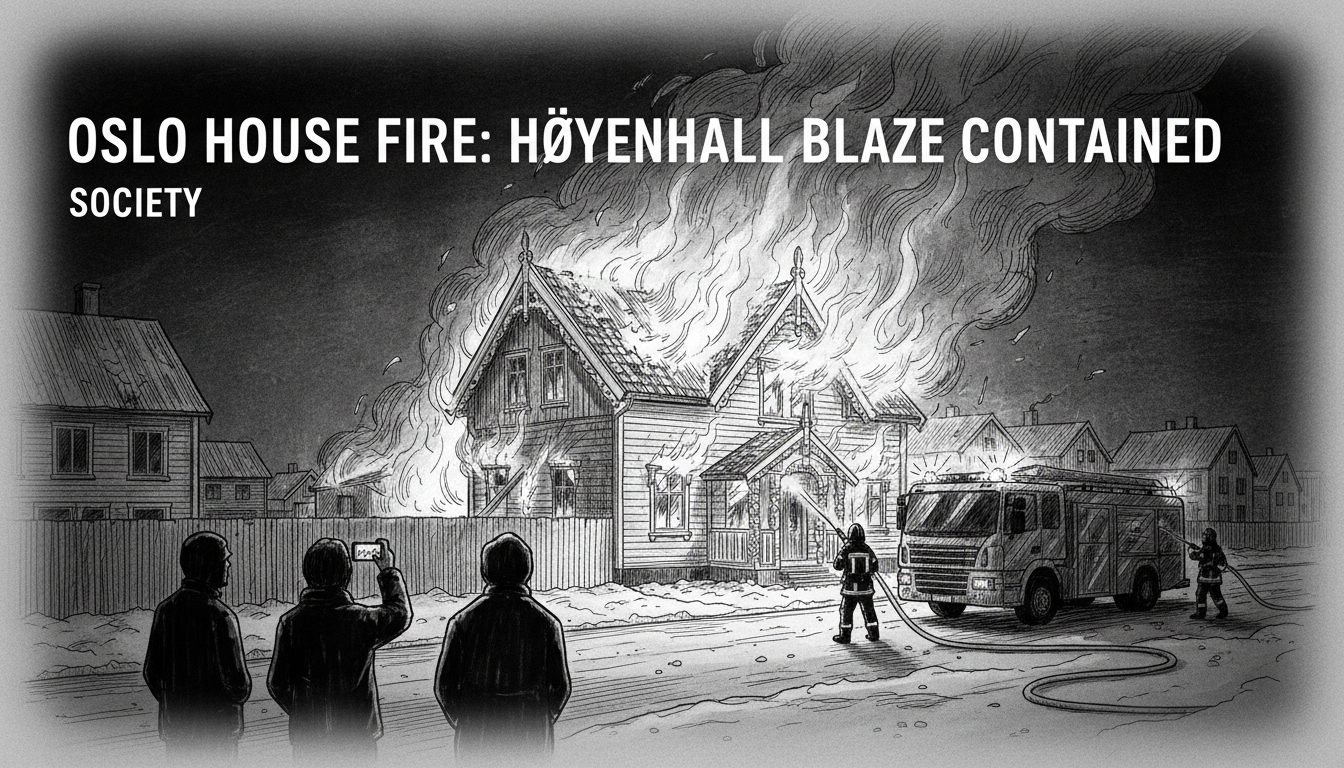
Norway's emergency services respond to over 4,500 building fires annually, with a new incident unfolding Thursday evening in Oslo's eastern suburbs. A detached house in the Høyenhall area of Østensjø district was fully engulfed in flames, prompting a major response from fire crews. Police advised nearby residents to close doors and windows due to heavy smoke as firefighters battled the blaze across both floors.
Vaktkommandør Tor Audunhus at the 110 emergency center confirmed that crews began gaining control of the fire around 6:00 PM. Operasjonsleder Øyvind Hammervold with the police stated authorities had been in contact with the residents. Preliminary information suggested the house was likely unoccupied when the fire broke out, a critical factor that may have prevented personal injury.
The call to neighbors highlighted the immediate public safety concern. Dense smoke from structure fires contains toxic combustion products, including carbon monoxide and particulate matter. Securing homes against smoke intrusion is a standard precautionary measure during nearby major fires.
Emergency Response and Containment
Oslo Fire and Rescue Service deployed multiple units to the Høyenhall address. Their strategy involved both offensive exterior attacks and, where safe, interior operations to fully extinguish the 'full overtenning'—a Norwegian term indicating a fire that has developed fully through all stages. Achieving control within a reported timeframe points to an effective initial attack and sufficient resource deployment.
Norwegian firefighting doctrine emphasizes quick containment, especially in residential areas where properties can be close together. Preventing fire spread via radiant heat or airborne embers is a primary tactical goal. The successful limitation of this fire to the single structure of origin will be a key measure of the operation's success.
The Safety Infrastructure Behind the Scenes
This incident activates Norway's integrated emergency response system. The 110 central serves as the single point of contact for police, fire, and medical emergencies, coordinating dispatch. Local fire departments, while municipally operated, follow national standards for training and equipment. Building codes updated regularly mandate smoke alarms in all homes and specify fire-resistant materials, particularly in shared walls and escape routes in multi-family buildings.
Detached homes like the one in Høyenhall are subject to stringent electrical and insulation standards designed to prevent ignition. Investigations following such fires often examine whether these codes were met and if any failures contributed to the blaze's start or rapid spread. The cause of this specific fire remains unknown and will be subject to official investigation.
Expert Analysis: Urban Density and Fire Risk
"A house fire in a densely packed area like Østensjø presents distinct challenges," explains Lars Berg, a former Oslo fire chief and current safety consultant. "While Norwegian building codes for detached homes are strong, the proximity of other structures, vegetation, and the potential for wind-driven embers requires firefighters to think defensively from the first moment. The instruction to neighbors to close windows was textbook and crucial."
Berg notes that while Norway has a strong fire safety record, older housing stock can present risks. "Many detached homes in Oslo's suburbs were built in the mid-20th century. Renovations and updates must respect modern fire safety principles. The speed with which this fire became fully involved suggests it had ample fuel and oxygen, which investigators will look at closely."
He also highlights the human factor. "The potential absence of occupants is a double-edged sword. It means lives were likely saved, but it also may mean there was no one to raise the early alarm, allowing the fire to establish itself before detection by neighbors or automatic systems."
Community Impact and Aftermath
The aftermath of a significant house fire extends beyond property damage. For the residents, it represents a total disruption of life and the loss of personal belongings. For the neighborhood, it is a visceral reminder of vulnerability. The sight and smell of smoke, the presence of emergency vehicles, and the damage to a familiar streetscape have a psychological impact.
Insurance assessment and the forensic investigation will begin once the site is cool and structurally safe. Police will determine the official cause, ranging from accidental electrical fault to appliance malfunction or other sources. In Norway, a very small percentage of building fires are determined to be deliberately set.
Community response in Norway often includes support from local municipalities and voluntary organizations like the Norwegian Red Cross, which can provide immediate assistance to displaced families with shelter, clothing, and crisis counseling.
A Look at the Broader Picture
This fire, while contained, occurs within a national context where fire prevention is a continuous public education campaign. The Norwegian Directorate for Civil Protection (DSB) constantly stresses the importance of working smoke detectors, having an escape plan, and being cautious with open flames and electrical equipment.
Data from DSB shows that the most common causes of house fires in Norway are related to cooking, fireplaces and chimneys, and electrical faults. Each incident provides data points that feed back into improved codes, appliance safety standards, and firefighter training.
The Høyenhall fire did not become a catastrophe. No injuries are reported, and it did not spawn a wider neighborhood disaster. This outcome is a testament to the professional emergency response and the built-in safety protocols that functioned as intended. Yet, it leaves a family without a home and a community briefly shaken, underscoring that even in one of the world's safest countries, the elemental threat of fire is ever-present.
The charred structure on a quiet Oslo street now stands as a silent question: How do we continue to build, renovate, and live to further minimize these devastating events? The answer lies in the ongoing work of planners, builders, safety inspectors, and the continued vigilance of every homeowner.