
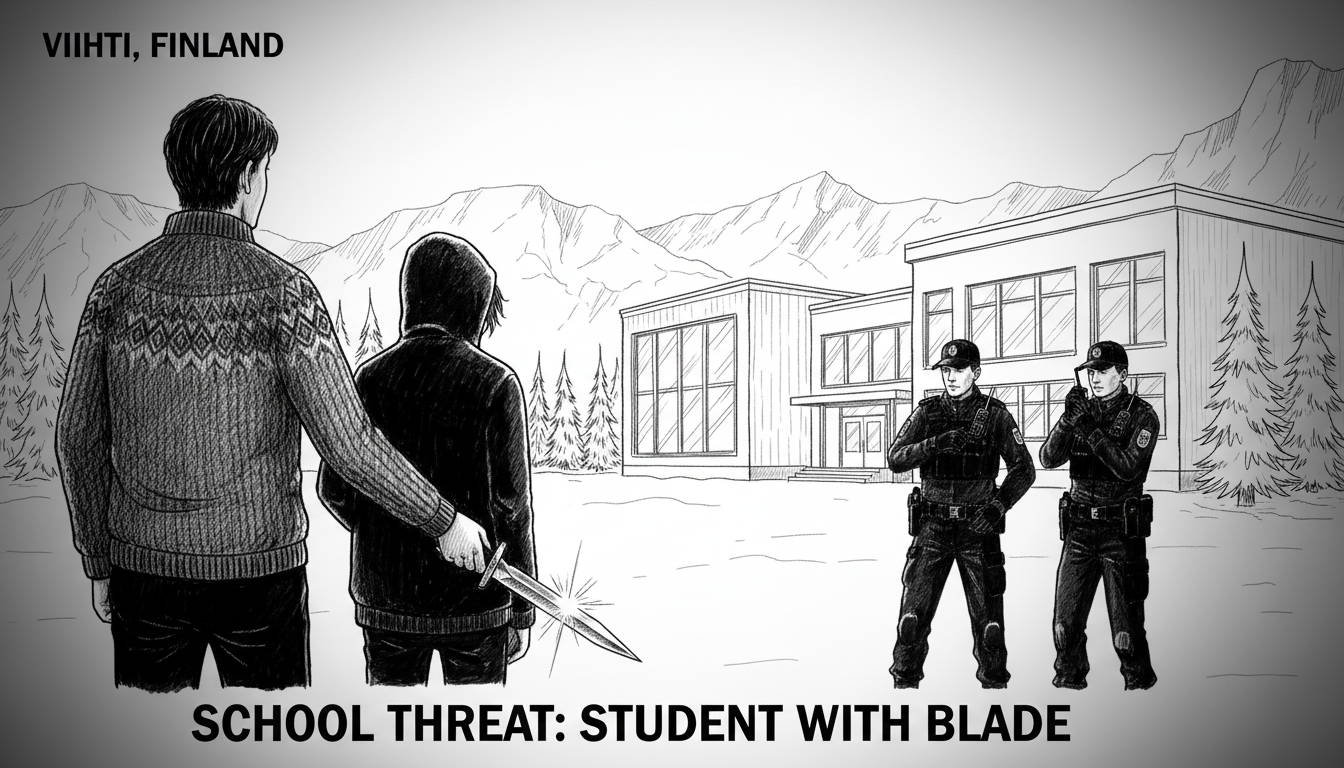
Police in the municipality of Vihti, part of the Greater Helsinki region, responded to a serious incident at Vihti Comprehensive School on Thursday afternoon. Authorities confirmed a 14-year-old male student had behaved threateningly and was found in possession of a bladed weapon. The situation escalated from a teacher's intervention over disruptive behavior, leading to a physical altercation and the discovery of the blade. No one was threatened directly with the weapon, and no injuries were reported from its use, according to police statements.
Commissioner Hannu Väänänen of the Western Uusimaa Police Department detailed the sequence of events. A teacher attempted to intervene after the student was causing a disturbance. The situation then developed into a scuffle. School staff subsequently learned the student had a blade in his possession. The school immediately initiated lockdown procedures, confining students to classrooms and summoning police to the scene. Police apprehended the student without further incident. The commissioner emphasized the school acted entirely correctly in its response.
Finnish criminal law stipulates a minimum age of criminal responsibility. The 14-year-old student, while suspected of minor assault related to the scuffle, faces no formal criminal charges due to his age. This legal framework shifts the primary response to child protection authorities and the school's own disciplinary systems. Police stated they will cooperate with the school and child welfare officials. Officers will speak with the child to clarify boundaries and acceptable behavior.
Two students present during the lunch break reported witnessing part of the event. They observed the student in question on a staircase with a bloody cheek and palm. Police clarified these minor injuries likely occurred during the initial disruptive behavior and scuffle. There is no suspicion the injuries resulted from actions by the teacher or police, or from deliberate self-harm by the student.
This incident highlights ongoing national discussions in Finland about youth welfare, school safety protocols, and support systems. While such events remain relatively rare in Finnish schools, they prompt reviews of de-escalation training and resource allocation for student mental health. The Finnish model typically emphasizes early intervention and support over punitive measures, especially for minors below the age of criminal responsibility. The focus now turns to the child protection process and the school's internal follow-up, aiming for a rehabilitative rather than purely disciplinary outcome. The case also underscores the challenging balance teachers must strike in managing classroom disruptions while ensuring overall safety, a topic frequently debated in the Eduskunta, Finland's parliament. The response demonstrated a coordinated protocol between educational staff and law enforcement, a system tested and activated effectively in this instance.