
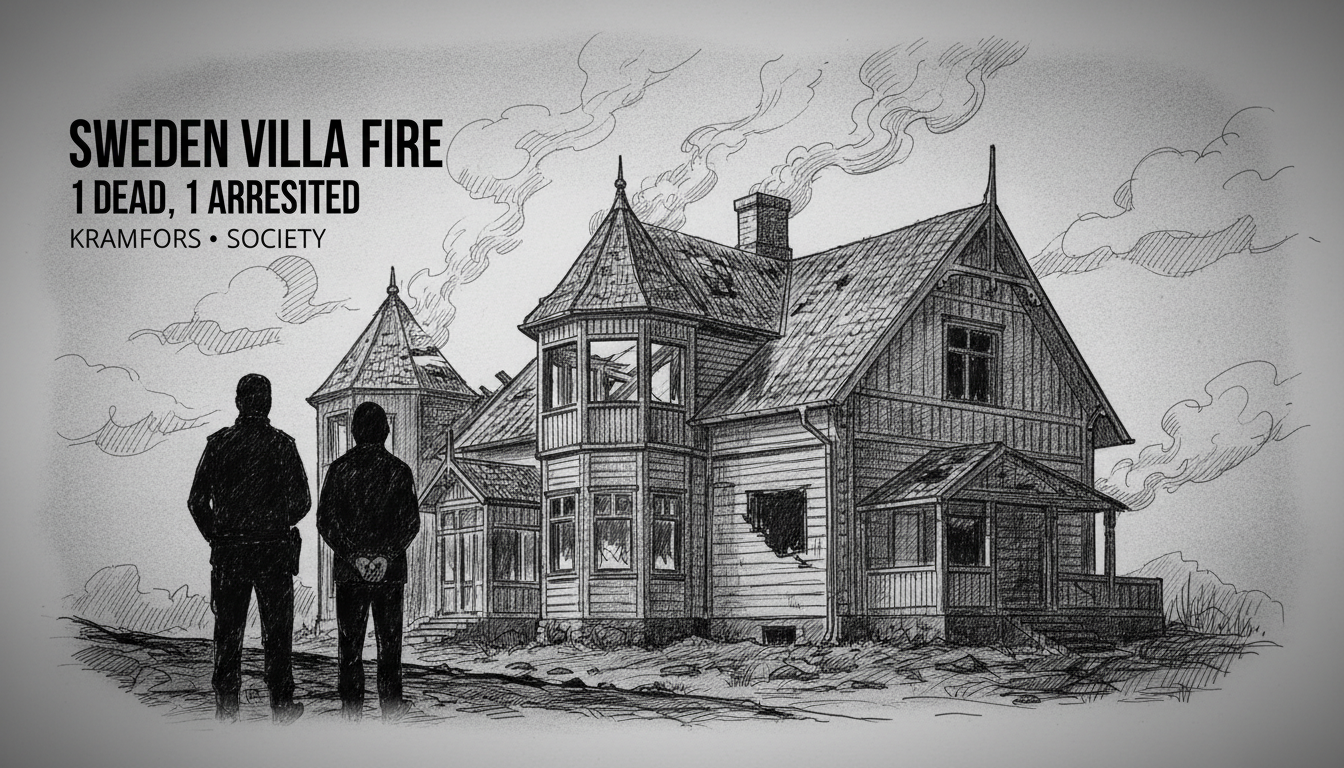
Swedish police are investigating a deadly villa fire in Kramfors after one person was found dead in the burned-out home. A man has been arrested on initial suspicion of murder and aggravated arson. The tragedy has shaken the small coastal community in northern Sweden, where violent crime remains a rare and shocking event.
Flames tore through the villa on a quiet Tuesday morning. Emergency services rushed to the scene, but they were too late. Firefighters discovered one fatality inside the charred remains of the house. The victim has not yet been publicly identified, a process police say could take time due to the fire's severity.
"We have cordoned off the area and will conduct a thorough crime scene investigation," a police spokesperson said in a statement. Authorities are urging anyone with information about the fire to contact them directly. The arrested man remains in custody as the investigation unfolds.
A Community in Shock
Kramfors, a municipality of around 6,000 people in Västernorrland County, is known for its forested landscapes and the Ångermanälven river. It is not known for violent crime. News of the fire and the arrest spread quickly through the tight-knit community, leaving residents in a state of disbelief.
"You hear about these things in the big cities, not here," said a local shop owner who asked not to be named. "It's a quiet place. Everyone is talking about it, wondering what could have happened." This sense of violated peace is common in Swedish towns when major crimes occur. The local response often involves a mix of fear, grief, and a rallying of community support.
Swedish society places high value on personal safety and the sanctity of the home, or hemmet. A violent crime in a private villa strikes at the heart of that sense of security. It transforms a personal tragedy into a communal one, prompting questions about safety and motive that may have no easy answers.
The Legal Framework: Arson and Intent
The suspect faces preliminary suspicions of mord (murder) and grov brandstiftelse (aggravated arson). In Swedish law, this is a serious combination. The distinction between murder and manslaughter (dråp) hinges on intent and planning. Prosecutors will need to prove the suspect acted with purpose to kill.
Similarly, arson laws are strict. Simple arson involves intentionally setting a fire. Aggravated arson, which carries a much longer prison sentence, applies when the fire seriously endangers life, causes major property damage, or is set in a residential building. A villa fire that claims a life clearly meets this threshold.
"The forensic investigation will be crucial," explained legal analyst Erik Lundström, who is not directly involved in the case. "Investigators will work to pinpoint the fire's origin and search for traces of accelerants. They must establish a clear link between the fire, the death, and the suspect's actions to secure a conviction."
This process is methodical and can take weeks. The Swedish police's National Forensic Centre is often called in for complex fire investigations. They comb through debris, analyze chemical samples, and create detailed maps of the burn patterns.
The Challenge of Investigating Fire
Arson is notoriously difficult to solve. The 2023 Swedish crime statistics recorded roughly 5,000 cases of arson and related offenses. The clearance rate for these crimes is consistently lower than for other violent crimes. Fire destroys evidence. It consumes the very materials that might tell the story of how it started.
"A fire investigation is like putting together a puzzle where half the pieces are ashes," said a retired fire investigator. "You look for the seat of the fire, for trails, for how materials burned. But if the structure collapses, the evidence goes with it." This is why witness testimony and digital evidence, like phone data or CCTV from neighboring properties, become so important in building a case.
In a small community like Kramfors, this can be a double-edged sword. Everyone might know everyone, but fear or loyalty can silence potential witnesses. Police have appealed for information, hoping someone saw unusual activity near the villa before the flames were visible.
A Look at Crime in Rural Sweden
This incident challenges the common perception that serious violent crime is confined to Sweden's major urban areas. While statistically more prevalent in cities, tragedies like the Kramfors fire remind the nation that no community is immune. It sparks a broader conversation about resources, as rural police districts often have fewer officers and longer response times than their urban counterparts.
However, Sweden's cohesive social structure often means rural investigations benefit from strong community-police relationships. Local officers might know the residents and the area intimately. This can aid in understanding contexts and motives that outsiders would miss.
The case also touches on the national conversation about Sweden's crime rate. While overall violent crime statistics are complex and often debated, a single, stark event in a quiet town cuts through the data. It becomes a human story with a profound local impact, far removed from political rhetoric.
A Long Road Ahead
For now, Kramfors is left waiting. The police investigation will proceed carefully. The victim's family awaits identification and answers. The judicial process for the suspect, if formally charged, will be long, beginning with a prosecutor's decision to indict.
Swedish court proceedings are meticulous and can take over a year to reach a conclusion in serious cases. The burden of proof is high, especially for a murder charge. The prosecution must convince the court beyond reasonable doubt that the suspect intentionally caused the fire and the death.
As the forensic teams work behind the police tape, life in Kramfors continues, but with a shadow. The burnt villa stands as a grim reminder of a Tuesday morning that changed everything. The community's sense of safety, once implicit, now feels fragile. The ultimate resolution in court may provide legal closure, but the human scar on this small Swedish town will take much longer to heal. The story is no longer just about a fire; it is about what remains in the ashes of a shattered peace.