
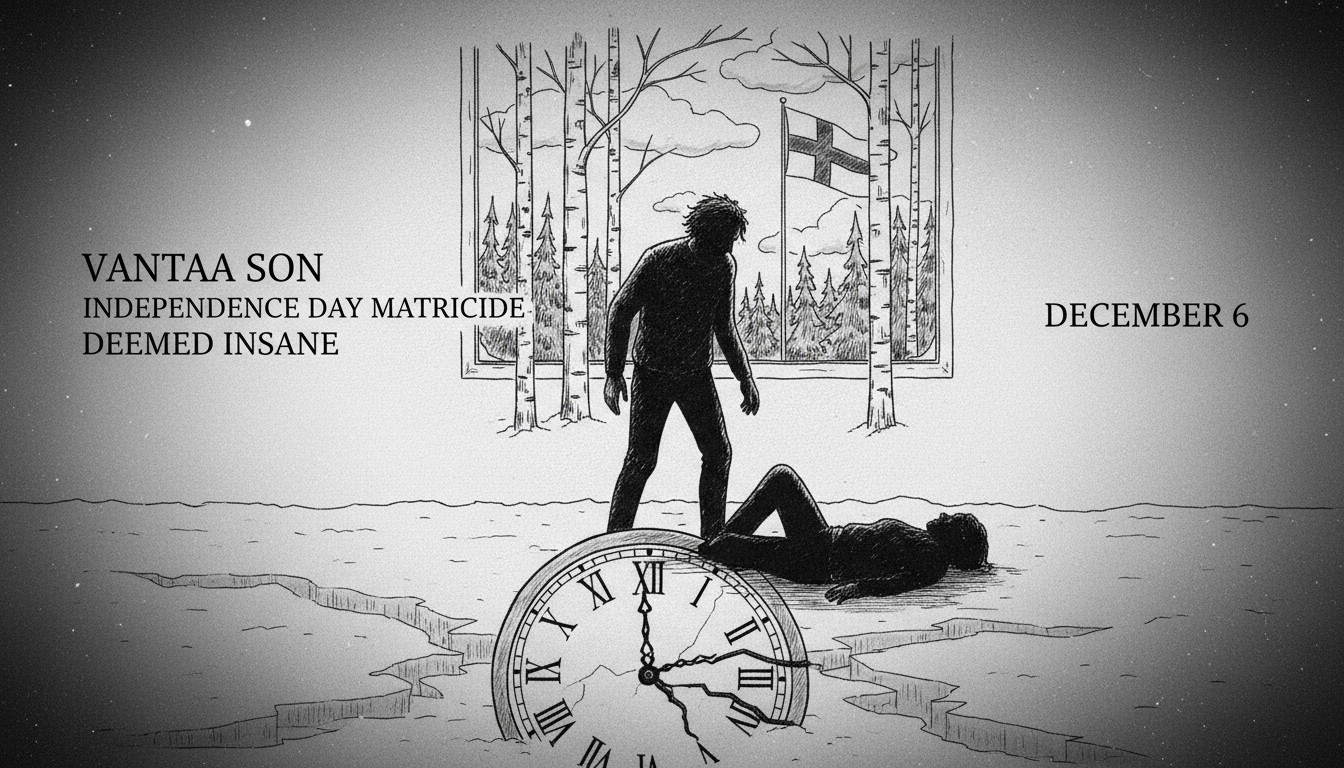
The East Uusimaa District Court delivered a verdict today in a harrowing case of matricide that occurred in Vantaa on Finland's Independence Day. A 28-year-old man was found guilty of murdering his 57-year-old mother but was not sentenced to prison. The court deemed him not criminally responsible due to insanity at the time of the act. He was ordered into involuntary psychiatric care. The court also mandated he pay his brother 16,000 euros in compensation for mental suffering. The verdict is not yet legally binding.
The tragic events unfolded in a terraced house in the Rajakylä district of Vantaa. Police received an emergency call just after 11 PM on December 6th. The caller, the victim's son, stated he had beaten his mother to death. Officers found the woman deceased in the apartment. During police interrogations, the son described a violent argument that erupted that afternoon. He admitted to striking his mother approximately one hundred times, pausing intermittently to speak with her before resuming the assault. He stated his intention was to kill her, driven by a belief that one of them had to die for their cohabitation to end. Toxicology reports indicated he was under the influence of alpha-PVP, a highly dangerous synthetic stimulant known as 'flakka'.
Prosecutors sought a life sentence for murder. The defense argued for a manslaughter conviction, claiming the act was not particularly brutal or cruel and suggesting the victim had somehow provoked her son. The court firmly rejected these arguments. It found no justification for the mother's killing and described the son's actions in the terms presented by the prosecution. Prior to the final ruling, the court had ordered a psychiatric evaluation of the defendant's mental state, which formed the basis for the insanity verdict.
This case highlights critical aspects of Finland's legal and mental health systems. The Finnish Penal Code allows for a finding of non-responsibility if the perpetrator, due to a severe mental disorder or severe mental deficiency, was unable to understand the factual nature or illegality of their act or to control their conduct. Involuntary care orders are serious measures, used only when a person poses a danger to themselves or others due to a mental illness and refuses voluntary treatment. The case also underscores the devastating societal impact of potent synthetic drugs like alpha-PVP, which can trigger extreme paranoia and violence.
Such a verdict often prompts public debate about justice for victims and the balance between punishment and treatment. The court's decision prioritizes public safety and the treatment of a severely ill individual over retributive punishment. The financial compensation to the brother acknowledges the profound secondary trauma inflicted on surviving family members. The case serves as a grim reminder of the complex intersections between substance abuse, mental health crises, and familial tragedy, issues that social and healthcare services in Finland and across the Nordic region continuously strive to address.