
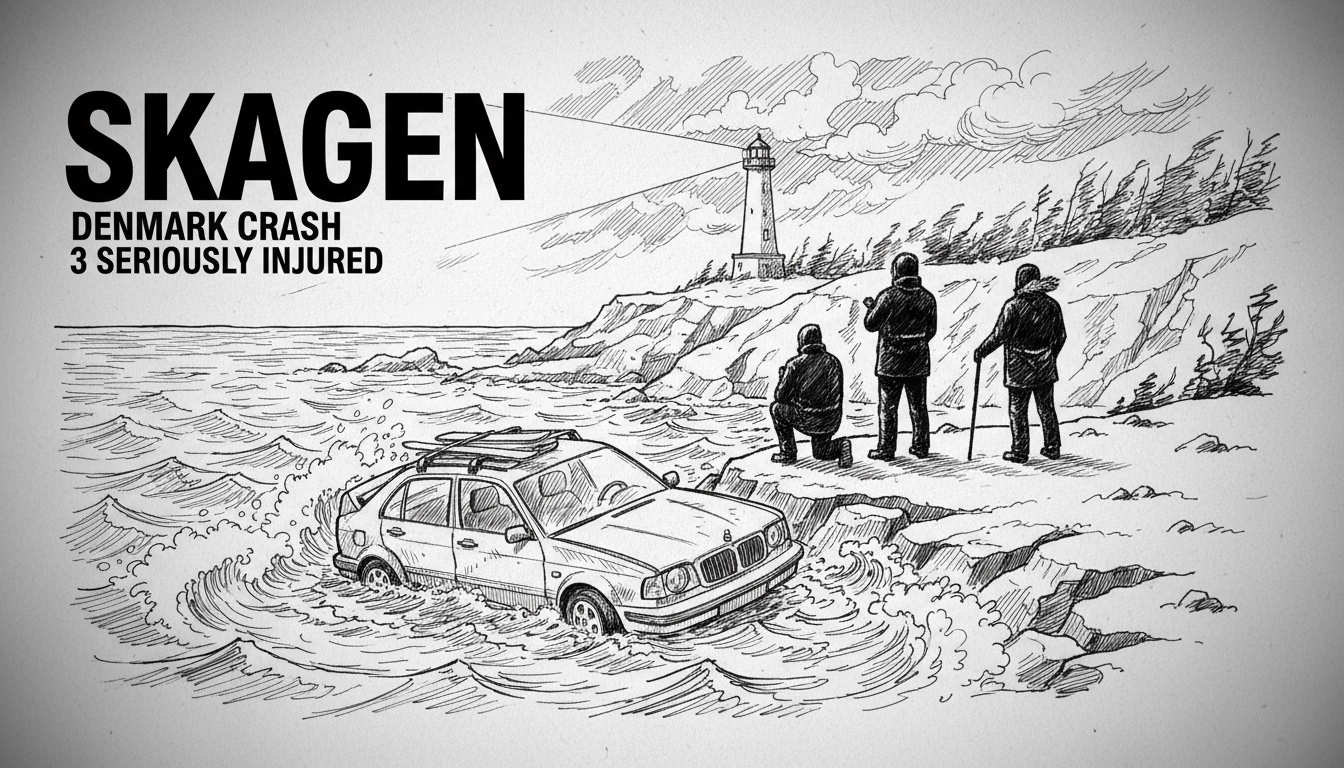
Denmark's Frederikshavnsvej road was the scene of a severe crash Monday, leaving three people with serious injuries. Two ambulances, escorted by police, rushed two victims to Aalborg University Hospital following the collision between two cars in Skagen. The incident, reported to North Jutland Police at 4:27 PM, prompted a full closure of the key northern road, causing significant disruption in the popular tourist area.
Witnesses described a scene of urgent activity as emergency services converged on Frederikshavnsvej. A police duty manager confirmed the seriousness of the injuries but could not provide details on the victims' conditions or whether their lives were in danger. The specific cause of the accident remains under investigation by a traffic accident inspector, who continued working at the site into the evening. By approximately 6:30 PM, police announced the road had partially reopened in both directions, though investigators remained on scene.
Emergency Response and Investigation
The immediate dispatch of two ambulances with police escorts highlights the protocol for serious trauma cases in Denmark's regional health system. Aalborg University Hospital serves as a major trauma center for Northern Jutland, equipped to handle severe injuries. The police escort facilitated rapid transit along the 70-kilometer route from Skagen, where every minute can be critical. The presence of a specialized car inspector indicates a standard procedure for analyzing collision dynamics, vehicle defects, and potential driver errors.
Local authorities have not released details about the vehicles involved or the identities of those injured. The police statement emphasized that the investigation's early stages prevent speculation about causes. This caution reflects standard Danish procedure, where thorough technical analysis precedes public conclusions. Road accident investigations typically examine speed, road conditions, visibility, and potential mechanical failure before determining contributing factors.
A Recurring Safety Challenge
This serious accident on Frederikshavnsvej brings renewed attention to road safety in Denmark's northern regions. While Denmark boasts one of Europe's lowest road mortality rates, with 2.7 road deaths per 100,000 inhabitants in 2022 according to the European Transport Safety Council, accidents persist on key arteries like Frederikshavnsvej. This road connects Skagen to Frederikshavn and larger highway networks, carrying both local traffic and seasonal tourists.
Road safety experts note that rural roads like Frederikshavnsvej present particular challenges. "While Danish motorways are among the safest, we see different risk profiles on regional roads," explains Lars Thuesen, a traffic safety researcher at the University of Southern Denmark. "Factors like varying driver familiarity, mixed traffic including bicycles, and sometimes higher speeds on straight sections can contribute to serious outcomes when collisions occur."
The Danish Road Directorate has implemented numerous safety measures in recent years, including better signage, rumble strips, and median barriers on high-risk routes. However, older roads like sections of Frederikshavnsvej may not have all modern safety features. This accident will likely prompt local municipality review of the specific stretch where the collision occurred.
The Human Cost and Community Impact
Behind the police bulletins and traffic disruptions lie profound human stories. Serious traffic injuries often result in long-term medical treatment, rehabilitation, and life-altering consequences for victims and families. The social costs extend beyond immediate healthcare to include lost productivity and long-term disability support, elements tracked by organizations like the Danish Transport Authority.
For the tight-knit Skagen community, such accidents resonate deeply. The town of approximately 8,000 residents sees its population swell with summer visitors, but year-round inhabitants form close networks. A serious accident involving locals would be felt across the community, while incidents involving visitors raise concerns about tourism infrastructure safety.
The psychological impact on first responders also merits consideration. Police officers, paramedics, and firefighters who attend serious collisions receive support through Denmark's established workplace care systems, but repeated exposure to trauma takes a cumulative toll. These professionals routinely manage the difficult balance between urgent medical intervention and securing evidence for future prevention.
Analysis: Denmark's Road Safety Paradox
Denmark presents a paradox: consistently ranking among Europe's safest countries for road travel, yet continuing to experience serious accidents like the Skagen collision. This incident offers several lenses for analysis. First, geographic distribution matters—safety resources and infrastructure improvements often focus on high-traffic urban corridors, potentially leaving some regional roads with lesser upgrades.
Second, human factors remain persistently challenging. Despite Denmark's strict drunk driving laws and seatbelt enforcement, driver distraction, fatigue, or error contribute to most accidents. The rise of smartphone use while driving presents a new challenge that legislation struggles to address effectively. Danish police conduct regular targeted campaigns, but enforcement gaps exist.
Third, vehicle safety improvements create a complex dynamic. Modern cars protect occupants better than ever, potentially encouraging riskier driving behavior through perceived invulnerability. Simultaneously, the increasing size and weight of popular SUV models can create greater danger for occupants of smaller vehicles in collisions.
Finally, infrastructure aging affects maintenance cycles. Denmark's extensive road network requires constant investment, with budget allocations sometimes favoring new projects over upkeep of existing routes. Municipalities like Frederikshavn Municipality, responsible for local roads, must balance numerous competing priorities within limited budgets.
Looking Ahead: Prevention and Policy
The Skagen accident investigation will eventually produce findings that could influence local safety measures. Potential outcomes include traffic calming installations, improved lighting or signage, or adjusted speed limits on specific Frederikshavnsvej sections. The Danish Road Safety Council typically reviews serious accidents for broader lessons applicable nationally.
Longer term, Denmark's road safety strategy faces evolving challenges. Electric vehicle adoption changes accident dynamics due to silent operation and rapid acceleration. Cycling infrastructure integration with road systems requires continued attention, especially in regions like North Jutland with popular cycling routes. Demographic aging means more elderly drivers and pedestrians with different risk profiles.
This accident serves as a somber reminder that statistical safety improvements don't eliminate human tragedy. As Denmark pursues its ambitious goal of zero traffic fatalities—part of the Vision Zero strategy adopted from Sweden—each serious incident generates renewed examination of what prevention measures could be strengthened. The Skagen victims' eventual recovery, and the investigation's conclusions, will write the next chapter in Denmark's ongoing road safety narrative. The question remains: can infrastructure and policy keep pace with human behavior and changing transportation technologies?