
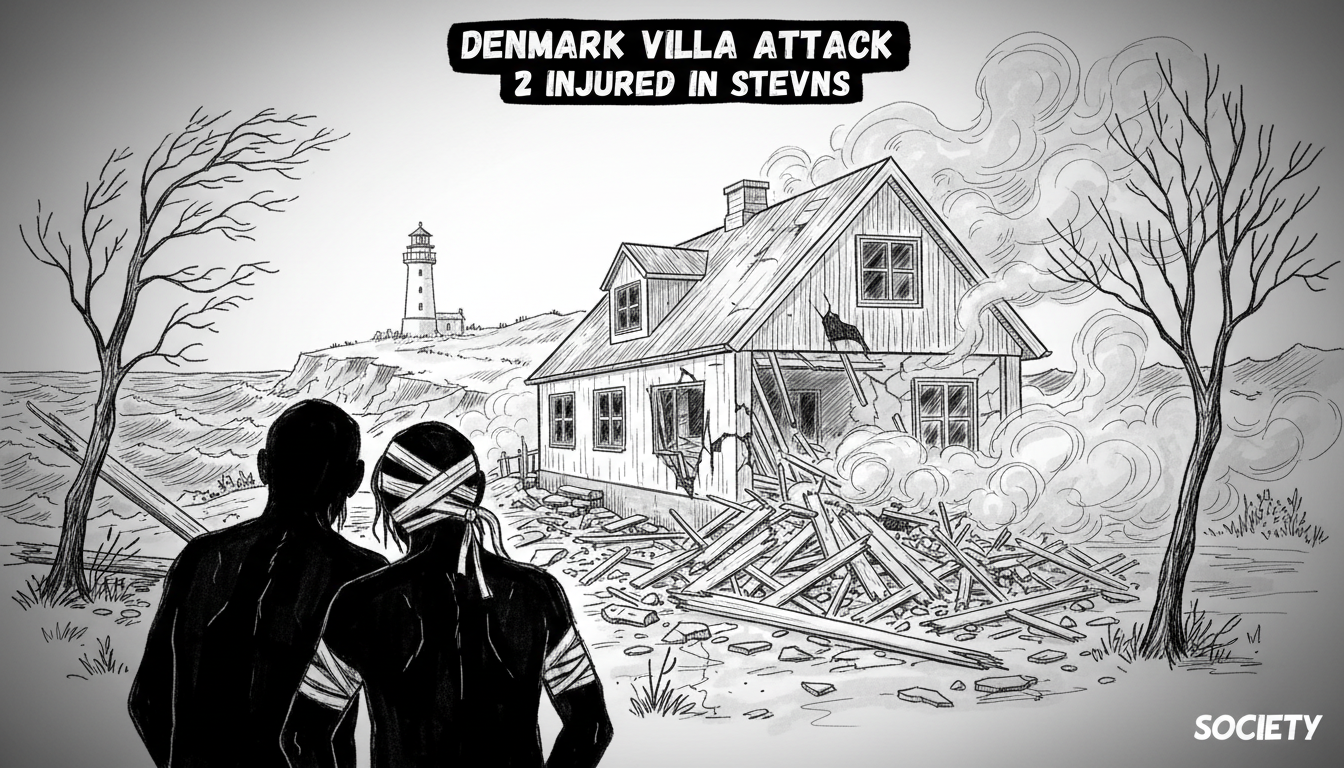
Denmark crime news is focusing on a coastal town after a violent Sunday evening incident left two people hospitalized. Police were called to a villa on Brombærvej in Faxe Ladeplads on the island of Stevns around 8:30 PM. Forensic technicians documented bloodstains and shattered windows at the scene, indicating a serious altercation. Authorities have confirmed only that they are investigating a "possible criminal offense" and have provided no details on the victims or a potential motive. This event has unsettled the quiet community, known more for its UNESCO World Heritage cliffs than violent crime.
A Peaceful Community Confronts Violence
Faxe Ladeplads is a harbor town of roughly 2,000 residents within Stevns Municipality. It is a place defined by its connection to the sea and the dramatic white chalk cliffs of Stevns Klint, a site of natural beauty that draws tourists from across the world. Crime here is typically measured in minor property offenses or seasonal disputes, not in bloodstains and forensic teams. The police response, including a dedicated forensics unit, underscores the severity of what investigators found. Local reports describe a scene that is starkly out of character for the area, transforming a residential street into a cordoned-off crime scene.
"When something like this happens in a small, close-knit community, the impact is profound," says Karen Mikkelsen, a sociologist who studies rural Danish communities. "There is no anonymity. Everyone is connected, and the shockwaves travel quickly through social networks and local institutions." She notes that while statistically safe, rural areas are not immune to isolated violent events. The lack of immediate information from police, she argues, can amplify anxiety as rumors fill the vacuum. Residents are left balancing their sense of security with the unsettling evidence left behind on Brombærvej.
The Deliberate Pace of a Police Investigation
The South Zealand and Lolland-Falster Police have been notably tight-lipped. Beyond confirming the two injuries and the ongoing investigation into a possible crime, officials have declined to comment on the nature of the incident. The lead investigator refused to characterize the potential offense when contacted by news agencies. This silence is a standard, if frustrating, part of major police work in Denmark. It is designed to protect the integrity of the investigation, prevent the spread of misinformation, and avoid compromising any future legal proceedings.
A former detective with the Danish police, who spoke on condition of anonymity, explained the process. "The presence of forensic technicians tells us they are treating the location as a primary source of evidence. They are mapping the scene, collecting physical samples, and documenting everything. Every piece of glass, every blood spatter pattern, is a data point. They will not discuss possibilities publicly until they have a coherent narrative supported by evidence." This methodical approach is standard but feels particularly slow to a community awaiting answers. The police must also interview witnesses, review any available video footage, and monitor the medical condition of the injured to gather statements.
The Context of Crime in Rural Denmark
To understand the significance of this event, one must look at the broader picture of safety in Denmark's rural municipalities. Overall, Denmark maintains low crime rates compared to international standards. Violent crime is relatively rare, and when it occurs, it is often concentrated in urban centers. Rural areas like Stevns typically report some of the lowest crime statistics in the country. Their challenges are more often related to access to services, demographic decline, or youth engagement rather than serious violence.
This incident, while serious, does not signify a trend. Isolated violent events can and do happen anywhere. Jens Thorhauge, a councilman in a neighboring municipality, commented on the social fabric. "Our communities are built on trust and a sense of shared responsibility. An event like this tests that. But the response is not panic; it is a collective concern for the well-being of those involved and a desire for clarity." He emphasizes that the local social welfare system, including community centers and municipal support services, often becomes a quiet backbone in such situations, offering informal support networks.
The Human Impact Beyond the Headlines
Behind the police statements and the technical term "possible criminal offense" are two people who required hospital treatment. Their conditions, identities, and relationships remain private. Were they residents of the villa? Were they visitors? The answers to these questions shape the story from a generic crime report into a human event with specific consequences. The trauma of such an experience extends beyond physical injuries, affecting families, friends, and neighbors who now view their own community through a lens of uncertainty.
Local community leaders, while respecting police protocols, are undoubtedly gauging the need for broader support. In Danish society, the municipal system is often the first line of psychosocial support outside the hospital. While major crises trigger formal responses, the everyday support comes from local networks. "The true measure of a community's strength is not the absence of crisis, but its response to it," observes sociologist Karen Mikkelsen. "In the coming days, watch for how people come together, check on one another, and reaffirm the bonds that make a village more than just a collection of houses."
Awaiting Answers in Faxe Ladeplads
As Monday turns to Tuesday, the investigation continues. The police have a duty to be thorough and a responsibility to be transparent when possible. For the residents of Faxe Ladeplads, life continues amidst a cloud of unanswered questions. Children go to school, people go to work, but the villa on Brombærvej stands as a silent reminder of a broken Sunday evening. The story is no longer just about an incident; it is about how a peaceful community processes disruption and waits for the facts to replace fear.
The road ahead involves patience. The police investigation will follow its course, evidence will be analyzed, and eventually, a clearer picture will emerge. This process is a cornerstone of the Danish justice system, designed to be meticulous and fair. For now, the Stevns crime report remains open, a single, stark entry in the otherwise quiet ledger of a rural municipality. It serves as a reminder that safety is a fragile construct, and community resilience is built one day at a time, often in the face of unsettling and unexplained events.