
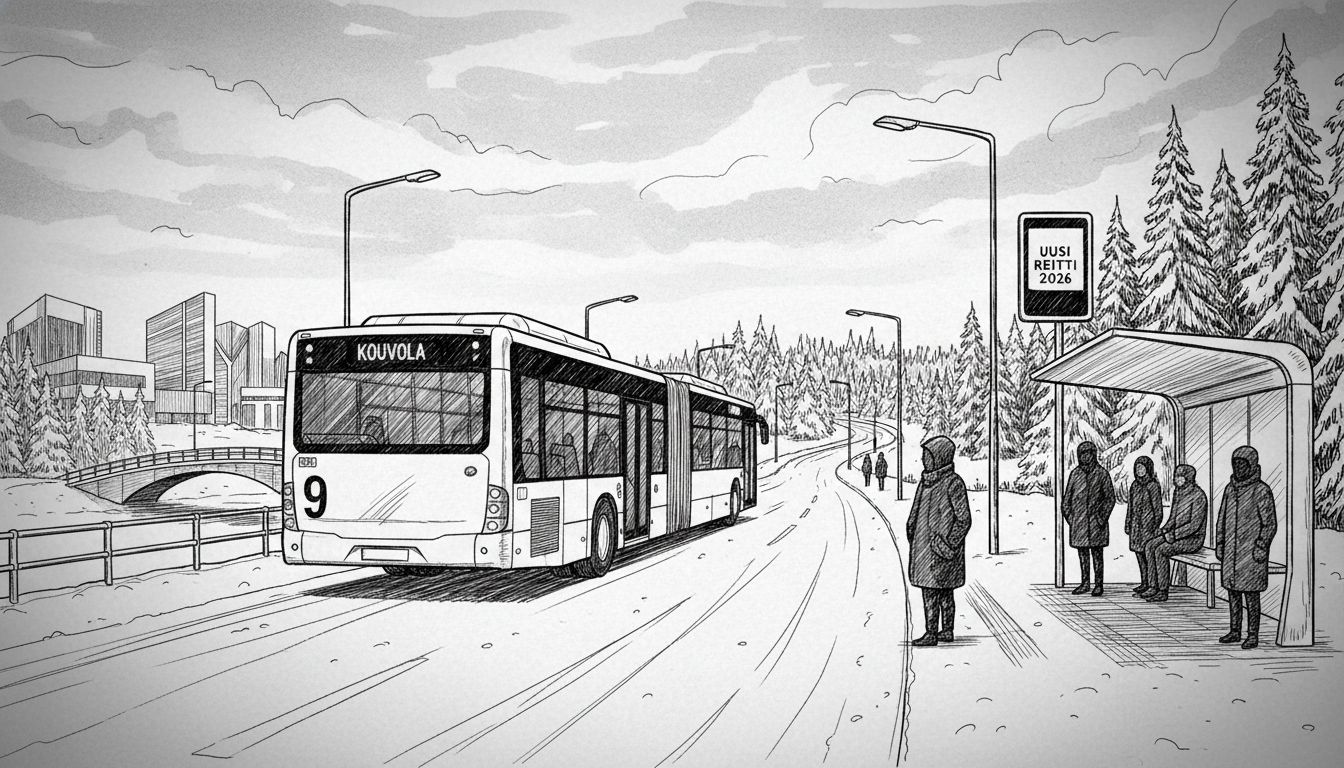
Finland's public transport authority in Kouvola is leveraging a five-minute efficiency gain to extend Bus Line 9, directly responding to resident demands for better connectivity. Starting January 5, 2026, the Koutsi-operated lines 9, 9A, and 9K will lengthen their journey through the Tornionmäki district, adding Nevantie and Sydänmaantie to their route. This adjustment, born from schedule monitoring and customer feedback, exemplifies a pragmatic approach to urban mobility in Finnish municipalities. For residents in these neighborhoods, the change means direct bus access for the first time, altering daily commutes and evening routines.
The Five-Minute Window That Enabled Change
During routine autumn surveillance, Koutsi officials noted that Bus Line 9 consistently arrived at its Tornionmäki terminus approximately five minutes ahead of schedule. This buffer, though seemingly minor, presented a tangible opportunity for service enhancement without requiring additional resources or significantly impacting operational costs. In the tightly managed world of municipal transit, such small margins are often the difference between stagnation and improvement. The discovery aligned perfectly with accumulated passenger requests, primarily from residents near Nevantie, who had long sought inclusion on a direct bus line.
Public transport analysts highlight this as a classic case of data-driven municipal management. "Finnish local authorities are adept at using operational data to make incremental, high-impact changes," said a transport policy researcher from the University of Helsinki, who preferred not to be named. "Identifying that five-minute window allowed Koutsi to solve a community access issue without overhauling timetables or budgets. It's efficient public administration in action." This move avoids the need for costly new routes or vehicles, instead making better use of existing capacity.
Community Feedback Translates into Concrete Action
The primary driver for the route extension was consistent customer feedback channeled through Koutsi's public engagement systems. Residents in the Nevantie area had formally requested bus service, citing the distance to existing stops and the need for better links to central Kouvola and the Jaala district. The new route will see buses from Jaala continue past the Eduko offices, loop via Nevantie and Sydänmaantie, and proceed onto Karjalankatu. The terminus will shift to the Harjuntie L stop, from which return trips to Jaala will commence.
This decision underscores the responsiveness of Finland's decentralized transport governance. Kouvola's city council, overseeing Koutsi, prioritizes such citizen-led initiatives within its strategic planning. The change reflects a broader Finnish political ethos where local needs can directly shape policy, even in technical areas like bus routing. It is a small-scale demonstration of the subsidiarity principle often discussed in EU contexts, where decisions are made at the most local effective level.
Revised Timetables and Driver Welfare Provisions
Accompanying the geographical extension are deliberate adjustments to the weekday evening schedule. To ensure compliance with strict Finnish and EU working time directives for drivers, the last departure from Jaala will move from 17:20 to 18:10. Similarly, the final weekday bus from Tornionmäki will leave at 19:20, instead of 19:05. These changes are not merely logistical but are mandated by Finnish labor laws and the EU's Working Time Directive, which dictate minimum rest periods and maximum shift lengths.
The timetable shift is a critical component, preventing driver fatigue and maintaining service safety. "Aikataulumuutoksilla varmistetaan kuljettajien työ- ja lepoaikasäädösten toteutuminen kaikissa tilanteissa," the city's statement noted, emphasizing the legal imperative. For passengers, this means slightly later last buses, potentially benefiting shift workers and evening commuters. The updated schedules are already visible on Koutsi's website and will appear in digital journey planners from the implementation date.
| Schedule Point | Current Last Departure (Weekdays) | New Last Departure (Effective Jan 5, 2026) |
|---|---|---|
| Jaala | 17:20 | 18:10 |
| Tornionmäki | 19:05 | 19:20 |
Integrating Local Transport with National and EU Agendas
While a localized route change, this adjustment connects to larger themes in Finnish and European policy. Finland's national transport system plan emphasizes accessibility and modal shift from private cars, goals supported by EU Cohesion Fund investments in regional infrastructure. Kouvola's decision enhances accessibility in a suburban district, aligning with strategic aims to make public transport a viable option for all residents.
From an EU perspective, efficient local transit contributes to broader carbon reduction targets and sustainable urban mobility plans (SUMPs), which many Finnish cities have adopted. The Finnish Ministry of Transport and Communications regularly monitors such local initiatives as part of national reporting to the European Commission. This route extension, though modest, represents the granular work required to achieve ambitious climate and mobility goals.
Political parties in the Eduskunta, Finland's parliament, consistently debate the funding and scope of local public transport. The center-left opposition often advocates for increased state subsidies to municipalities for service expansions, while the governing coalition stresses budgetary responsibility and evidence-based planning. Kouvola's move, requiring no significant new expenditure, offers a model that could resonate in these national discussions.
The Practicalities of Implementation and Passenger Information
Koutsi has initiated a public information campaign to ensure a smooth transition. The new route and timetable details are already published online, with physical updates to bus stop signage and printed materials scheduled for late 2025. The authority emphasizes that the extended route can be operated within the existing framework, causing minimal disruption. Passengers on the affected lines will need to note the new stopping points and the adjusted times for the last evening services.
The extension also serves the Eduko office facilities, potentially catering to evening workers in that area. This highlights the role of public transport in supporting local economic activity, a factor considered by Kouvola's city planners. The responsiveness to feedback may set a precedent for future adjustments on other Koutsi lines, as the authority continues to monitor passenger volumes and travel patterns post-pandemic.
A Model of Incremental Improvement in Public Service
As Finland navigates economic pressures and demographic shifts, the Kouvola bus route extension stands as a testament to pragmatic, responsive local governance. It demonstrates how continuous monitoring, community engagement, and adherence to regulatory frameworks can coalesce into tangible service improvements. The change is small in scale but significant in its impact on the daily lives of Tornionmäki residents.
Looking ahead to the 2026 implementation, the success of this adjustment will be measured by increased ridership and satisfaction in the newly served areas. It raises a question for other Finnish municipalities: how can they identify similar micro-opportunities within their own transit systems to enhance connectivity without straining public finances? In the intricate landscape of Finnish public administration, sometimes a five-minute margin is all that is needed to drive meaningful change.