
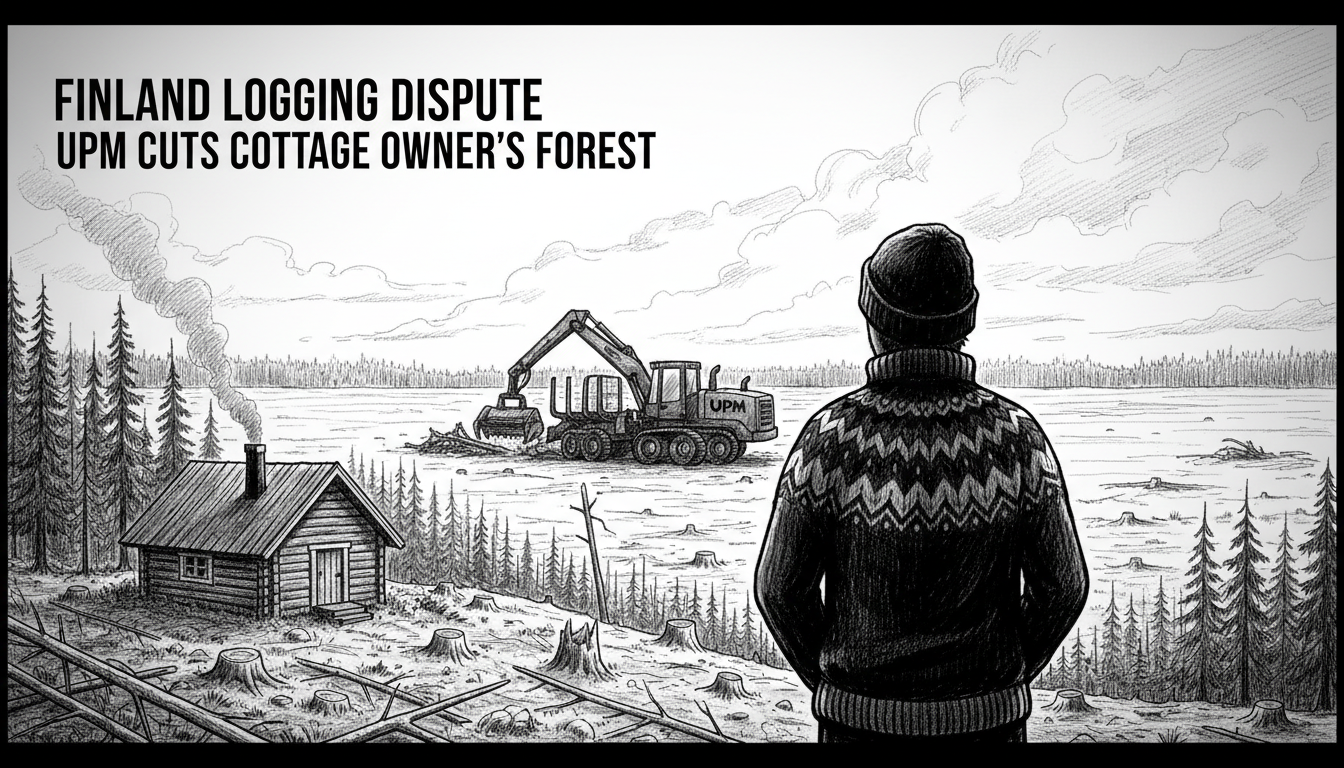
Finland's vast forests, covering over 75% of the country's land, are a source of national identity and economic power. For private owners like Eija Hakanen, they are also a personal sanctuary. That sense of ownership and peace was shattered when forestry giant UPM conducted logging operations that reached the edge of her cottage yard in Mikkeli, despite assurances it would not. This incident highlights a growing tension between large-scale commercial forestry, climate-driven ecological threats, and the rights of Finland's many small-scale forest owners.
Eija Hakanen inherited a summer cottage and its surrounding forest from her father a few years ago. Wanting to be a responsible steward, she contacted UPM's forest customer advisor for expert guidance on necessary care measures for her woods. The advisor visited and identified an over-aged spruce stand that was at risk from the European spruce bark beetle, known in Finnish as 'kirjanpainaja'. This beetle, a significant pest in forestry, can rapidly kill spruce trees. Hakanen agreed to a logging operation to manage this threat. She was given a clear promise: the cutting would not extend into her cottage yard. "UPM promised it would not extend the logging to the cottage yard. The opposite happened," Hakanen stated, expressing her shock at seeing the harvest reach her property line.
A Broken Promise at the Property Line
The situation embodies a classic conflict in Finnish land use. Approximately half of Finland's forests are owned by private individuals, often families who have held the land for generations. These owners balance personal attachment, recreational use, and economic benefit from timber sales. Companies like UPM, a global leader in pulp, paper, and timber, rely on a steady supply from these private forests, offering management services and purchasing wood. Trust is a crucial component of this relationship. For Hakanen, the breach of a specific promise about the logging boundary transformed a cooperative forest management exercise into a personal violation. The visual impact of a cleared area directly abutting a cherished cottage landscape is significant, changing the character and privacy of the property.
The Rising Threat of the 'Kirjanpainaja' Beetle
The rationale given for the urgent logging was scientifically sound, reflecting a major challenge for Nordic forestry. The European spruce bark beetle (Ips typographus) is a native insect whose populations have exploded due to climate change. Warmer temperatures allow the beetle to produce more generations per year, while drought-stressed spruce trees become less resistant to attack. Outbreaks have caused widespread tree mortality across Central Europe and are increasingly problematic in the south of Finland. Proactive removal of vulnerable, mature spruce stands is a standard and recommended forest management practice to prevent catastrophic outbreaks. From a purely silvicultural perspective, UPM's initial advice to Hakanen was correct. The failure, therefore, was not in the prescription but in the execution and communication of the logging operation's limits.
The Power Imbalance in Private Forestry
This incident sheds light on the practical power dynamics between individual forest owners and large forestry corporations. While the owner holds the deed, the company possesses the heavy machinery, the forestry expertise, and the commercial network. An individual relying on a company's advisor for professional counsel is in a vulnerable position. The complexity of forestry regulations and cutting plans can be daunting for non-experts. "Disputes often arise from misunderstandings about the spatial details of a logging plan or from on-the-ground changes during operation," explains a Finnish forestry consultant who wished to remain anonymous due to industry ties. "The map viewed in an office can look different to a machine operator in a dense stand. However, clear boundary markings and strict supervision are non-negotiable for maintaining trust."
Sustainable Management or Commercial Pressure?
The core question is where the line falls between necessary, sustainable forest management and aggressive commercial harvesting. UPM and other companies operate under Finland's Forest Act, which mandates sustainable use and regeneration. The law aims to balance ecological, social, and economic values. Critics, however, argue that the economic dimension often dominates in practice, especially when companies are responding to high global demand for pulp and timber. The pressure to secure wood fiber can sometimes lead to overly aggressive harvesting or marginal expansions of cutting areas to improve efficiency for the harvesting machinery. For the cottage owner, what is a beloved view is, for the harvester, a few additional cubic meters of timber and a more convenient turning radius for the forwarder.
Seeking Recourse and Resolution
For Eija Hakanen, the path forward involves seeking redress. Finnish forest owners have channels for complaint, starting with the forestry company itself and potentially escalating to the Finnish Forest Centre (Metsäkeskus), the state authority overseeing forestry compliance. Compensation may be sought for the unauthorized cutting, but this does not restore the lost trees or the immediate landscape. The case serves as a cautionary tale for other small forest owners. Experts advise getting all promises—especially regarding exclusion zones around yards, waterways, and heritage trees—in detailed, written form on the harvesting contract. Independent verification of boundary markings before work begins is also recommended.
A Broader Nordic Challenge
This dispute is not unique to Finland. Similar tensions exist across the Nordic region, where extensive private forest ownership meets a powerful forestry industry. In Sweden and Norway, debates rage about clear-cutting practices, biodiversity loss, and the rights of Sami indigenous peoples. The added stressor of climate change, manifesting in pest outbreaks and increased storm damage, is forcing all parties to adapt their practices. The need for more resilient, mixed-species forests is becoming ecologically evident, even if it challenges the traditional economics of conifer-dominated forestry.
The story of Eija Hakanen's cottage yard is a microcosm of these vast forces. It is about a specific broken promise, but also about the future of Europe's last great forests in an era of climatic and economic pressure. It asks whether the model of large-scale industrial forestry can coexist with the fine-grained, personal values of hundreds of thousands of individual landowners. As the spruce bark beetle continues its northward march, driven by warming climates, the pressure to cut will only increase. How Finland manages these conflicts—honoring promises, respecting boundaries, and balancing all values of the forest—will define its landscape for generations to come. The health of the forest ecosystem and the trust of its people depend on it.