
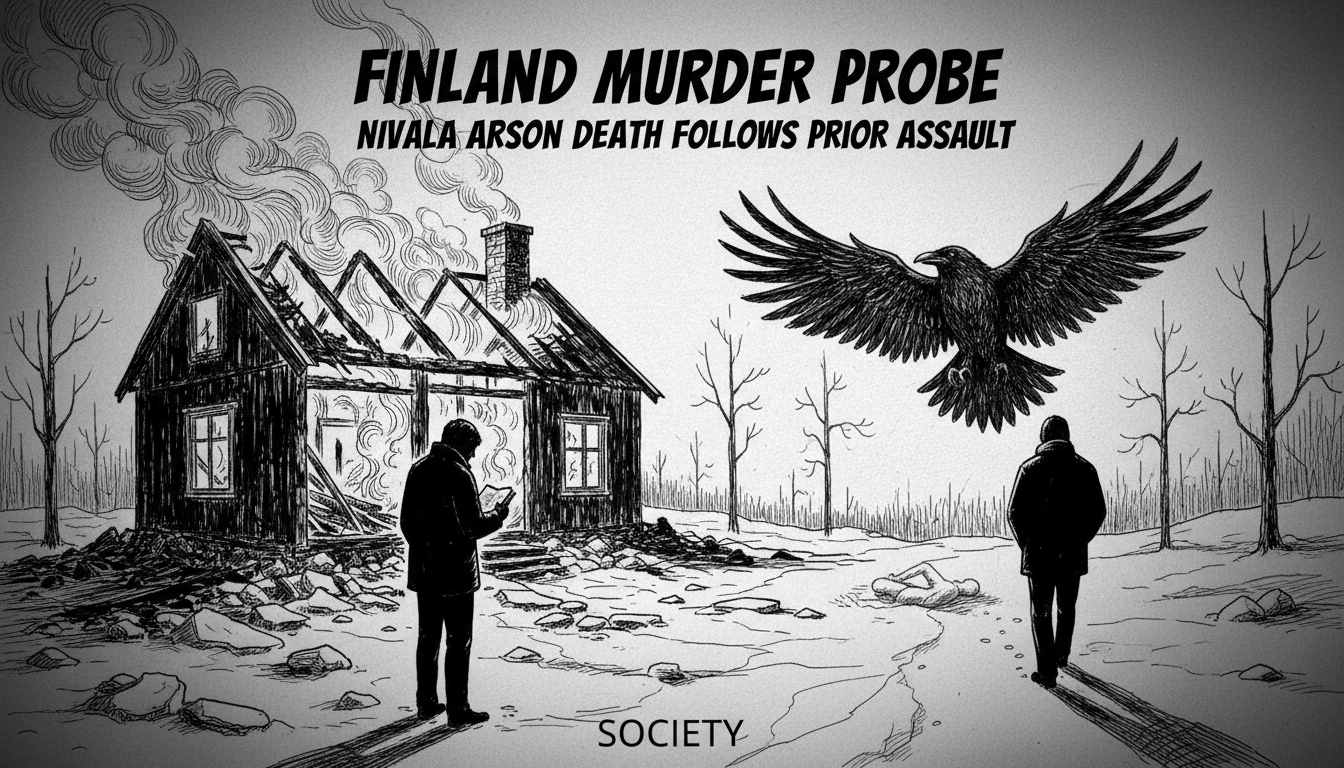
Finland's quiet town of Nivala became the site of a grim homicide investigation last week after a 61-year-old man was arrested for allegedly setting his neighbor's house on fire, resulting in the 69-year-old victim's death. The tragedy follows a prior conviction where the same suspect was found guilty of assaulting the victim with a fruit knife nearly two years earlier, raising urgent questions about violence escalation and community intervention.
A Fatal Fire in a Frozen Landscape
Emergency services received a call about a house fire in Nivala, a municipality in the North Ostrobothnia region, on the afternoon of Friday, December 19, 2025. A passerby reported the blaze shortly before 5 pm. Nearly ten units from the North Ostrobothnia Rescue Department rushed to the scene. During firefighting operations, responders discovered the body of the 69-year-old male resident inside the burning home. Police quickly shifted their investigation from a fire response to a suspected homicide. The arrest of the victim's 61-year-old neighbor came the following day. The Oulu District Court ordered the suspect imprisoned on suspicion of manslaughter and criminal damage, specifically arson, on December 23rd.
A Violent History Between Neighbors
The investigation revealed a disturbing prior connection between the two men. Court records show the now-suspected arsonist was convicted last October, in 2024, for assaulting the same neighbor. That violent incident occurred on Valentine's Day, February 14, 2024. According to the prior case, the two men were socializing at the victim's home when an alcohol-fueled evening turned violent. The suspect grabbed a fruit knife, swinging and slashing at the victim, wounding him in the finger. The injured man called emergency services, leading to the suspect's arrest at that time. The court sentenced the attacker to 70 day-fines, totaling 420 euros, and ordered him to pay approximately 1,200 euros in compensation to the victim for damages and suffering. Finnish police sources indicate the suspect had no other criminal record for at least the past decade prior to this assault conviction.
Examining a System Under Scrutiny
This case places Finland's justice and social systems under a microscope. The sequence of events—from a convicted assault to a fatal arson attack over a span of nearly two years—prompts analysis from criminologists and legal experts. "When we see interpersonal violence escalate to this extreme level, it forces us to examine the points where intervention might have been possible," said Dr. Elina Saarinen, a criminologist at the University of Helsinki, speaking on general principles of violence prevention. She emphasized that while Finland's penal system focuses strongly on rehabilitation, cases involving repeated violence between known parties require careful risk assessment. Investigators in Nivala will likely explore all potential motives and contributing factors, including the role of mental health and substance abuse, which are common elements in studies of interpersonal violence. The prior conviction, while resulting in a financial penalty, did not involve a prison sentence, a point that will be scrutinized in the wake of the fatal outcome.
Finland's Context of Low Crime and High-Impact Cases
Finland maintains one of the lower homicide rates in the world, a fact that makes individual cases particularly shocking to the national conscience. According to latest official statistics, Finland's homicide rate stands at approximately 1.2 per 100,000 inhabitants. In 2023, police recorded 63 homicides nationwide. Arson leading to death is a severe but statistically rare crime. The legal consequences for such acts are significant; a conviction for manslaughter in Finland can result in a prison sentence ranging from a few years to life imprisonment, with the severity of arson as an aggravating factor. The case in Nivala does not fit common gang-related or organized crime patterns seen in some urban centers, but rather appears as an intensely personal tragedy rooted in a deteriorating relationship between two individuals. This pattern aligns with broader Nordic crime data where a substantial portion of homicides occur within known social circles, often involving alcohol.
Community Impact and Legal Proceedings Ahead
The town of Nivala, with a population of around 10,000, is now grappling with the aftermath. Such events resonate deeply in close-knit communities where violent crime is an exceptional occurrence. Local social and health services often activate support systems following traumatic incidents affecting community well-being. The suspect remains in pre-trial detention as the National Bureau of Investigation, which often leads complex homicide probes, continues its work. Police must now build a forensic case linking the suspect to the fire's origin and demonstrate intent. They will examine all evidence from the scene, digital records, and witness statements. The prior assault conviction will almost certainly form part of the prosecution's narrative, illustrating a history of conflict. The defense will have the right to present its own explanation of events. A trial at the Oulu District Court is likely many months away, as Finnish judicial procedures allow time for thorough investigation and preparation. The final outcome will hinge on whether prosecutors can prove beyond reasonable doubt that the suspect intentionally set the fire, knowing it could cause the death of his neighbor.
A Broader Look at Prevention and Response
This tragedy sparks a difficult conversation about monitoring and managing known risks within communities. It highlights the challenge authorities face nationwide: identifying situations where a past act of violence might signal potential for future lethal danger. Finland has extensive social and healthcare services, but proactive intervention relies on identification and resource allocation. The case also underscores the devastating impact of arson, a crime treated with utmost seriousness due to its inherent danger to life and property. As the investigation continues, the people of Nivala are left with a profound sense of loss and a search for answers that may never fully come. The story serves as a somber reminder that even in societies with low crime rates, human conflict can escalate to irreversible tragedy, leaving legal systems and communities to manage the painful consequences.