
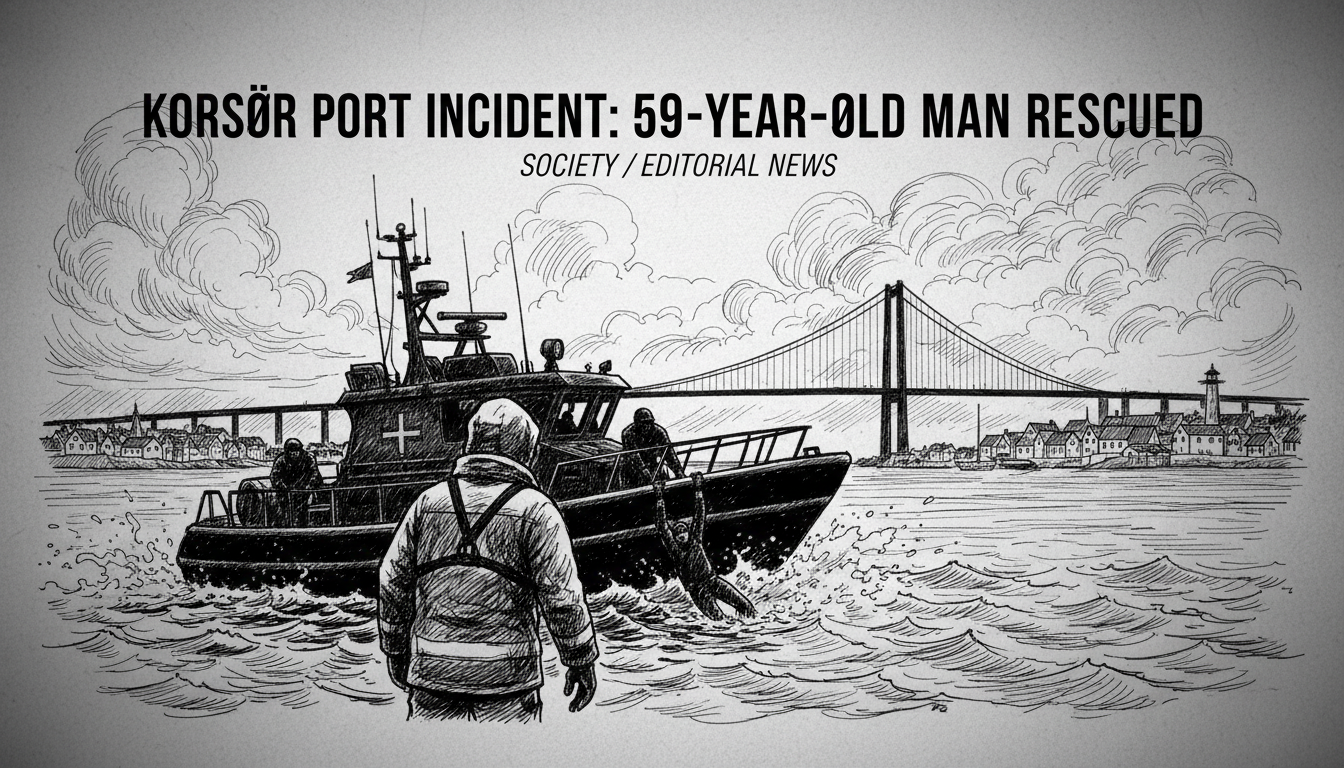
Denmark harbor accident unfolded early Sunday morning at the historic Korsør port. A 59-year-old man was found in the water at Havnearkaderne, the town's central waterfront area, prompting a rapid emergency response. Police were alerted at 6:44 AM, and the man, suffering from severe hypothermia, was pulled from the harbor and transported to Slagelse Sygehus. The initial police assessment points to an accident caused by the man's own lack of caution, though the exact circumstances of how he entered the water remain unclear. This incident casts a spotlight on waterfront safety and the fragility of life in Denmark's coastal communities.
A Chilling Morning Rescue
The quiet of a Sunday morning in Korsør was broken by an urgent call to the South Zealand and Lolland-Falster Police. Kasper Skotte, the police duty manager, confirmed the basic details of the Korsør port incident. Emergency services, including fire brigade personnel, rushed to Havnearkaderne. When rescuers retrieved the man from the cold Belt Strait waters, his body temperature had dropped dangerously low. Hypothermia sets in quickly in Danish waters, even in summer, making immediate medical attention critical. The swift transport to Slagelse Hospital likely played a decisive role in his survival, a testament to the region's emergency response protocols.
This rescue operation highlights the ever-present risks in harbor areas. Denmark, with its vast coastline, has developed extensive maritime safety procedures. Yet, individual accidents still occur. The police have not indicated any suspicion of foul play, focusing instead on the theory of an accidental fall. For a 59-year-old man, such an ordeal represents a profound physical trauma. His current condition has not been publicly disclosed, respecting patient confidentiality laws that are strict pillars of the Danish welfare system.
The Historic Heart of Korsør
To understand the setting of this Denmark harbor accident, one must know Korsør. This town in Slagelse Municipality is defined by its relationship with the Great Belt strait. For generations, it served as a vital ferry terminal, the primary link between Zealand and Funen before the majestic bridge was built. Havnearkaderne, where the man was found, is the modern embodiment of that maritime heritage—a public space for leisure, lined with boats and walking paths. It is a place of community and calm, which makes a sudden emergency there so jarring.
My own reporting on Danish society often focuses on how public spaces function as social connectors. Havnearkaderne is precisely such a place. It is where people walk dogs, fish, and watch the sunset. An incident like this reverberates through the tight-knit fabric of a town like Korsør. It prompts quiet questions among residents about safety rails, lighting, and the invisible lines where community space meets inherent risk. The local municipality will undoubtedly review the area, though the police assessment of 'own carelessness' suggests no immediate fault with the infrastructure.
Waterfront Safety and Social Responsibility
This event, while an isolated personal accident, opens a window into broader discussions about safety and social care. Danish social policy is built on a foundation of preventative care and community well-being. Public areas are generally designed with a high degree of safety in mind. However, absolute prevention of accidents is impossible. The response, therefore, is key. The efficiency of the rescue operation—from the first call to the hospital admission—shows the Danish welfare system in action, a network of professional services funded by the collective.
Statistics on accidental drownings in Denmark show they are relatively rare but often involve adults near harbors or piers, sometimes linked to undisclosed medical events or slips. The police did not mention if a medical episode preceded the man's fall, a detail that may remain private. This incident serves as a seasonal reminder of the dangers of cold water and uneven surfaces. As summer approaches and more people seek out Denmark's beautiful harbors, the balance between open access and safety becomes a quiet concern for local authorities.
The Human Story Behind the Headline
Behind the brief police bulletin lies a profound human story. A man in his late fifties, at an age where life often settles into a predictable rhythm, experienced a terrifying and life-threatening event at dawn. The psychological impact of such a trauma, for him and possibly for his family, is significant. Denmark's robust healthcare and social support systems will be crucial in the follow-up, offering physical rehabilitation and potentially mental health services.
In my conversations with integration and social service leaders in Copenhagen, a common theme is the network of support that exists outside the hospital walls. Municipal social services, community health nurses, and local voluntary organizations form a safety net. For the man in Korsør, accessing this net may become part of his recovery. It is a facet of Danish society that often goes unseen but is mobilized precisely for moments like this. The story is not just about a fall into the water, but about what happens after the rescue—the process of healing supported by the system.
A Community's Quiet Reflection
Korsør is a town familiar with the power and peril of the sea. Its history is written in ferry schedules and fishing logs. A Sunday morning rescue is a stark reminder that the water that gives the town its identity and beauty also holds danger. The community will likely absorb this event with a characteristically Danish reserve, trusting in the authorities' assessment while perhaps looking more carefully along the harbor's edge during evening strolls.
There will be no major political scandal or urgent parliamentary debate stemming from this single incident. Instead, it settles into the pattern of local news—a somber event met with professional competence and community concern. It reinforces a silent contract in Danish society: that public spaces are for everyone, but personal vigilance is the first line of defense. The successful rescue underscores the value of a well-funded, coordinated emergency response, a feature of the Danish model that is easy to take for granted until the moment it is needed.
The man's story ends, at least publicly, with his admission to the hospital. His personal experience from that point forward is his own. Yet, this Denmark harbor accident leaves a trace on the community consciousness in Korsør. It asks, without demanding an answer, how we balance our love for the water's edge with an acknowledgment of its risks. As the town moves on, the gentle lap of waves against Havnearkaderne continues, a constant sound bearing witness to both daily peace and sudden alarm.