
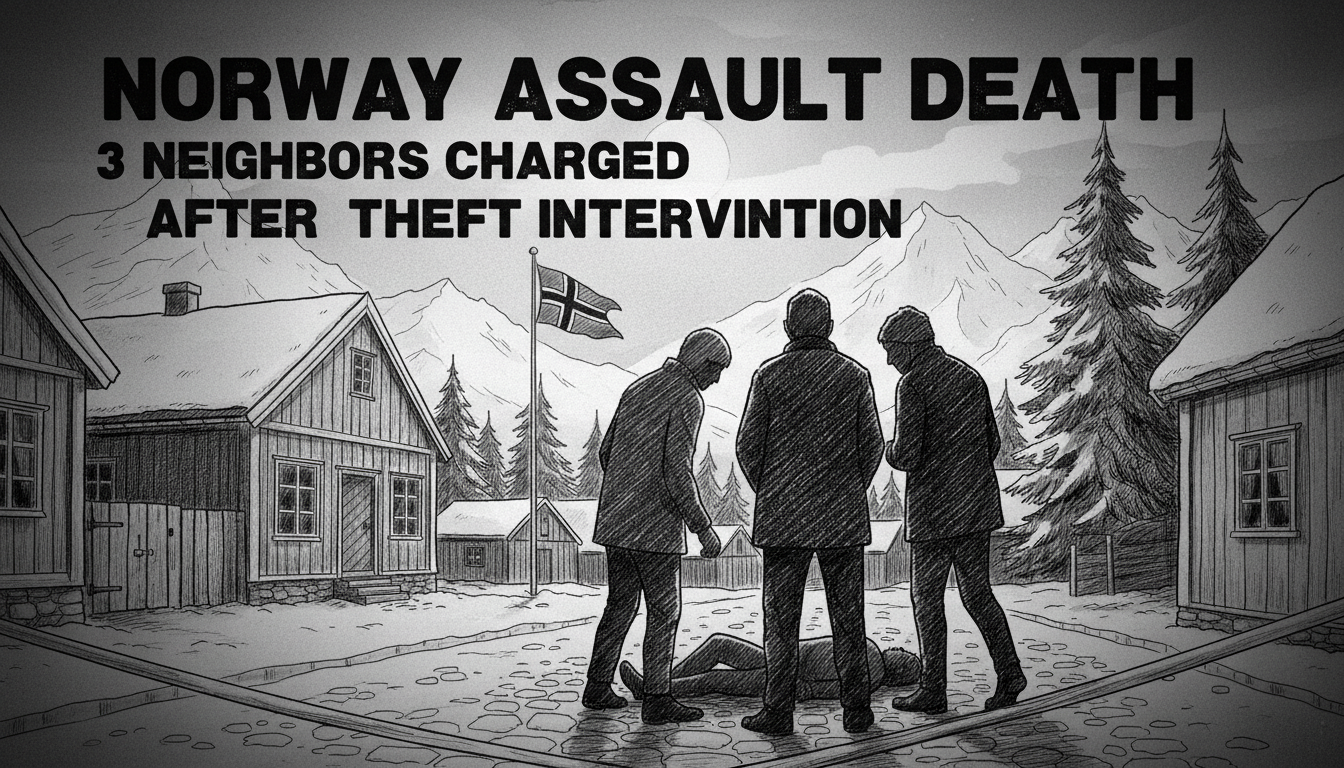
Norway police are investigating a fatal assault case that raises urgent questions about citizen intervention and the limits of self-defense. Three neighbors are charged with aggravated assault resulting in death after they reportedly intervened to stop a theft. A man in his 40s died after he stopped breathing while being restrained.
Police prosecutor Unni Byberg Malmin confirmed the charges and the ongoing investigation. "We are interested in contacting people who have information that can shed light on the case," Malmin said in a statement. The incident occurred in a residential area, though police have not disclosed the specific location while the investigation continues.
This case strikes at the heart of a complex legal and social dilemma in Norway. While community vigilance is often encouraged, the law demands strict proportionality in the use of force. The death of a suspect during a citizen's arrest presents a tragic outcome that will be scrutinized through both legal and ethical lenses.
A Deadly Attempt to Stop a Crime
According to initial information, the three accused individuals confronted the man on suspicion of theft. During the confrontation, a physical altercation occurred. The man was reportedly held down, a method of restraint that can be particularly dangerous if not applied correctly. At some point during this restraint, the man stopped breathing.
Emergency services were called to the scene. Despite resuscitation attempts, the man was pronounced dead. The police investigation will now meticulously reconstruct the sequence of events. They will examine the level of force used, the techniques of restraint employed, and whether the neighbors' actions remained within legal boundaries from start to finish.
The charge—'grov kroppskrenkelse med døden til følge'—carries a maximum prison sentence of 15 years under Norwegian law. It is applied when an assault directly leads to a person's death, regardless of whether death was the intended outcome. The severity of the charge reflects the gravity of the result.
The Fine Line Between Intervention and Excess
Norwegian law permits citizens to use force to prevent a crime, a principle known as 'nødverge' (self-defense/necessity). However, this right is not unlimited. The core legal principle is proportionality. The force used must be reasonable and necessary to stop the criminal act. It must also cease once the threat is neutralized.
"The law is clear that any use of force must be proportionate to the threat you are facing," explains Professor Johs. Andenæs, a leading Norwegian legal scholar whose work on criminal law remains foundational. "Intervening to stop a theft is one thing. Using force that results in death is an entirely different matter that the courts must examine with extreme care."
The investigation will assess if the theft in progress presented an immediate physical threat that justified a forceful restraint. It will also determine if the method of holding the man down was inherently dangerous or if underlying health conditions contributed to his death. The autopsy report will be a critical piece of evidence.
This case differs significantly from scenarios where a homeowner confronts an armed intruder. Here, the alleged crime was theft, and the response involved physical restraint that proved fatal. The transition from lawful intervention to unlawful assault can happen in seconds, a reality this case tragically illustrates.
Community Safety and Legal Responsibility
The incident has sparked a quiet but intense debate in Norwegian communities. There is a strong cultural value placed on looking out for one's neighbors and maintaining safe, close-knit communities. Many Norwegians would instinctively act to protect their neighbor's property.
Yet this tragedy serves as a somber reminder of the risks involved. Legal experts uniformly advise citizens to prioritize calling the police (112) over physical confrontation. "Your primary duty is to alert the authorities," says defense lawyer Marianne Høgetveit. "If you choose to intervene physically, you assume significant legal responsibility for the consequences. The burden of proof that your actions were justified and proportionate will fall on you."
Police training emphasizes de-escalation and controlled restraint techniques, skills private citizens typically do not possess. What might begin as an attempt to detain someone can quickly escalate due to adrenaline, fear, or a struggle. The deceased man's right to life and bodily integrity, even as a suspected thief, is a fundamental principle that investigators must balance against the neighbors' right to act.
A Broader Look at Citizen Arrests in Scandinavia
While rare, fatal outcomes from citizen interventions have occurred elsewhere in the Nordic region. Each case prompts a re-examination of public guidelines. In Sweden, a similar case several years ago led to renewed public information campaigns about the risks of physical intervention.
The Norwegian Directorate of Police publishes general advice, stressing that citizens should never put themselves in danger. The official guidance is unambiguous: observe, report, and be a good witness. Provide the police with the best possible description rather than becoming an active participant in a potentially violent situation.
This advice can feel counterintuitive in the moment, especially when witnessing a crime against a neighbor. The instinct to act immediately is powerful. This case demonstrates the potential for that instinct to lead to irreversible tragedy and severe legal repercussions for all involved.
The Path Forward for the Investigation
The police investigation, led by prosecutor Malmin, is now in a critical evidence-gathering phase. Forensic teams will have examined the scene. Witnesses, beyond the three charged individuals, are being sought. The police statement explicitly calls for anyone with information to come forward.
The three neighbors charged will be interviewed extensively by their defense lawyers and the police. Their accounts of the perceived threat, their intentions, and their actions in the moment will form the narrative defense. They will likely argue they were acting in good faith to protect property and stop a crime.
The prosecution must prove that the force used was unreasonable and that it directly caused the man's death. This is a complex causal chain to establish. The court will need to weigh the defendants' intent against the objective outcome. A key question will be whether a reasonable person would have considered the force used necessary and proportionate to stop the theft.
A Tragedy With Multiple Victims
Beyond the legal process, this event has created a web of human tragedy. A man has lost his life. Three individuals who apparently sought to do what they thought was right now face the prospect of lengthy prison sentences and lifelong criminal records. Their families and the community are left to grapple with the aftermath.
The family of the deceased man is also victimized, first by his alleged actions and then by his death. The emotional and psychological impact on everyone who witnessed the event or is connected to those involved will be profound and lasting.
This case is not about vigilantism in the classic sense. It appears to be a case of well-intentioned intervention that went catastrophically wrong. That distinction makes it perhaps more unsettling for the average citizen. It highlights how quickly a situation can spiral beyond control, turning a citizen into a defendant.
The Unanswered Questions and Lasting Implications
As the investigation proceeds to the courts, several questions will dominate. Was the theft violent, or was it a property crime? Did the deceased man resist, and if so, how? What exactly did the restraint involve? Were the neighbors trained in any form of physical control, or were they acting on pure instinct?
The answers will shape the final legal judgment. They will also inform future public discourse on citizen responsibility. This case may prompt community police districts to offer more public information sessions on the legal boundaries of self-defense and intervention.
For now, the case stands as a grim cautionary tale. It underscores the paramount importance of human life within the Norwegian justice system, a principle that applies equally to crime victims and suspects. The desire for a safe community is universal, but this tragedy reveals the devastating cost when that desire is pursued beyond the strict limits of the law. The ultimate question for the court will be whether this was a terrible accident during a lawful act, or a criminal assault that began with a noble intention.