
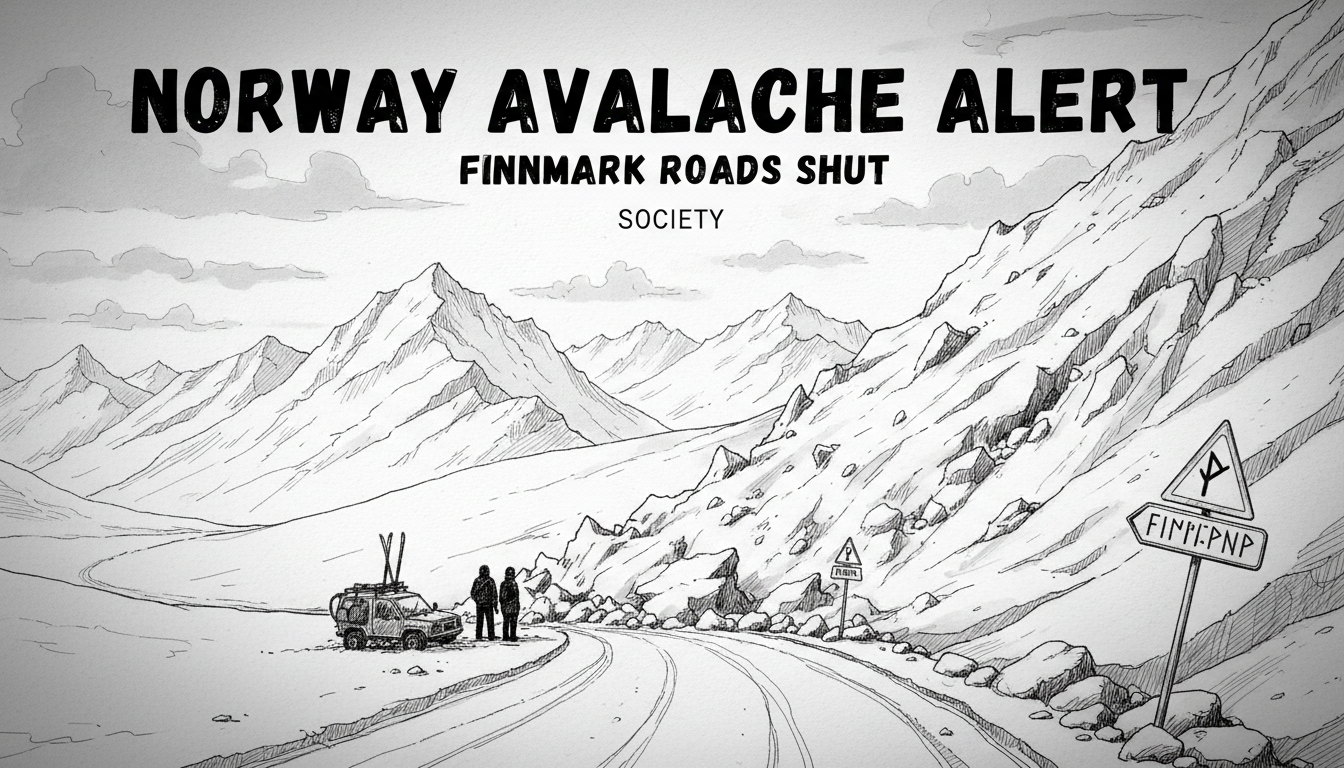
Norway’s national avalanche warning service has issued a ‘Considerable’ danger level for Finnmark, triggering major road closures and transport chaos across the Arctic region. Varsom.no reports persistent avalanche danger, classified as Faregrad 3, along the Finnmark coast and in western Finnmark. The warning has led to the closure of the vital E6 highway at Sennalandet, with multiple other roads either shut or operating under escorted convoy systems. Local bus and ferry departures across the county are also canceled.
Authorities are urging residents and travelers to avoid all non-essential travel in avalanche-prone terrain. This elevated risk level indicates unstable snow layers where avalanches can be easily triggered by a single skier or snowmobiler. The disruptions highlight the persistent vulnerability of northern Norway's infrastructure to extreme winter weather, even as the season progresses.
Immediate Impacts on Arctic Travel
The immediate consequence of the warning is severe transport paralysis. The E6 at Sennalandet is a critical north-south artery for Finnmark, Norway's largest and northernmost county. Its closure effectively severs a main route for goods and people. Local police have implemented kolonnekjøring, where vehicles are led in convoys behind snowplows on some stretches, a slow and cumbersome process only for essential journeys.
Beyond this major highway, a network of county and municipal roads is also affected. The sparse population and vast distances in Finnmark mean a single road closure can isolate entire communities. Canceled bus and ferry routes compound the isolation, cutting off access to schools, workplaces, and services. For residents, this is a familiar but disruptive winter routine.
Understanding the 'Considerable' Danger Level
The Faregrad 3 warning is the midpoint on Norway’s five-level scale. It represents a significant threat. "At level 3, the snowpack is moderately to weakly stabilized," explains an avalanche forecaster's handbook from the Norwegian Water Resources and Energy Directorate (NVE). "Human-triggered avalanches are likely. Natural avalanches are possible, and the conditions require experienced judgment."
This scale is a crucial public safety tool. Level 1 is ‘Low’ danger, while Level 5 is ‘Very High’, where widespread natural avalanches are certain. The jump to Level 3 signals a transition from generally stable conditions to a situation requiring careful decision-making. Backcountry travelers are advised to stick to gentle, low-angle terrain and avoid slopes steeper than 30 degrees.
A Recurring Challenge for Northern Infrastructure
Finnmark’s geography makes it uniquely susceptible. The region encompasses exposed coastal mountains, the vast Finnmarksvidda plateau, and deep fjords. Heavy, wind-driven snow accumulates on slopes above key transport corridors. When instability reaches a critical point, the only safe option is to close the road and wait for conditions to improve or for mitigation work—like controlled detonations—to be performed.
This cycle of closure and clearance represents a major operational and economic cost. The Norwegian Public Roads Administration spends substantial resources on monitoring and avalanche mitigation. Yet, the power of nature in the Arctic often overrides human planning. The closures underscore the ongoing challenge of maintaining reliable year-round connectivity in Europe’s northern frontier.
Expert Advice for Navigating the Risk
Avalanche safety professionals stress that official warnings are just the starting point. "Varsom.no gives the regional picture," says a veteran mountain guide from Troms. "You must perform your own local assessment. Check the specific forecast for your altitude and aspect. Look for signs of wind-loading, recent avalanche activity, and listen for hollow ‘whumphing’ sounds in the snowpack."
For the general public, the advice is simpler: heed the official travel advice. Do not attempt to bypass roadblocks or travel on closed roads. The risk of being caught in an avalanche, or triggering one that hits the road or others below, is dangerously high during a Level 3 period. Preparedness is key for remote communities, where emergency response times can be lengthy.
The Broader Context of a Harsh Winter
This event is not isolated. The 2023-24 winter has seen several periods of elevated avalanche danger across Norway. Changing precipitation patterns and temperature fluctuations, potentially influenced by broader climatic shifts, can create more complex and persistent weak layers in the snowpack. This makes forecasting more challenging and can extend periods of heightened risk.
While Finnmark is currently the epicenter, the systems monitoring this danger are national. NVE’s Varsom platform provides real-time data for the entire country, a critical resource for everyone from highway engineers to backcountry skiers. The investment in this monitoring infrastructure reflects Norway’s proactive approach to managing its hazardous yet majestic winter landscape.
Looking Ahead: Mitigation and Adaptation
As the immediate crisis is managed, the longer-term conversation continues. Can infrastructure be made more resilient? Projects like snow sheds and diversion dams are expensive but can protect crucial lifelines. Improved forecasting and more frequent controlled releases of avalanches are other tools. However, in a region defined by its dramatic topography, absolute safety is an impossible goal.
The current closures serve as a stark reminder. In Norway's Arctic, human schedules remain subject to the fundamental mechanics of snow, wind, and slope. The Faregrad 3 warning will eventually be lowered, and the E6 will reopen. But the underlying tension between connectivity and natural hazard will define life in Finnmark for winters to come. How will Norway balance the development of its northern regions with the immutable realities of its climate?