
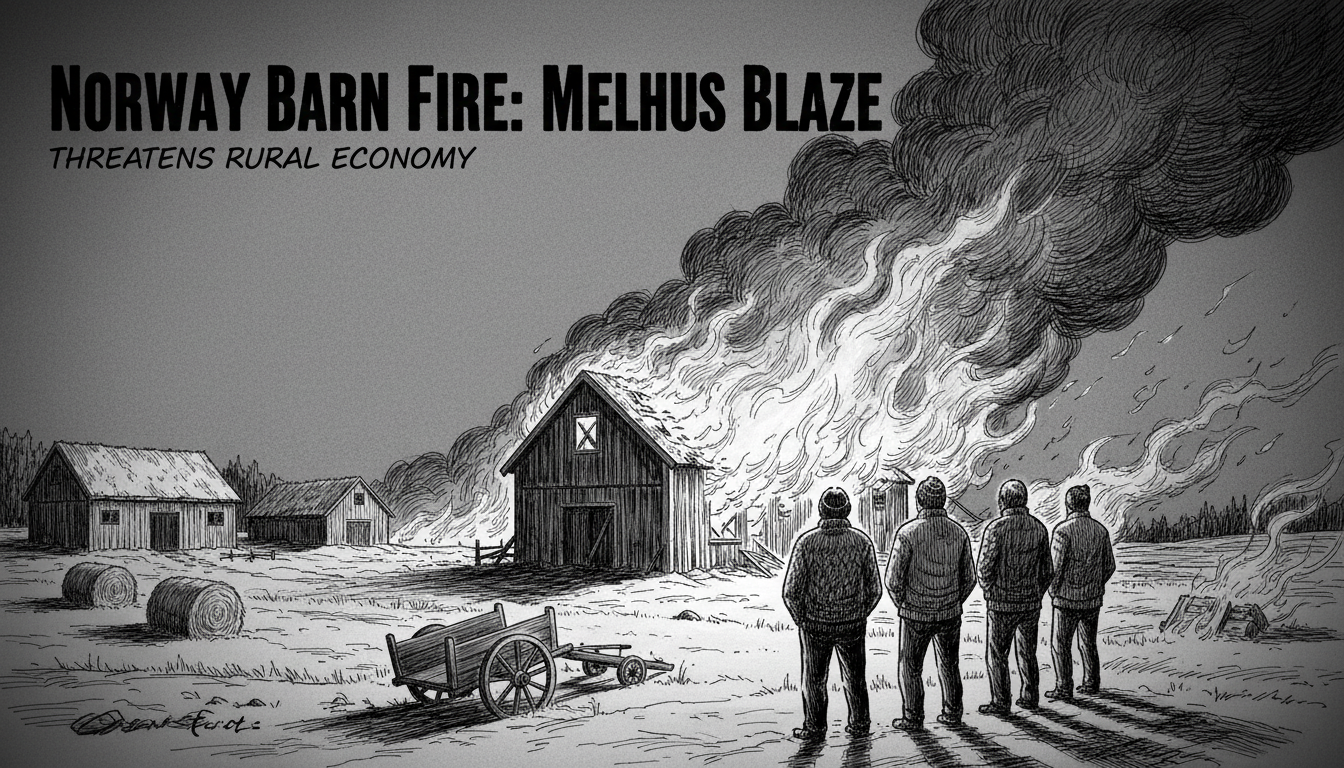
Norway's emergency services are battling a significant barn fire in Melhus, Trøndelag, with officials warning of a serious risk the flames could spread to other structures. The fire, reported in a building used for agricultural storage, contained no animals but poses a substantial threat to surrounding farm property.
Operational commander Trond Volden confirmed the critical details. "There are reportedly no animals inside the barn," Volden said in a statement. "But there is a significant risk of the fire spreading to other buildings." This single sentence encapsulates the dual relief and acute danger of the situation—averted tragedy for livestock but a looming economic disaster for the farmstead.
A Common Threat in the Norwegian Countryside
Barn fires represent a persistent and devastating risk in rural Norway. The municipality of Melhus, situated just south of Trondheim, is part of an agricultural belt where farming remains a cornerstone of the local economy. Structures like the one now ablaze are typically filled with highly combustible materials: dry hay, harvested grains, wooden equipment, and sometimes fertilizers or fuels.
These contents can turn a barn into a towering inferno within minutes. "A barn fire is a firefighter's nightmare, especially in remote areas," explains Lars Holen, a retired fire safety instructor with decades of experience in rural firefighting. "The fuel load is enormous, access for large vehicles can be difficult, and water supply is often a major logistical challenge. The primary strategy frequently shifts from saving the burning structure to preventing a catastrophic spread."
This containment effort is now the priority for crews in Melhus. The threat to adjacent buildings—which could include equipment sheds, workshops, or even the main farmhouse—turns a single-structure fire into a potential farm-wide catastrophe.
The Economic and Emotional Toll of Farm Fires
While the immediate drama involves flames and smoke, the long-term impact of a barn fire is measured in lost livelihoods and heritage. For a farming family, a barn is not just a storage space; it is the heart of operational infrastructure. It may hold an entire season's harvest of hay, essential to feeding livestock through the long Nordic winter. It can store expensive machinery and generations of accumulated tools.
Its loss can cripple a farm's financial viability overnight. Insurance may cover rebuilding, but it cannot replace lost harvests or restore unique equipment. The disruption can last for years. "There's the obvious material loss," says Dr. Kari Nilsen, a sociologist at the Norwegian University of Life Sciences who studies rural communities. "But we must also consider the profound psychological impact. A farm is often a multi-generational home. These buildings are tied to family history and identity. Losing them is a traumatic event that resonates deeply within the small, close-knit rural community."
In Melhus and similar municipalities, neighbors rely on each other. A major fire on one farm is felt across the district, prompting solidarity but also sober reflection on shared vulnerabilities.
Prevention and Preparedness in Rural Areas
The Melhus fire inevitably raises questions about prevention. Norwegian authorities and agricultural organizations continuously work to improve fire safety standards on farms. Key recommendations include proper electrical installation in older buildings, safe storage of flammable liquids and chemicals, and maintaining clear access roads for emergency vehicles.
However, implementing these measures can be costly for farmers operating on thin margins. Older barns, constructed entirely of wood, are particularly vulnerable. Spontaneous combustion of damp hay is a known, though less common, risk. More frequent causes are electrical faults, heating equipment, or sparks from welding and grinding work.
"Prevention is always better than response," Holen emphasizes. "This means regular inspections of wiring, keeping heat sources away from combustible materials, and having a clear, practiced emergency plan. Every farm should have multiple, well-marked fire extinguishers placed strategically. In many cases, the time between spotting a fire and the arrival of the fire brigade is the most critical window. What the farmer does in those first minutes determines everything."
The Logistics of Fighting a Rural Blaze
The response to the Melhus fire highlights the specialized challenges of rural emergency services. Unlike urban fires, where hydrants supply ample water, rural firefighters often depend on tanker trucks to shuttle water from nearby lakes, streams, or designated drafting points. This relay system requires immense coordination and manpower.
Weather conditions play a brutal role. Wind, like that common in the Trøndelag region, can whip embers across long distances, igniting spot fires and validating fears of spread. The topography of a farm—its placement on the land, the proximity of other buildings, the available access points—becomes a key factor in the battle.
Fire crews from smaller districts often rely on mutual aid agreements, calling in reinforcements from neighboring municipalities. This collaboration is essential but adds time to the buildup of a full-scale attack. The initial responders on scene carry the heavy burden of making rapid, strategic decisions to protect life and contain the damage.
Looking Beyond the Smoke
As the smoke clears over Melhus, the investigation into the fire's cause will begin. The Norwegian Fire Investigation Service (Norsk Brannvernforening) may be involved if the blaze is large or the cause is unclear. Determining the origin is crucial not only for insurance purposes but for compiling national statistics that guide future safety campaigns.
This single incident feeds into a broader national conversation about the sustainability and security of Norway's agricultural sector. As the country focuses on its future energy and food security, the resilience of its farming infrastructure becomes increasingly important. Protecting these assets from a perennial threat like fire is a fundamental part of that equation.
Will this event spur local farmers in Melhus to review their own safety protocols? Will it lead to increased municipal support for fire prevention upgrades on older farmsteads? The true cost of the fire will be tallied not just in charred timber and lost assets, but in the community's collective response to a stark reminder of its fragility. For now, all attention is on the firefighters' exhausting work, hoping the wind stays calm and the flames are contained to a single, devastating loss.