
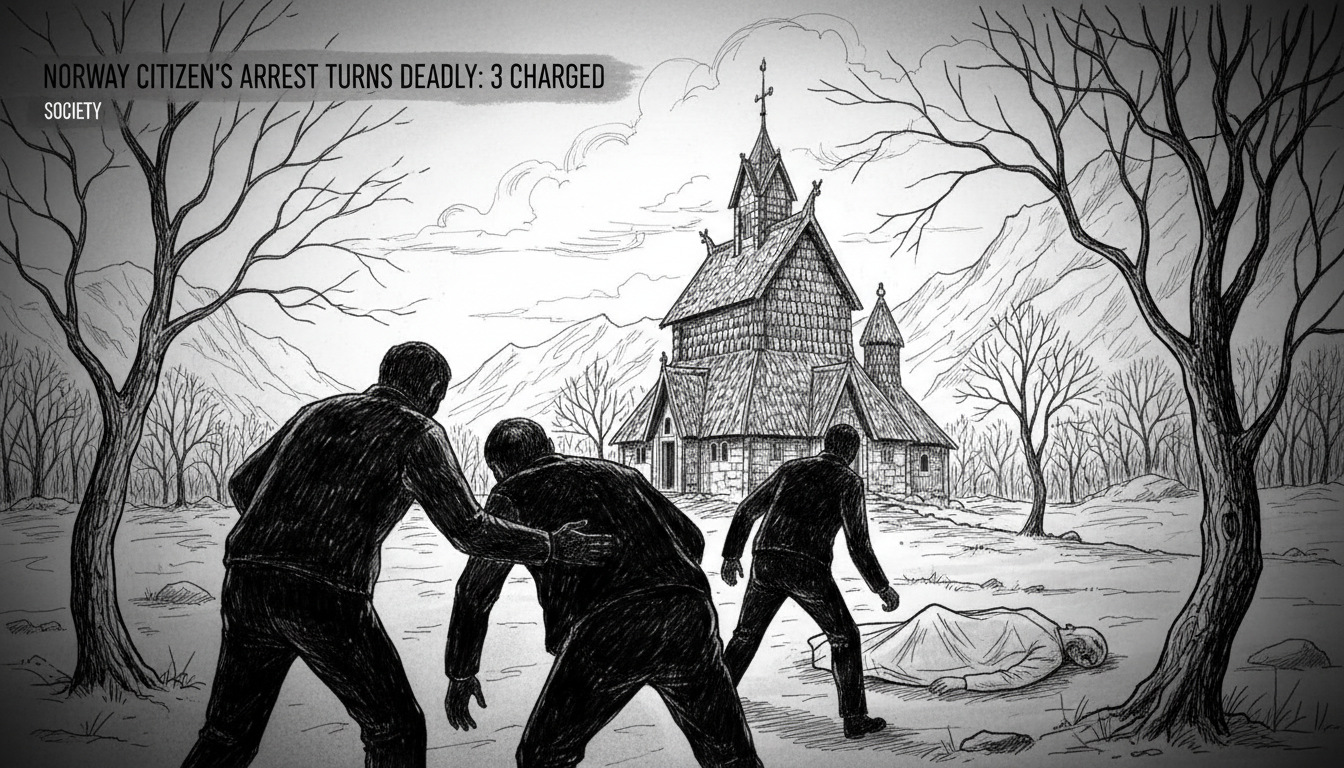
Norway's strict citizen's arrest laws face scrutiny after a man died in Stavanger on New Year's Day. A 40-year-old man was pronounced dead at Stavanger University Hospital after three individuals physically restrained him on a construction site. The suspects, aged in their 20s, 40s, and 60s, have been charged with aggravated assault resulting in death.
Police said the incident began around 10 p.m. on January 1st. The three individuals confronted the man after suspecting he intended to steal items from the construction site. During the physical restraint, the man stopped breathing. Bystanders initiated CPR before an ambulance arrived. He was declared dead at the hospital at 10:51 p.m.
"The reason was that the three persons suspected that the individual intended to steal objects from the construction site," police stated. "In connection with them taking physical control of the person, the individual stopped breathing."
Police attorney Kjetil Solhaug confirmed the three suspects worked together to hold the man down. Based on this, they were arrested and charged with aggravated assault resulting in death or complicity in the act. The deceased man was known to police from previous incidents. The suspects had no connection to the construction site or the victim.
A Legal Line Crossed
Norwegian law permits citizen's arrests under specific conditions. An individual can detain someone caught in the act of committing a crime punishable by imprisonment. The critical legal principle is proportionality. The force used must correspond to the offense and be necessary to prevent its continuation or to secure the offender's identity.
"This tragic case will become a textbook example of where that line was crossed," said legal scholar Arne Haug, a professor at the University of Bergen. "The suspected crime was theft from a construction site. The response was a physical restraint that led to a man's death. The law is clear that the reaction must be reasonable and measured. The investigation must now determine if the force used was grossly disproportionate."
The police investigation will focus on the exact cause of death from the upcoming autopsy and the specific actions of the three suspects. Police attorney Stian Eskeland noted they are still working to notify all next of kin. All three suspects have been interrogated and will be questioned again as the probe continues.
The Scene on New Year's Night
The construction site, located in Norway's oil capital, became an unexpected crime scene on what is typically a festive holiday. The area was sealed for forensic examination. Police are appealing for witnesses who might have seen the altercation or events leading up to it.
"Now the persons are arrested, and we must now look at what they have explained and hold it up against the information we have," Solhaug told local media. "We are also interested in getting in contact with witnesses."
The age range of the suspects—spanning from their 20s to their 60s—suggests they were not a formal group. Police have not disclosed their relationship to each other or whether they were local residents. The incident raises immediate questions about vigilante justice and public perception of crime.
Proportionality in Practice
Legal experts emphasize that the citizen's arrest power is not an invitation for private justice. "It is a narrow right, not a broad one," explained lawyer Marte Skaar. "You can detain someone, but you must immediately call the police. The purpose is to hand the person over to authorities, not to punish or interrogate them. The use of force must be an absolute last resort, and even then, it must be minimal."
In cases of suspected petty theft, which this appears to be, the permissible force is extremely limited. Shouting, blocking a path, or a firm grip might be justifiable. Violent takedowns, prolonged restraint, or any action that risks health are almost certainly not.
Norwegian courts have previously convicted individuals for exceeding the bounds of citizen's arrest. Outcomes depend heavily on the severity of the initial crime and the methods used during detention. A charge of "grov kroppskrenkelse med døden til følge" (aggravated assault resulting in death) carries a significant prison sentence.
Community and Legal Repercussions
The death sends shockwaves through Stavanger, a city of around 150,000 known for its offshore energy industry and generally low crime rates. It places a spotlight on how communities respond to perceived threats of property crime.
"This is a profound tragedy on multiple levels," said local council member Ingrid Hauge. "A man has lost his life. Three other individuals now face serious criminal charges that will alter their lives forever. It should prompt a serious community conversation about the rule of law and the dangers of taking matters into one's own hands."
The police investigation will be meticulous. Officers will reconstruct the timeline, analyze forensic evidence from the site, and review the medical examiner's report to understand the mechanism of death. The legal process will then assess whether the suspects acted with criminal negligence or intent.
For now, the case serves as a grim reminder. The law's allowance for citizen intervention comes with strict responsibilities. When the balance between prevention and proportionality is lost, the consequences can be fatal. The courts will now decide where that balance was on a dark New Year's night in Stavanger.