
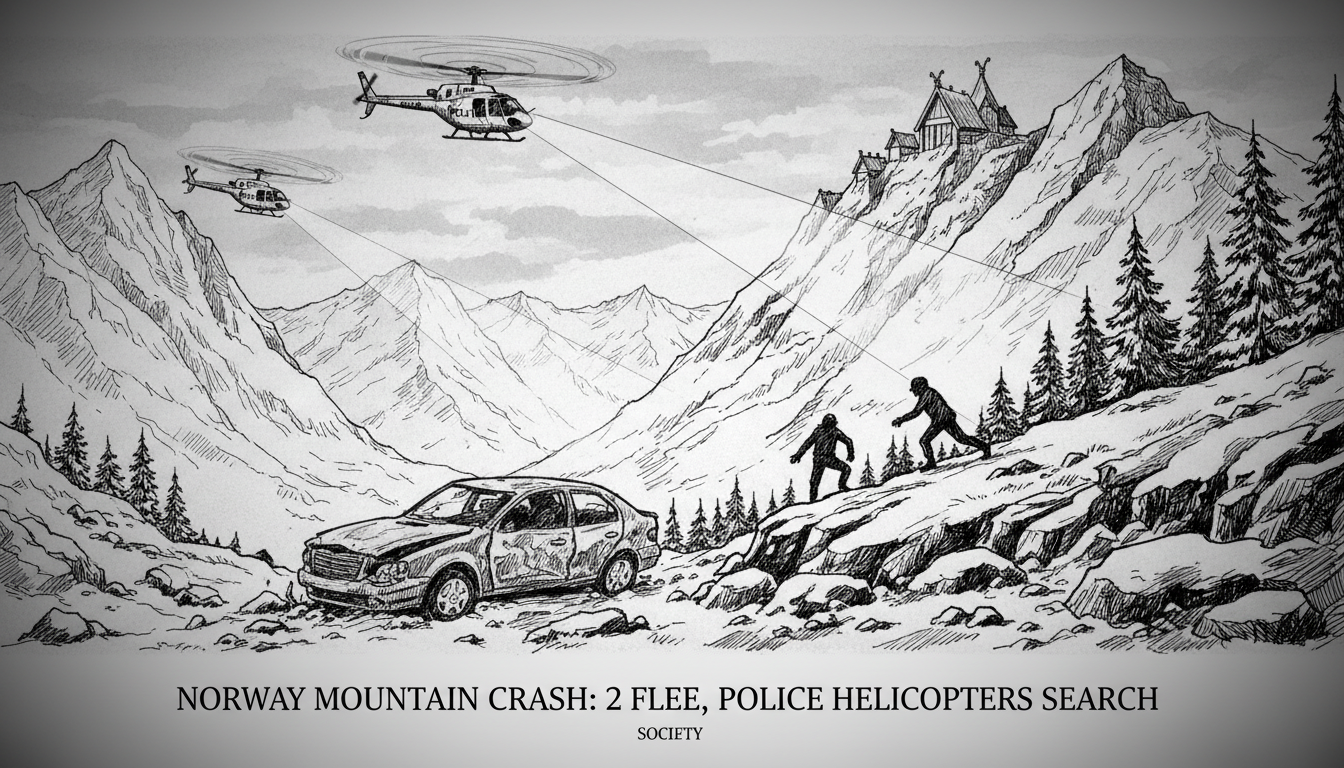
Norway police deployed two helicopters and dog patrols Sunday in a major search operation on Norefjell after witnesses reported two people fleeing the scene of a multi-vehicle crash. The incident occurred around 9:30 AM on Norefjellveien road in Krødsherad municipality, Buskerud. No serious physical injuries were reported from the collision itself, but the subsequent flight of the two individuals triggered an extensive aerial and ground manhunt.
Operational leader Marius Fosvold confirmed the details in a police log. "Witnesses observed two persons run from one of the involved vehicles and out into the terrain," Fosvold's statement read. The search involved multiple patrol units, a dedicated dog team, and the two police helicopters. By 11:00 AM, the operation was still actively underway across the mountainous landscape.
A Search in Challenging Terrain
The decision to deploy significant air assets underscores the challenges posed by the Norefjell area. Known primarily as a popular ski resort, its off-season terrain is rugged, forested, and difficult to navigate. Norefjellveien, the road where the crash occurred, winds through this landscape, presenting driving challenges that become more pronounced during transitional seasons with potential ice and variable weather.
"A search in this type of terrain is resource-intensive," said Lars Holm, a former search and rescue coordinator for the mountain regions. "When individuals leave a roadway and enter the wild, especially if they are not properly dressed or equipped, they become vulnerable very quickly. The use of helicopters is critical for covering large areas and accessing steep or remote sections that ground teams cannot reach swiftly."
The immediate police response suggests several potential concerns. Authorities typically treat individuals who flee an accident scene as a high priority. Reasons can range from panic and lack of documentation to more serious circumstances like outstanding warrants, intoxication, or involvement in other criminal activities. The police have not commented on any specific suspicions, focusing instead on locating the individuals for their own safety and to clarify their role in the incident.
The Legal and Safety Implications of Flight
Fleeing the scene of a traffic accident in Norway is a criminal offense under the Road Traffic Act. Drivers involved in an incident have a clear legal duty to stop, provide assistance, and exchange information. Abandoning the scene complicates insurance claims, liability assessments, and the official investigation into the cause of the crash.
"From a legal standpoint, fleeing invariably makes the situation worse for those involved," explained attorney Eva Strand, who specializes in traffic law. "What might have been a simple matter of reporting damages turns into a police investigation. The court will view flight as an aggravating factor, potentially leading to heavier fines or other penalties. The primary concern for police now, beyond welfare, is to secure evidence and statements before the chain of events becomes muddled."
The fact that no serious injuries were reported at the scene is a fortunate element in an otherwise serious situation. However, the risk immediately transfers to the individuals who fled, as well as to the search teams. Mountain terrain in late December presents hypothermia risks, especially without proper outdoor gear. The police operation thus serves a dual purpose: law enforcement and lifesaving.
Norefjell's Roads in Focus
This incident brings attention to the driving conditions on mountain roads like Norefjellveien. These routes are essential for local communities and tourism but require heightened driver awareness. Weather conditions can change rapidly, with black ice, snow drifts, and reduced visibility being common hazards outside the summer months.
The Krødsherad municipality, now fully back within Buskerud county following the dissolution of Viken county in January 2024, manages these roads. Local authorities often run campaigns reminding drivers to use winter tires, reduce speed, and be prepared for variable conditions when traveling in mountain areas. This crash, occurring on a Sunday morning, will likely prompt renewed scrutiny of road safety measures in the region.
What Comes Next in the Investigation
As the search continued Sunday, the investigation proceeded on parallel tracks. Forensics teams would have examined the vehicles involved to determine the mechanics of the collision—speed, braking, and point of impact. Meanwhile, other officers interviewed witnesses to get a clearer picture of the moments before and after the crash, particularly the direction the two individuals took when they ran.
The successful location of the two persons is the immediate next step. Once found, they will be questioned to establish their reasons for leaving. This will determine whether the case remains a traffic incident or expands into other legal areas. The police will also need to verify the identities of the individuals and their connection to the vehicle they allegedly fled from.
Such incidents, while not daily occurrences, highlight the complex interplay between traffic safety, law enforcement, and mountain rescue in Norway. The extensive resources committed—two helicopters, multiple patrols, a dog unit—demonstrate the standard protocol when public safety and unanswered legal questions converge in a remote location.
The story serves as a stark reminder of the consequences of a single decision. A traffic accident, itself a stressful event, can escalate rapidly when parties involved choose to run. It triggers a cascade of police action, consumes significant public resources, and places the individuals at grave physical risk. For the residents and visitors of Norefjell, the sight and sound of police helicopters circling the familiar peaks on a December day is a disruption of the peace this area typically represents. The hope is for a swift and safe conclusion, followed by answers to the questions that now hang over a windy mountain road.