
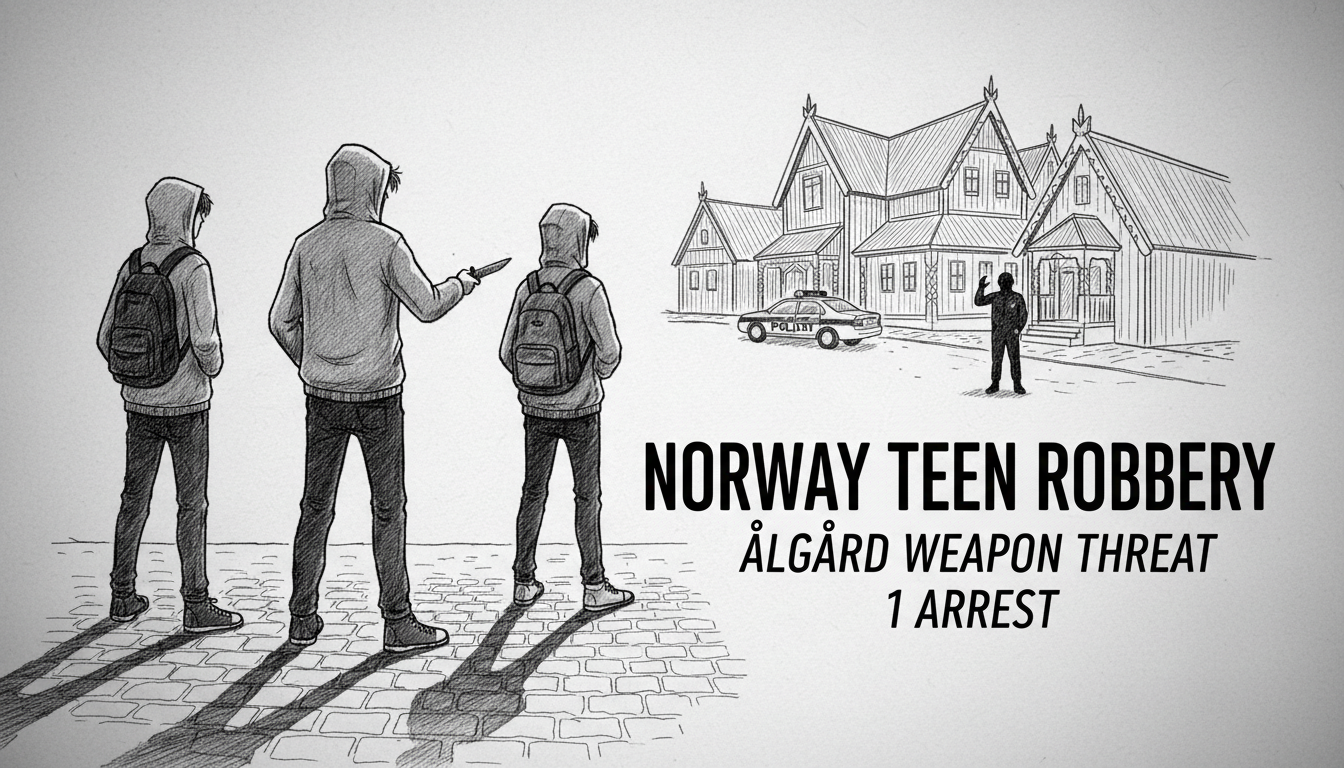
Norway's typically tranquil Jæren district was shaken by an armed robbery targeting a teenager near Ålgård center early Tuesday morning. A man in his late teens was arrested after allegedly threatening another teenager with a weapon to steal personal belongings. The victim escaped physical injury, but the incident has sparked a local conversation about safety and crime in rural communities.
A Violent Intrusion on a Quiet Coast
The robbery occurred in the heart of Ålgård, a town of approximately 9,500 residents within the agricultural and coastal region of Jæren in Rogaland county. Known for its vast sandy beaches and flat farmland, Jæren is an area where serious violent crime remains a statistical rarity. The police report states the suspect used a weapon to threaten the victim, coercing him to hand over his possessions. The swift arrest of a suspect, also a teenager, highlights both the seriousness with which police treated the event and the close-knit nature of the community where such acts stand out starkly against the norm.
“An event like this has a profound impact, not just on the direct victim, but on the collective sense of security in a small community,” said Kari Høiland, a criminologist at the University of Stavanger who studies regional crime patterns. “In urban centers, crime statistics can feel abstract. In a place like Ålgård, everyone feels they know the streets where this happened. It shatters the assumption of safety.”
The Ripple Effect of Rural Crime
While Norway consistently ranks as one of the world's safest countries, criminologists note that crime in rural areas carries a unique psychological weight. The overall risk of being robbed in Norway is low, but the experience can be more isolating for victims outside major cities where anonymity is lower and support networks may feel different. The fact that the victim was not physically harmed is a crucial detail, but experts stress the psychological trauma of a weapon threat can be long-lasting.
“The use of a weapon transforms a property crime into a violent personal violation,” Høiland explained. “The threat of lethal force, whether the weapon is used or not, creates a deep sense of vulnerability. For a young person, that experience can fundamentally alter their relationship with their own neighborhood.”
Local police have increased patrols in the Ålgård sentrum area following the incident. They have urged any witnesses or individuals with information to come forward, though the arrest indicates they have a strong lead. The case is being handled as a serious robbery, which in the Norwegian penal code carries a maximum penalty of six years in prison, with aggravating circumstances like weapon use leading to longer sentences.
Jæren's Contrasting Realities
The incident presents a stark contrast to Jæren's everyday reality. The region is the agricultural heartland of southwestern Norway, famous for its potato fields and long, windswept beaches like Bore and Orre. Its communities, including Ålgård, are often characterized by strong social bonds and low population density. Major crime headlines from Rogaland county are typically dominated by economic issues from the nearby energy capital of Stavanger, not armed street robberies in its smaller towns.
This duality is key to understanding the community's reaction. The crime rate in Gjesdal municipality, which encompasses Ålgård, is significantly below the national average for most offense categories. A single violent event therefore occupies a disproportionate amount of social and police attention. It challenges the perceived boundary between urban crime problems and rural safety.
“We must avoid painting a picture of rising rural lawlessness, because the data does not support that,” cautioned Høiland. “What we see are isolated, high-impact events. Their power lies in their exceptional nature. The response should be measured, focusing on support for the victim and a thorough judicial process, not alarmism.”
A Look at Norway's Broader Crime Landscape
To contextualize the Ålgård robbery, it is useful to examine national trends. Norway's crime rate has seen a gradual decline in several categories over the past decade, though fluctuations occur year-to-year. Robberies reported to police have remained relatively stable in number, but their geographic distribution and nature evolve.
Police resources in Norway are distributed across a vast and sparsely populated country, requiring a balance between proactive presence and rapid response. In districts like Jæren, police stations cover large areas. A serious incident in one town can draw resources from across the district, demonstrating the interconnectedness of regional policing.
The arrest of a suspect within hours of the robbery suggests effective coordination and response, a point local police commanders are likely to emphasize in community communications. The next steps involve the formal questioning of the arrested individual, forensic analysis if any weapon was recovered, and building a case for prosecution.
The Path Forward for a Shaken Community
For the residents of Ålgård, the immediate shock will gradually give way to a longer-term conversation about community safety. Local politicians may face questions about street lighting, youth activity programs, or police visibility. These discussions, while important, often arise directly from the emotional aftermath of a single event.
The true test will be whether this incident becomes a footnote in the town's history or a catalyst for change. Community leaders have an opportunity to reinforce social cohesion, encourage reporting of suspicious activity, and ensure victim support services are visible and accessible. The focus, experts agree, should remain on healing for the individual affected and maintaining perspective on the area's overall safety.
“The greatest resilience in rural areas comes from the community itself,” Høiland concluded. “How neighbors check on each other, how they talk to their children about safety without instilling fear, and how they support the victim without defining him solely by this crime. That response will determine the lasting impact far more than the robbery itself.”
As the police investigation continues and the judicial process begins, the quiet streets of Ålgård will slowly return to their normal rhythm. But for those involved, and for a community unaccustomed to such headlines, the memory of a threatening weapon on a Tuesday night will linger, posing a quiet question about safety in the places Norwegians trust the most.