
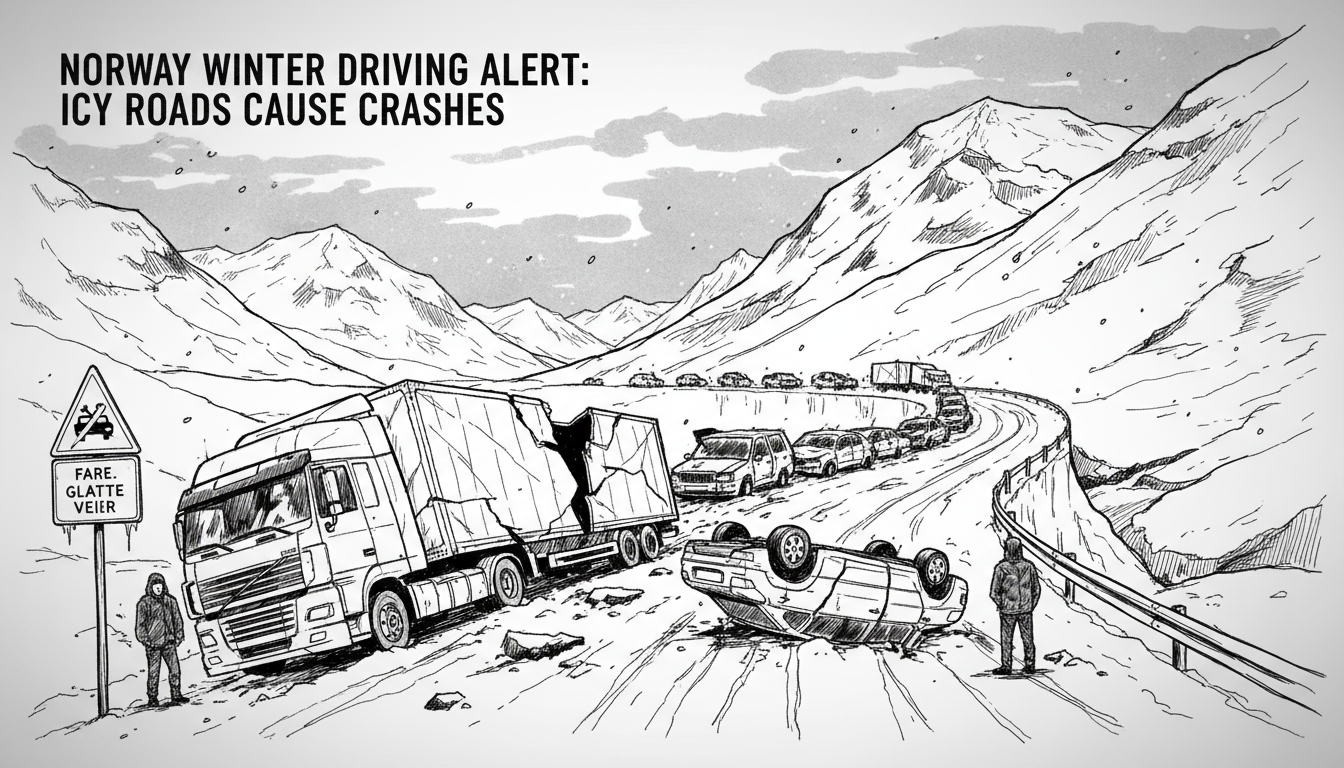
Norway winter driving conditions turned hazardous Friday morning as fresh snow created slippery roads across the eastern region. The Norwegian Public Roads Administration issued urgent warnings for drivers to reduce speed and increase caution. 'Today it is very important to be aware that it can be slippery,' said traffic operator Trude Lindstad.
Multiple accidents were reported on major highways, including two separate incidents on the E18 in Vestfold. Near Sande, one car drove into another from behind. On the Farrisbrua bridge in Larvik, a car spun and ended up in the guardrail. The northbound E18 at Larvik was temporarily closed but reopened by 8 a.m. No injuries were reported in these collisions.
In Indre Østfold, emergency services responded to a single-vehicle accident around 6 a.m. A car had slid off the road at the Trømborgveien/Smerkerudveien intersection. The driver was unable to get out and was later taken to an emergency clinic for examination. Police confirmed the road was slippery at the scene.
A Sudden Shift in Conditions
Traffic officials noted the winter had been relatively mild until this point. The overnight snowfall marked a significant change. 'Now we have had a very kind winter so far, but with the snow now, it becomes significantly more slippery,' Lindstad explained. While main roads around the capital were generally in fair condition, smaller roads in and around Oslo were particularly problematic.
Personnel were out plowing and salting roads throughout the morning. The image from the E6 at Kløfta, taken at 8:45 a.m., showed slushy, wet conditions. Another from the E6 at Taraldrud toward Oslo at 7:30 a.m. captured the early morning commute. Despite the conditions, traffic on main roads around the capital was lighter than usual Friday morning.
Transport Disruptions and Commuter Impact
Public transport in the Oslo area operated normally for the most part. Buses, trams, and trains ran without major issues. However, in Akershus county, a couple of bus lines were partially suspended due to the slippery conditions. Affected areas included Gjerdrum and Nordre Follo. 'This is because there is a lot of snow and it's slippery, and plowing and salting has been ordered,' said Ruter press officer Karoline Berg.
Berg advised travelers to allow extra time for their journeys and to check the latest route information before departing. The ferry operator Color Line also faced weather-related disruptions, though from strong winds rather than ice. The company cancelled several Friday departures between Larvik, Kristiansand, and Hirtshals, Denmark.
The Science and Safety of Slippery Roads
Slippery road conditions, or 'glatte veier,' are a common winter challenge in Norway. They occur when snow, ice, or freezing rain reduces the friction between tires and the road surface. The Norwegian Public Roads Administration (Statens vegvesen) is responsible for maintenance and safety information. Their efforts include deploying salt and gravel to improve traction, but these measures are not instantaneous or universal.
Traffic safety experts consistently stress that driver behavior is the most critical factor in preventing accidents during winter. Adjusting speed to match conditions is paramount. A safe following distance must be increased significantly, as braking distances can double or triple on ice. Proper winter tires with adequate tread depth are not just recommended but legally required in Norway during winter months. Vehicle maintenance, including checking lights and windshield wipers, also contributes to safety.
Expert Analysis: Beyond the Salt Trucks
While road authorities work to clear routes, experts say driver preparedness is the first line of defense. 'The plows and salt trucks cannot be everywhere at once,' explains a veteran driving instructor from the Norwegian Automobile Federation (NAF). 'The first snowfall of the season is always a sharp reminder. Drivers grow accustomed to dry autumn roads and must re-learn winter habits.'
These habits include gentle inputs for steering, braking, and acceleration to avoid skidding. Planning routes to favor main roads, which are cleared more frequently, can help. Checking the road condition reports on the Statens vegvesen website or app before traveling provides crucial real-time information.
The incidents on the E18, a major European highway, highlight that no road is immune. A rear-end collision often indicates insufficient following distance for the conditions. A single car spinning out suggests a loss of control, possibly from a combination of speed and a localized icy patch, such as on a bridge, which cools faster than other road surfaces.
A Regional Weather Pattern
The conditions primarily affected the Østlandet region, which includes Oslo and surrounding counties. This area, home to a large portion of Norway's population, sees high traffic volumes that amplify the impact of any weather disruption. The timing of the snowfall during the night and early morning meant it affected the core commute period.
Fortunately, no serious injuries were reported from the morning's incidents. This outcome underscores the effectiveness of modern vehicle safety systems like airbags and electronic stability control, but also a degree of luck. It serves as a warning for the weekend and coming weeks as winter fully sets in.
Looking Ahead: A Long Winter Season
This early January event is a standard opening chapter in Norway's long winter narrative. The response from authorities was typical: warnings issued, plows deployed, and incidents managed. For residents, it was a routine disruption, albeit an unwelcome one. For visitors or new residents, it was a practical lesson in Norwegian winter mobility.
The broader context is Norway's generally high standard of winter road management. The country invests heavily in winter maintenance infrastructure and public information campaigns. Yet, as Friday proved, nature ultimately dictates the conditions. The responsibility then shifts to the individual driver.
Will this event lead to a sustained period of cautious driving, or will complacency return until the next major storm? The data shows that accident rates often spike with the first significant snowfall, then gradually decline as drivers adapt. The true test will be during the next freeze-thaw cycle, which can create black ice—a transparent, nearly invisible layer that is even more dangerous than snow-covered pavement. For now, the message from officials remains simple, clear, and worth repeating: slow down, pay attention, and respect the conditions.