
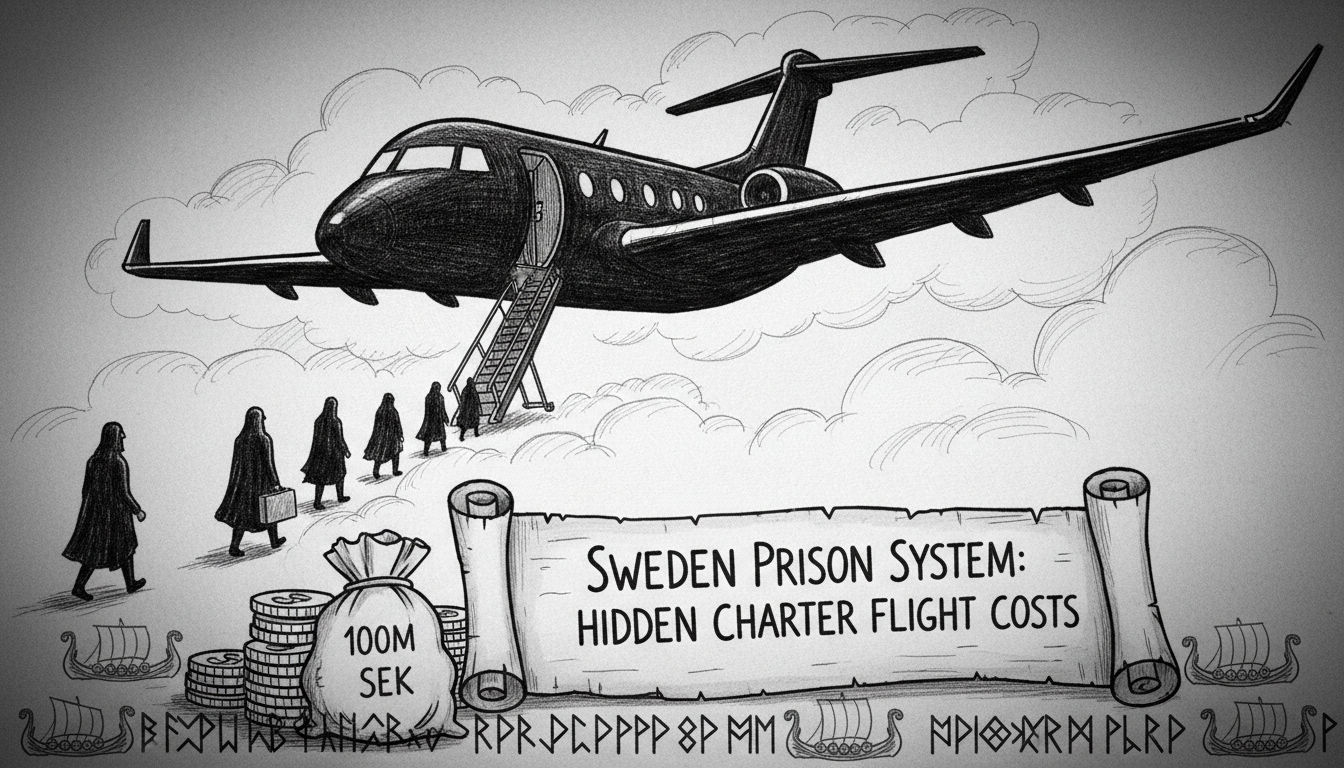
Sweden's prison system has spent over 100 million kronor on domestic charter flights for inmate transport in the past six years. This significant expenditure was not separately reported, remaining hidden within broader transportation budgets and surprising even the union representing the transport workers. The revelation raises serious questions about transparency and cost control within the Swedish Prison and Probation Service, known as Kriminalvården.
Marcus Carlström, the national chairman for Seko's transport division within Kriminalvården, expressed shock. "We have not received any information about this," he said. "The flights have been baked into other domestic transport costs." For the union, which advocates for its members who handle these complex and sensitive operations, the lack of detailed accounting is a major concern. They plan to confront management to demand a clear breakdown of where the public's money is going.
A Cost Hidden in Plain Sight
The scale is substantial. From 2020 to the present, thousands of inmates have been moved across Sweden using chartered aircraft. While secure transport is non-negotiable for a corrections service, the complete absence of this line item in financial reports is unusual. In Sweden's system of public accountability, where government agency budgets are scrutinized, such a large, recurring cost flying under the radar is notable. It suggests a reporting gap that prevents proper oversight.
Experts in public finance point to a fundamental principle: you cannot manage what you do not measure. "When costs are aggregated to this degree, it becomes impossible to conduct a proper cost-benefit analysis," says Dr. Lena Forsberg, a professor of public administration at Stockholm University. "Are charter flights the most efficient and secure method? Without transparent data, that question can't be answered. It also shields the expenditure from the natural budget debates that occur within agencies and in parliamentary committees."
The Human and Security Equation
The work itself is high-stakes. Transporting incarcerated individuals, often between courts, remand prisons, and long-term facilities, requires immense planning. Security is paramount. Ground transport over long distances, say from a facility in northern Sweden to a court in Stockholm, can take many hours and involves multiple vehicle transfers and rest stops, each a potential security risk. Charter flights reduce transit time dramatically, minimizing exposure.
A correctional officer, who spoke on condition of anonymity due to not being authorized to speak to media, described the process. "A charter flight from Luleå to Stockholm might take two hours. The same trip by secure van could take over twelve, with meal breaks and shift changes. For high-risk individuals, the flight is often safer for everyone—the staff, the inmate, and the public." This perspective highlights the operational logic that may drive the use of air transport, justifying a higher price tag for a perceived higher level of control and reduced operational strain on personnel.
A Question of Priorities and Scrutiny
Yet, the core issue remains one of accountability. Over 100 million SEK is a considerable sum. It could fund rehabilitation programs, staff training, or facility upgrades—all areas frequently cited as needing more investment within the Swedish prison system. The lack of specific reporting means this trade-off is never openly discussed. The money simply disappears into a general transport budget.
"This isn't necessarily about waste," argues criminologist Erik Månsson. "It might be money well-spent for optimal security. The problem is the opacity. Taxpayers, parliament, and even the agency's own unions have a right to know how major resources are allocated. Transparency fosters trust and can lead to better, more efficient practices. Secrecy, even if unintentional, breeds suspicion."
The union's reaction is telling. Seko is not an external watchdog but an integral part of the system. Their surprise indicates that the cost aggregation was so complete it even insulated internal stakeholders from the financial reality. Marcus Carlström's statement is clear: "Now we will raise this with management so we can see exactly what the money is being spent on." This move could prompt a formal review of transport accounting practices across Kriminalvården.
Looking at the Broader Nordic Picture
How does Sweden's approach compare to its neighbors? While direct comparisons are complex due to differing geography and population distribution, transparency standards are a common benchmark. Norway's Correctional Service, for example, publishes detailed annual reports with categorized expenditures, allowing for public tracking of major cost areas. Denmark's system also operates with a high degree of budgetary transparency mandated by law.
Sweden is not typically a country where large public expenditures are easily concealed. The "offentlighetsprincipen" or principle of public access to official records is a cornerstone of Swedish democracy. This case appears to be less about active concealment and more about a reporting methodology that fails to provide meaningful detail. It is a bureaucratic blind spot, not a scandal—but one with a multi-million kronor price tag.
The Path Toward Clearer Skies
The immediate next steps seem clear. Kriminalvården will likely face internal pressure from Seko and external questions from media and oversight bodies to itemize its transport costs. Implementing a more granular accounting system for charter flights versus ground transport would be a straightforward fix. This would allow for the informed debate that has been missing: are these flights essential for security, or could some routes be served more cost-effectively by other means?
Furthermore, this incident may trigger a review in other Swedish government agencies. How many other substantial costs are buried in aggregated budget lines, preventing proper analysis? In an era of increasing demands on public services, every krona needs to be justified. The story of these hidden flight costs is ultimately a story about the importance of clear financial language in the public sector. When costs are visible, choices can be debated, and trust in institutions is maintained. As the Swedish autumn clouds gather, the call for clearer financial reporting within Kriminalvården is taking flight.