
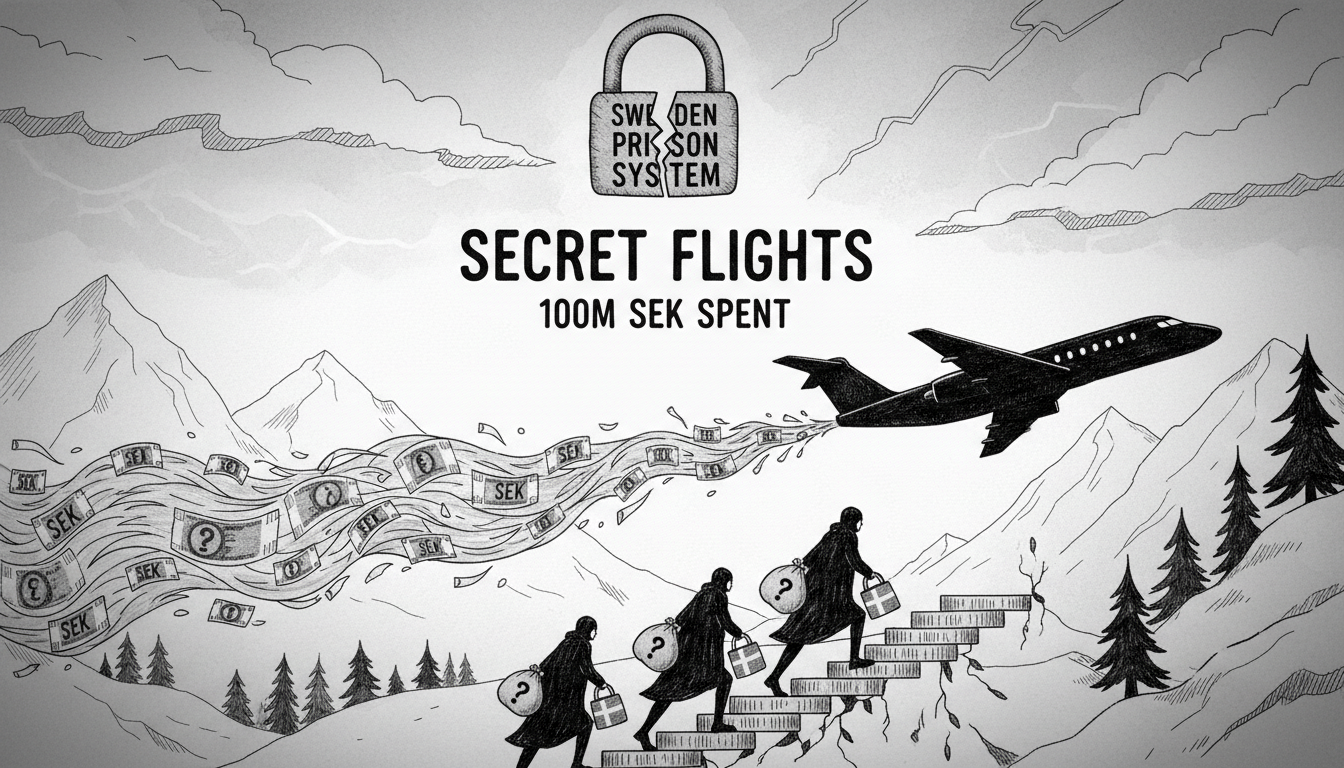
Sweden's prison system has spent more than 100 million kronor on domestic charter flights for transporting inmates over six years, a cost kept hidden within broader transport budgets. The revelation, uncovered through a recent review, has shocked the very union representing the transport workers, who say they were kept in the dark about the scale and price tag of these covert airlifts.
“We have not received any information about this. The flights have been baked into the other domestic transport costs,” says Marcus Carlström, chairman for Seko, the Swedish Prison and Probation Service's national transport department. For the Seko union, the details of the costs and the operation came as a complete surprise. “They have flown under the radar. Now we will raise this with management so we can see exactly what the money is going to,” Carlström added in a statement.
A Cost Hidden in Plain Sight
The flights, which have transported thousands of inmates across Sweden since 2020, represent a significant but previously unaccounted-for slice of the state's correctional budget. In a country known for its transparency and meticulous public accounting, the lack of specific reporting for such a large expenditure stands out. The Swedish Prison and Probation Service, known as Kriminalvården, is tasked with the secure and humane transport of individuals in custody between courts, hospitals, and various detention facilities. This is a complex, daily operation across a vast country, where land transport can mean hours of driving through remote areas. While charter flights might, in some specific cases, be justified for security or logistical reasons, the blanket secrecy surrounding their use raises immediate questions about oversight and value for taxpayer money.
This story touches a nerve in Swedish society, where trust in public institutions is high but expectations for accountability are even higher. The concept of 'offentlighetsprincipen' – the principle of public access to official records – is a cornerstone of Swedish democracy. When large sums of public money are not clearly itemized, it violates a fundamental social contract. For the average Swede reading this news over their morning coffee in a Stockholm suburb like Hökarängen or while waiting for a tram in Gothenburg, it’s not just about prison flights. It’s about whether the system designed to uphold rules is, in fact, following them itself.
The Security Argument and Its Limits
Officials might argue that air transport is sometimes necessary for high-security risks or for moving inmates quickly over long distances, such as from a detention center in Malmö to a court hearing in Luleå. Sweden’s geography, with its long distances and sparse population in the north, can make ground convoys long, vulnerable, and resource-intensive. A flight could, in theory, reduce the time an inmate is exposed during transit and lower the risk of escape attempts or ambushes. However, security concerns alone cannot justify a lack of financial transparency. The public and its elected representatives have a right to assess whether the security benefit outweighs the multimillion-krona cost, especially when those funds could potentially be used to improve rehabilitation programs, staff salaries, or prison conditions.
“This is a classic case of operational secrecy spilling over into financial obscurity,” says a Stockholm-based expert in public administration, who requested anonymity due to ongoing work with government agencies. “The security rationale for certain transport methods is understandable. But budgeting and cost-reporting exist for a reason. Burying 100 million kronor in a general ‘transport’ line item prevents any serious analysis of cost-effectiveness. Could that money have been better spent? We can’t even start that conversation without clear data.”
A Union Left Out of the Loop
The surprise expressed by the Seko union is a significant part of this story. In Sweden’s labor market model, unions are typically deeply involved in discussions about workplace changes, resource allocation, and operations that affect their members' work. The fact that the transport union was unaware of a major, ongoing transport operation suggests a breakdown in this collaborative model. It hints at a compartmentalized decision-making process within Kriminalvårdens administration, where charter services may have been contracted without engaging the expertise of the ground transport staff who handle the vast majority of inmate movements.
This disconnect could have practical implications. The union’s members possess firsthand knowledge of the challenges and risks of inmate logistics. Excluding them from the conversation about when and why to use air transport means missing out on that practical insight. Furthermore, it creates a climate of suspicion. “If this was a standard, justified procedure, why not be open about it?” asks a veteran prison transport officer from western Sweden, who did not wish to be named. “When you hide things, people naturally assume the worst—that it’s wasteful, or that there’s something improper about the contracts.”
The Broader Context of Prison Costs
This incident does not exist in a vacuum. The Swedish prison system, like many in Europe, faces pressures related to overcrowding, staff retention, and the integration of foreign-national inmates. Every krona counts. Public debates frequently focus on the high daily cost of incarceration and whether the system is achieving its goals of reducing recidivism. A sudden, previously unknown expense of over 100 million SEK inevitably leads to tough questions about priorities. Could these funds have bolstered educational programs inside prisons? Could they have been used to hire more probation officers to support reintegration?
The lack of clear reporting also makes it impossible to compare the cost-efficiency of charter flights against alternative solutions. For instance, could dedicated, high-security train carriages or better-coordinated regional hub systems have achieved similar security outcomes for a fraction of the price? Without transparent data, these alternatives are never properly evaluated. This is a failure of basic public stewardship.
A Test for Transparency
The reaction from politicians and agency leadership will now be crucial. The Swedish Prison and Probation Service will be expected to provide a full breakdown of these flights: the number of trips, the routes, the specific security justifications for each, and the details of the contracting process. The question of whether this was a deliberate obfuscation or a bureaucratic oversight will demand an answer. The Riksdag’s committees for justice and finance will likely scrutinize the agency's future budget requests much more closely.
For Swedish citizens, this is a reminder that transparency can never be taken for granted. It requires constant vigilance from journalists, auditors, unions, and engaged citizens. The Swedish model functions on sunlight. This episode shows what can happen when a significant area of spending is left in the shadows. As the union prepares to confront management and the media spotlight shines on Kriminalvården’s accounting, the fundamental question remains: In a society built on open data and public trust, how did a hundred-million-kronor air force operate in secret for so long? The answer will tell us a lot about the health of Swedish governance.