
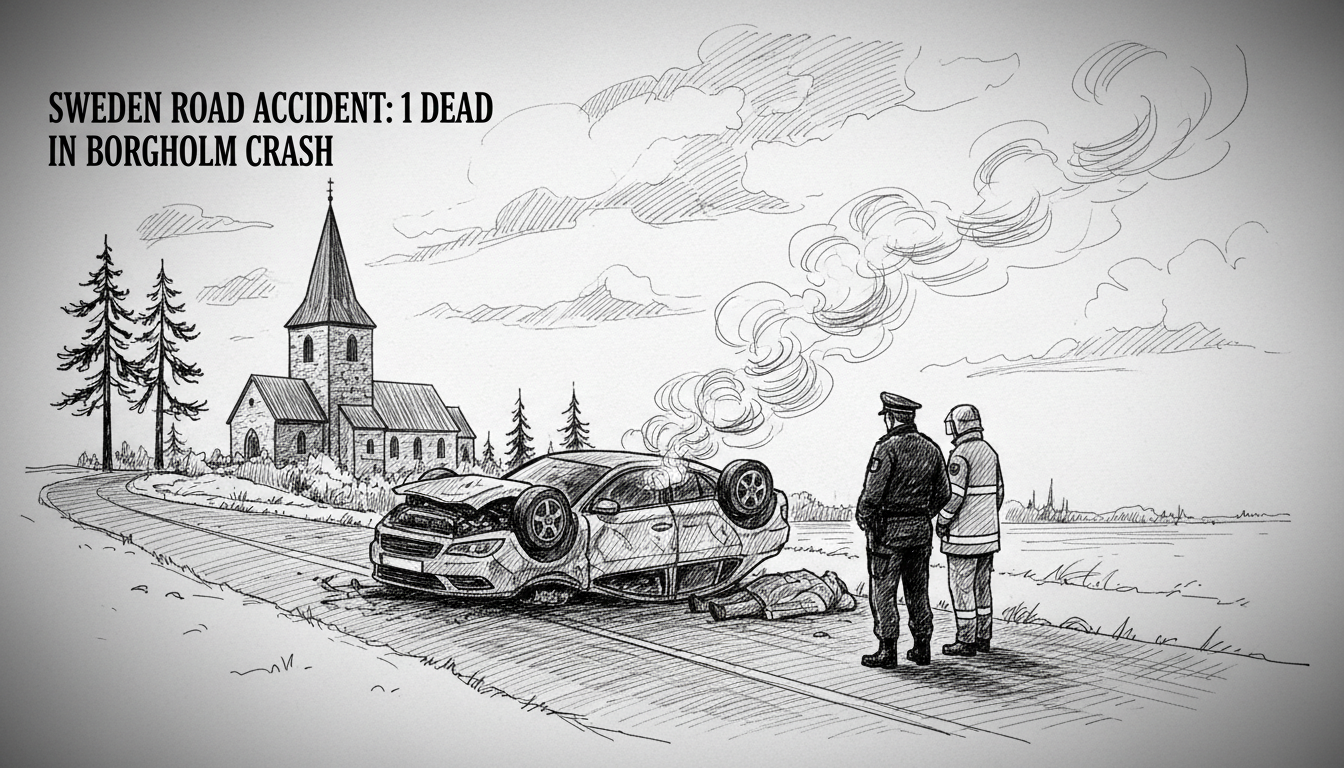
Sweden road accident investigators are piecing together the events that led to a fatal collision in Borgholm on December 26th. An elderly woman in her eighties died from her injuries. The crash, involving two passenger cars, occurred around 6 p.m. on what Swedes call 'annandagen,' the second day of Christmas. Two other individuals were hospitalized, their conditions currently unclear. Police have classified the incident as an investigation into reckless driving, known in Swedish law as 'vårdslöshet i trafik.' The woman's next of kin have been notified.
This single tragedy on a quiet holiday road casts a long shadow. It represents a painful subtraction from Sweden's ambitious 'Vision Zero' goal. That national policy aims to eliminate all traffic fatalities and serious injuries. For the family involved, and for the community on Öland island where Borgholm is located, the statistics have a name and a profound personal cost.
A Holiday Interrupted on Öland
Borgholm, the main town on the island of Öland, is typically associated with summer tourism. Its famous castle ruins and coastal scenery draw crowds in July. In late December, however, the atmosphere is different. The holiday period between Christmas and New Year's is a time for quiet family visits, leftover 'julbord' feasts, and perhaps a walk in the crisp winter air. Traffic is usually light, especially on the smaller roads outside the town center.
The accident happened as daylight had faded on Boxing Day. The specific location has not been disclosed, but the investigation will scrutinize every factor. Road conditions, potential winter hazards like ice or slush, visibility, and the actions of both drivers will be examined. The classification of 'vårdslöshet' suggests police suspect a failure in the duty of care expected of all road users, which could encompass a range of behaviors.
The Vision Zero Context
Every traffic death in Sweden is measured against the nation's pioneering Vision Zero policy, adopted by parliament in 1997. It is a cornerstone of Swedish transport philosophy. The approach is fundamentally ethical: it is unacceptable for people to be killed or seriously injured while moving within the road transport system. The responsibility for safety is shifted from the individual road user alone to a shared duty between system designers and users.
This has led to tangible changes familiar to anyone driving in Sweden. It inspired the widespread implementation of 2+1 roads with a barrier separating oncoming traffic. It is behind the proliferation of pedestrian zones and speed bumps in urban areas. It is the reason for strict alcohol limits and robust vehicle safety standards. The goal is to create a system that forgives human error.
'When we see a fatality, we don't just ask what the driver did wrong,' explains a road safety analyst who has worked with Trafikverket, the Swedish Transport Administration. 'We are compelled to ask if the road design could have prevented the severity of the crash. Could a different speed limit have made a difference? The investigation in Borgholm will follow this systemic logic, even as it looks at individual actions.'
In 2022, 335 people died in traffic accidents across Sweden. Preliminary data for 2023 suggests a similar figure. While these numbers are among the lowest in the world per capita, each one is a policy failure from the Vision Zero perspective. The death of an octogenarian highlights the particular vulnerability of older road users, whether they are drivers, passengers, or pedestrians.
The Human Cost Behind the Headline
The brief police report contains a universe of grief. The phrase 'Anhöriga är underrättade' – 'Next of kin have been notified' – is a standard formulation. It signifies the moment a family's world fractures. For this woman's family, the aftermath of Christmas will now be forever marked by loss.
In Swedish society, which often values a strong sense of communal well-being, such events resonate deeply. They spark local conversations about specific dangerous intersections or road conditions. They lead to quiet reflections on our own driving habits, especially during holiday periods when routines are disrupted. The 'annandagen' crash is a stark reminder that risk does not take a holiday.
'We tend to think of road safety in terms of long journeys or highway driving,' says Lars Malmström, a driving instructor from Kalmar, the county where Borgholm is located. 'But many serious accidents happen on familiar local roads, close to home. A moment of distraction, a misjudgment on a road you drive every day, can have irreversible consequences. This is especially poignant during the holidays, a time meant for togetherness.'
What the Investigation Will Seek
The police investigation into 'vårdslöshet i trafik' is a serious undertaking. It is not a mere traffic violation. In the Swedish legal system, it can lead to prosecution for causing another person's death through negligence behind the wheel. Investigators will work methodically.
They will map the collision scene with precision. The vehicles will be examined for technical faults. Data from any onboard recorders or black boxes will be retrieved. Witness statements will be gathered, though the quiet holiday timing may mean few eyewitnesses. A critical focus will be on whether speed, distraction, impairment, or fatigue played a role.
This process is thorough but slow. It can take months before any potential charges are considered. For the family of the deceased woman, it is a parallel journey to their personal mourning—a search for answers and accountability conducted by the state.
A Somber Reminder for All Road Users
As Sweden moves into the darkest weeks of winter, this Borgholm car crash serves as a somber reminder. Vision Zero is not a guarantee, but a relentless pursuit. It requires constant vigilance from everyone: from the engineers who design roads to the municipal workers who maintain them, and crucially, to every person who gets behind the wheel.
The holiday season sees a mix of conditions. There are visitors unfamiliar with local roads. There are drivers tired after festive gatherings. Weather can change rapidly. This tragic event underscores the need to double down on the basics: adhering to speed limits, ensuring full focus on the driving task, and adjusting one's pace to the conditions, not just the posted sign.
Sweden's roads are among the safest in the world, but that is cold comfort to a family on Öland today. Their loss is a stark data point in the annual statistics, a case file for investigators, and a community tragedy. Most importantly, it is the end of a life, a reminder that the journey toward zero is measured one painful loss at a time. As the new year begins, the question remains: what must we all do, individually and collectively, to prevent the next headline?