
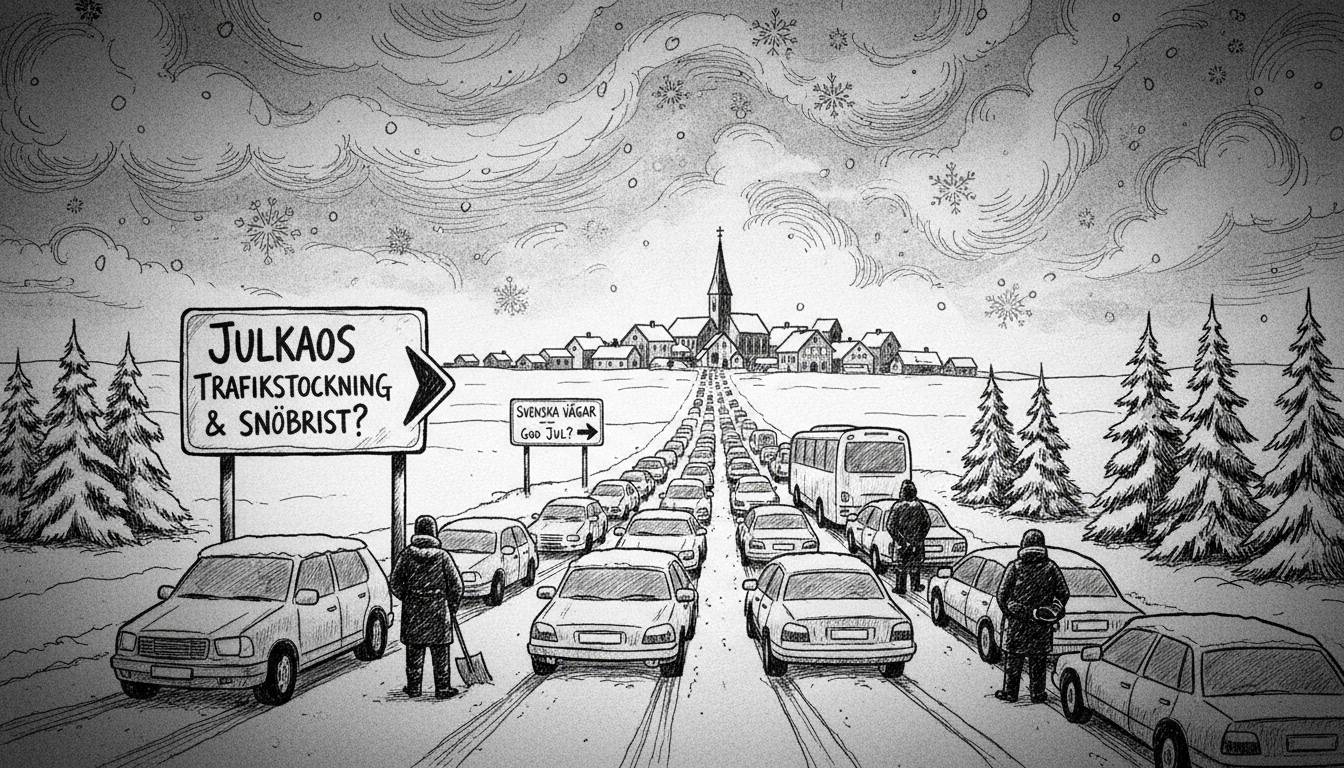
Sweden Christmas travel hit its peak on Monday afternoon, bringing parts of Stockholm to a standstill. The crucial Södra länken tunnel, a major artery for the capital's southern suburbs, saw its entrances at Sickla and Gullmarsplan closed. Traffic officials made the call to prevent total gridlock as queues stretched for kilometers. 'It might happen that we have to close it again,' said Katarina Wolffram, a press officer at the Swedish Transport Administration, Trafikverket. Her warning hangs in the air for thousands of Stockholmers still needing to travel to family across the country for the holiday.
This scene is a familiar Swedish December ritual. The days before Christmas Eve, or julafton, see a mass migration. People leave cities like Stockholm, Gothenburg, and Malmö, heading for childhood homes in smaller towns and villages. Roads that are normally busy become saturated. In 2023, Trafikverket reported a 15% surge in traffic on major highways during this period. This year appears to be following the same stressful script.
The Stockholm Snarl-Up
The closure of Södra länken's entrances is a tactical move. This tunnel is part of Stockholm's inner city bypass, a lifeline for commuters from areas like Hammarby Sjöstad and Johanneshov. When it clogs, the ripple effect is immediate. 'Strategic closures are a necessary evil,' explains traffic analyst Mats Lundgren, who has studied holiday patterns for years. 'Letting more cars into a full tunnel doesn't help anyone. It creates a parking lot that can take hours to clear, blocking emergency services and causing even longer delays. By closing the ramps, you contain the problem and allow the existing queue to move.'
For drivers caught in the mess, the theory offers little comfort. Emma Forsberg, a teacher trying to get from her job in Södermalm to her parents in Nyköping, was stuck for over an hour. 'You just sit there, watching the clock tick closer to Christmas,' she says, speaking from her stationary car. 'The anxiety builds. Did you pack all the presents? Will the julmust (Christmas soda) be warm by the time you arrive? It turns what should be a happy journey into a test of patience.'
Beyond the Capital: A National Crawl
While Stockholm's tunnels make headlines, the congestion is a nationwide phenomenon. The E4 north towards Uppsala and the E6 south towards Helsingborg are traditional hotspots. Trafikverket's live traffic maps light up with red and black lines indicating slow or stationary traffic across the country. Many Swedes plan their travel for very specific times, aiming to leave work early or travel late at night, but when everyone has the same idea, the roads fill up regardless.
Public transport also strains under the pressure. Stockholm's pendeltåg (commuter trains) and long-distance SJ trains are packed with passengers carrying gift bags and coolers filled with holiday food. The atmosphere is a mix of festive anticipation and mild stress. There's a shared understanding, a collective deep breath, as the nation moves in unison.
Will It Be a White Christmas?
Parallel to the traffic drama runs another quintessentially Swedish preoccupation: the quest for a white Christmas. The definition is specific—snow must cover the ground on Christmas Eve. In Stockholm, the odds are historically about 40%. But this year, like many recent years, the forecast is uncertain. Meteorologists point to increasingly unpredictable weather patterns linked to a changing climate.
'Forecasting a white Christmas in southern Sweden is becoming more challenging,' says Lisa Berg, a meteorologist with the Swedish Meteorological and Hydrological Institute, SMHI. 'We see more fluctuations between cold and mild air. A week of snow can be washed away by rain a day before the 24th. The traditional image is under pressure.'
In the north, snow is virtually guaranteed. The question is one of depth and quality. In the south, from Malmö to Stockholm, families watch the forecasts with hope. A vit jul (white Christmas) is deeply woven into the cultural fabric—it's in the songs, the stories, and the ideal. It transforms the landscape, muffles sound, and makes the glowing candles in the windows seem even brighter.
The Cultural Weight of the Journey
To understand the traffic chaos, you must understand what's at the end of the road. Swedes are traveling for julbord (Christmas smorgasbord), for gift exchanges, and for the quiet morning coffee on Christmas Day. They are heading to a tradition that emphasizes mys (coziness) and family. The journey, however stressful, is a pilgrimage to a set of cherished rituals: watching Kalle Anka (Donald Duck) on TV at 3 PM sharp on the 24th, dancing around the Christmas tree, and eating rice pudding with a hidden almond.
This migration is also a testament to Sweden's geography and demography. A large portion of the population lives in a handful of urban centers, while many have roots—and aging parents—in more rural areas. The Christmas trip reconnects these threads. It's why people endure the traffic. The reward is worth the hassle.
Coping Strategies and Looking Ahead
How do Swedes cope? Preparation is key. Trafikverket urges people to check live traffic maps, consider alternative routes, and travel at off-peak times if possible. Packing patience, snacks, and Christmas music is standard advice. For many, the journey itself becomes part of the tradition—the shared experience of being part of the great Christmas exodus.
Looking forward, experts see few easy solutions. 'The demand is concentrated on a very short period,' says analyst Mats Lundgren. 'We can't build roads for the two busiest days of the year. Better information and maybe encouraging more staggered travel times are our best tools.' Some suggest that as remote work becomes more normalized, the travel peak might spread out slightly, as people can leave the city earlier in the week.
The question of the white Christmas has no solution, only adaptation. The cultural attachment remains, even as the climate changes. Perhaps the definition will soften, or new traditions will emerge. But for now, the dual anxieties of traffic and weather define the Swedish lead-up to Christmas. They are the price paid for the quiet magic that follows, when the traveling is done, the doors are closed, and the candlelight flickers—whether on a blanket of snow or a patch of bare, brown earth.
As Katarina Wolffram from Trafikverket implied, the closures might not be over. The great Swedish Christmas journey continues, a blend of modern logistics and ancient longing, all moving slowly forward, one car at a time.