
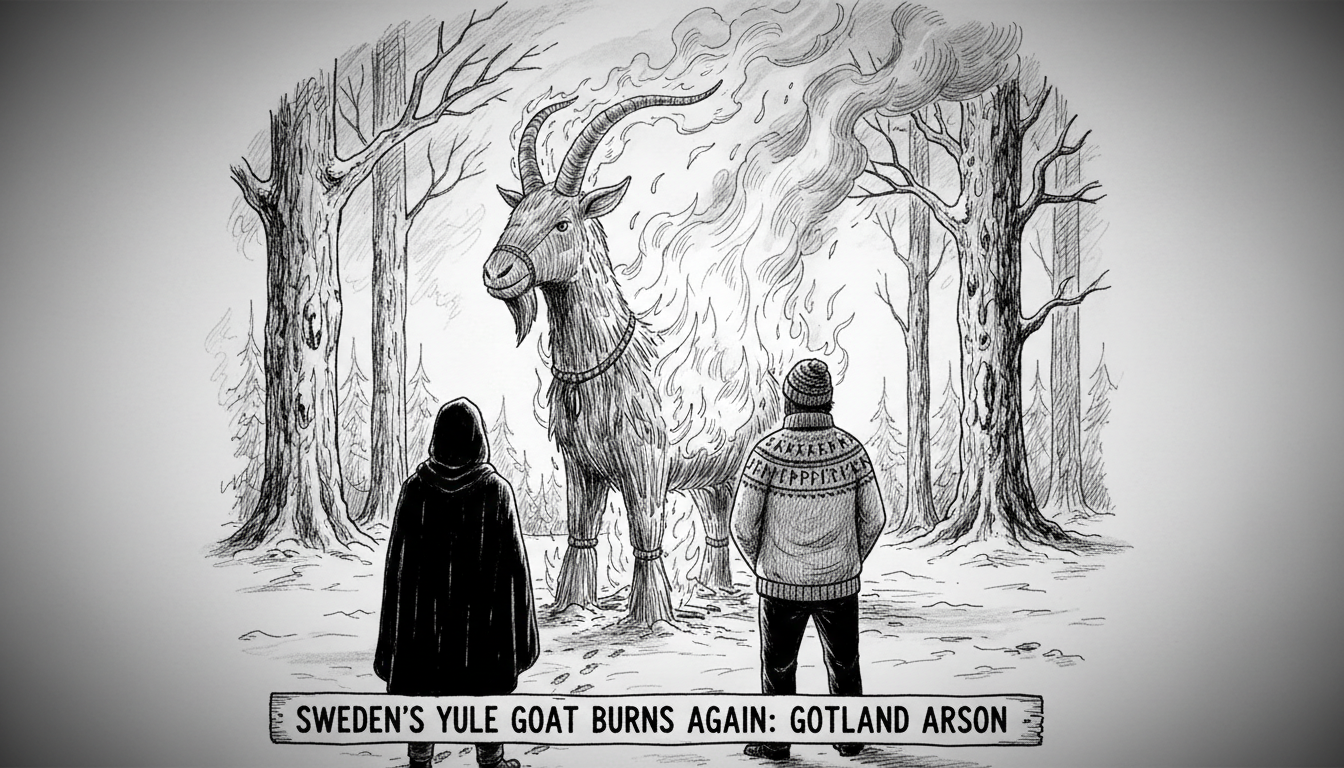
Sweden's recurring Yule Goat arson tradition has struck again, this time on the island of Gotland. A three-meter-tall straw goat outside a supermarket in the village of Fole was set ablaze early Sunday morning, adding another chapter to the nation's peculiar and persistent festive vandalism. The fire, reported just after 7:30 AM, left only a charred frame where the Christmas symbol once stood. Police have opened a case for vandalism by arson but have no suspects. For many Swedes, the news prompted a weary, familiar sigh. The burning of the Julbock, or Yule Goat, is a dark, unofficial part of the holiday season, a tradition of destruction that shadows one of goodwill.
A Smoldering Start to Advent
The quiet Sunday morning in Fole, a small community on Gotland, was shattered by the sight of flames. The goat, positioned freely outside the local ICA store at Fole Lilla Sojdeby, was a community effort, a marker of the approaching Christmas. Its destruction so early in Advent felt particularly jarring. "It's about three meters high and three meters long," a rescue service operator confirmed, describing the scale of the lost display. The incident moves beyond simple mischief. Police are treating it as a criminal act of skadegörelse, or damage to property. The investigation is in its earliest stages, with authorities appealing for information. For residents, it’s a loss of a local landmark that required time and resources to build.
The Shadow of the Gävle Goat
To understand the Fole fire, one must look north to the city of Gävle. Since 1966, a massive straw goat erected in Gävle's main square has become the epicenter of this bizarre cultural phenomenon. The Gävle Goat's survival each year is a national betting pool. Its destruction is a global news story. It has been burned, vandalized, stolen, and even hit by a car. A dedicated security firm, webcams, and fences now guard it. The goat has been set alight over thirty times. This history has created a cultural script. It has normalized, even glamorized for a certain element, the act of burning a large public Yule Goat. "The Gävle Goat's notoriety absolutely sets a precedent," says Lars Magnusson, a Swedish folklorist based in Uppsala. "It transforms an act of vandalism into a performance, a way to achieve a twisted form of fame. The perpetrator isn't just burning straw; they're inserting themselves into a national narrative."
More Than Just Straw: The Goat's Deep Roots
The irony is profound. The Yule Goat is one of Sweden's oldest and most complex Christmas symbols. Its origins are pre-Christian, linked to the Norse god Thor and his two goats who pulled his chariot. Later, it became associated with the Christmas gift-giver, a precursor to the tomte or Santa Claus. In traditional celebrations, young men would dress as goats, a custom called "julebukking." Today, small straw goats are common household decorations, representing a connection to Swedish agrarian history. The large public goats, like the one in Gävle or now in Fole, are modern incarnations of this tradition. They are meant to be symbols of continuity and community spirit. Their burning represents a violent break from that spirit, a rejection of the cozy, domestic
hygge (or Swedish mys) that defines the Scandinavian holiday season.
A Community Ritual of Loss and Resilience
The reaction in Fole likely mirrors that in other affected towns. There is initial shock and disappointment, especially from those who built it. Then comes a wave of frustration at the senselessness of the act. Finally, there is often a determined discussion about rebuilding. This cycle is part of the ritual. The destruction becomes an unintended, adversarial part of the community's Christmas story. "It feels personal," says Anna Karlsson, a shopkeeper in a Stockholm suburb that faced a smaller goat burning years ago. "People give their time to make something beautiful for everyone. To see it destroyed is like someone spitting on that collective effort. But then you see everyone talk about it, get angry together, and then decide to make a new one. In a strange way, it sometimes brings people closer."
Why Does This Keep Happening?
Experts point to a confluence of factors. The long, dark Nordic winters certainly play a role. Boredom and a desire for excitement can fuel destructive behavior. The straw construction makes the goats incredibly flammable—a literal tinderbox temptation. Then there is the powerful lure of tradition, even a destructive one. Once an act enters the cultural consciousness as "something people do," it becomes self-perpetuating. The media coverage of each burning, while reporting the crime, also amplifies the act. For a perpetrator, it offers a guaranteed spotlight. "It's a perfect storm of symbolism, vulnerability, and notoriety," Magnusson explains. "You have a highly symbolic, highly flammable object, and a known history of attacks that guarantees your action will be noted far beyond your local area. For some, that's an irresistible pull."
The Legal and Social Stakes
While some abroad may see it as a humorous quirk, Swedish authorities take it seriously. Arson is a major crime, carrying penalties of up to six years in prison. If a burned goat collapses onto a road or building, or if firefighters are endangered, the charges can escalate. The social stigma is also significant. While an anonymous online commenter might cheer, in close-knit communities, being identified as the goat burner is a profound social transgression. It marks you as someone who attacks a shared symbol. The police report in Fole is the first step in a process that treats this not as a prank, but as a serious property crime with potential danger to public safety.
Beyond the Ashes: A Swedish Paradox
The enduring phenomenon of the burning Yule Goat presents a unique Swedish paradox. It is a nation known for its deep respect for rules, order, and consensus—the very concept of lagom (just the right amount). Yet, it harbors this persistent, anarchic tradition of festive arson. It speaks to a undercurrent of rebellion against conformity, a desire to break the monotony of the long winter and the sometimes rigid social expectations. The goat, as a symbol of old traditions, becomes a target for those feeling disconnected or constrained by them. Its burning is a dramatic, destructive release valve. This coming Christmas, towns across Sweden will erect their goats. Some will employ guards or fire retardants. Many will simply hope. The story from Fole is a reminder that the threat is always there, smoldering in the dark, waiting to ignite. It is a strange, dark thread woven into the fabric of Swedish Christmas, a tradition that, for better or worse, shows no signs of going up in smoke for good.