
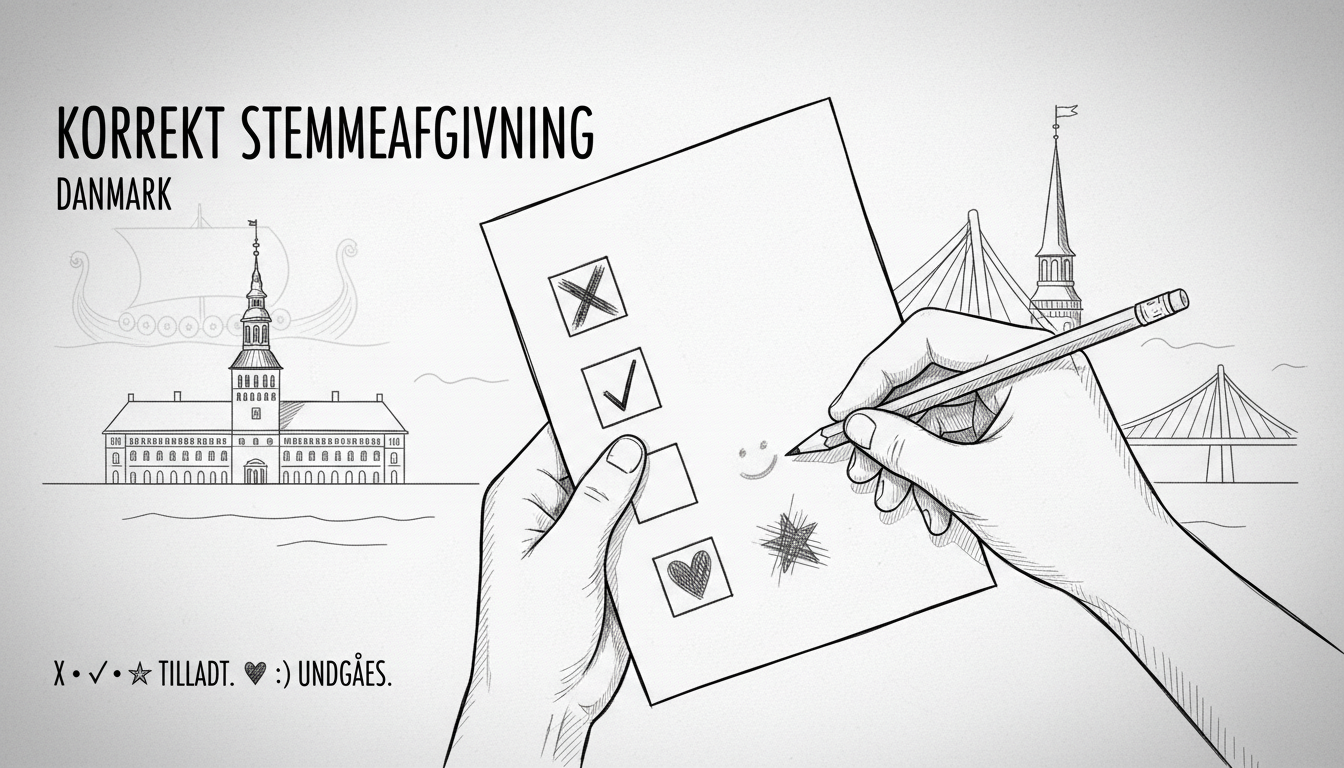
Danish election authorities have simplified voting rules to reduce invalid ballots. Hearts and smiley faces still invalidate your vote, but checkmarks and stars now count as valid marks. The changes took effect in the new year.
Christine Boeskov, an election consultant with the Interior and Health Ministry, explained the reasoning behind the updated regulations. Officials want to decrease the number of rejected ballots while maintaining voting integrity.
"We approved additional symbols to reduce invalid votes," Boeskov said in a statement. "But we strongly recommend using a simple cross on your ballot. Nothing more, nothing less. People might question the other symbols."
This creates an interesting contradiction. Why introduce potentially confusing symbols if they might create uncertainty? The answer lies in recent election data showing too many ballots being rejected despite clear voter intent.
"Too many votes were declared invalid even when counting officials had no doubt about the voter's choice," Boeskov explained. "We want as many votes as possible to count."
Denmark's voting system allows for party votes or personal votes. For party votes, place your mark in the box next to the party name. For personal votes, mark the box beside your preferred candidate's name. You may only place one mark regardless of voting method.
Blank voting remains an option for those dissatisfied with all choices. Simply place your unmarked ballot in the box. Your blank vote still counts toward voter turnout statistics without supporting any candidate or party.
Recent elections show substantial blank voting. Municipal elections recorded 39,691 blank ballots, while regional elections saw 118,727 blank votes.
Denmark maintains strict ballot secrecy. Any marking that could identify your ballot invalidates your vote. This includes writing messages, drawing doodles, or using distinctive pens like glitter markers. Even sharing a selfie with your marked ballot violates secrecy rules.
Voters may use writing instruments provided at polling stations or bring their own ordinary pens or pencils. After marking your ballot, fold it to conceal your choice before depositing it in the ballot box.
Mistakes happen. If you mark incorrectly or damage your ballot, you can request a replacement—provided you haven't already deposited the original in the ballot box.
These rule changes reflect Denmark's practical approach to democracy. Rather than insisting on perfect compliance with technical rules, the system prioritizes capturing voter intent. This contrasts with more rigid systems where minor marking errors can disenfranchise voters.
The updates particularly benefit first-time voters, elderly citizens, and immigrants who might be unfamiliar with Danish voting conventions. By accepting multiple clear marking methods, Denmark makes democratic participation more accessible while maintaining election security.
Danish election officials continue emphasizing that simple crosses remain the safest choice. The expanded acceptable symbols serve as a safety net rather than an invitation for creativity. This balanced approach demonstrates how electoral systems can evolve without compromising their fundamental integrity.